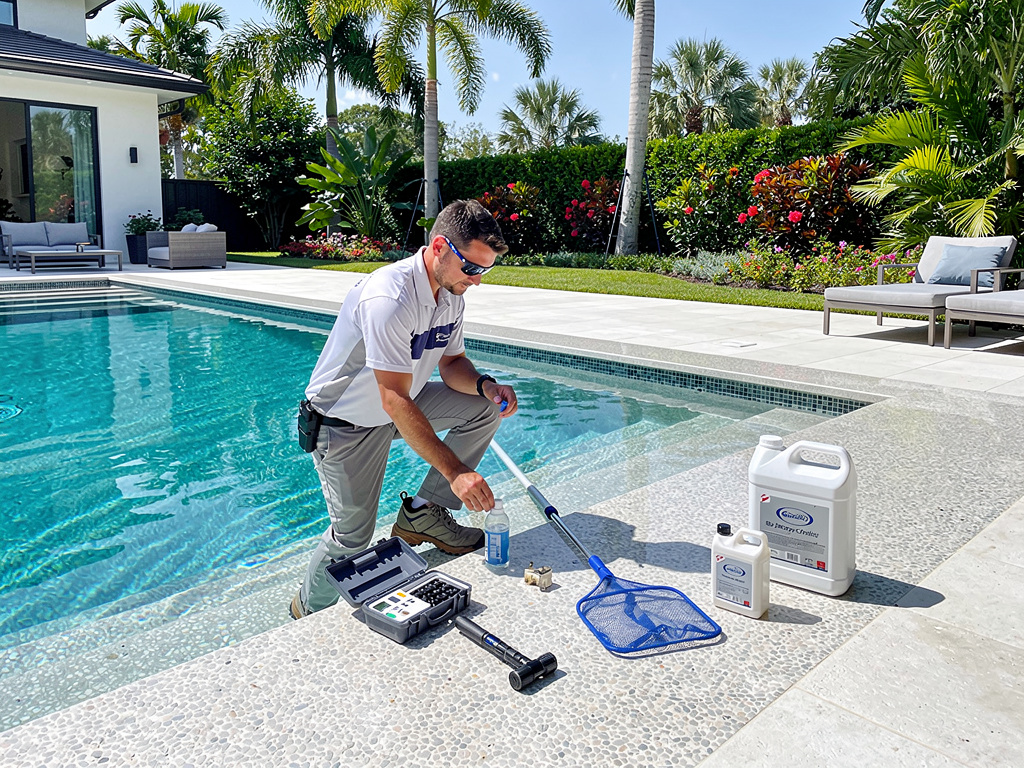
Plantation’s Premium Pool Finish Market
Plantation FL’s upscale residential market — with its higher income demographic, emphasis on property aesthetics, and strong entertainment and lifestyle culture — has been an early adopter of premium pool surface materials. While standard white marcite plaster was the near-universal pool finish in Broward through the 1990s, Plantation’s renovation and new construction market moved substantially toward pebble aggregate (PebbleTec, Wet Edge, SGM Pebble) and quartz aggregate finishes (Diamond Brite, Hydrazzo) in the 2000s, and has more recently seen premium glass tile installations in high-end estate renovations and new builds. Understanding the specific maintenance requirements of these premium materials is essential for protecting an investment that typically costs 2–4× more than a standard marcite finish.
The appeal of premium finishes is well-founded: pebble aggregate surfaces are significantly more durable than marcite, resisting the etching and surface roughening that standard plaster shows within 10–15 years of South Florida service. Quartz aggregate finishes sit between marcite and pebble in cost and durability, offering improved stain resistance and a longer service life than pure marcite. Glass tile delivers the most visually stunning result and is essentially impervious to chemical attack at normal pool chemistry ranges — the glass itself cannot be etched or stained in the way plaster surfaces can. But each of these premium materials has its own chemistry vulnerabilities and maintenance requirements that must be understood to protect the finish investment over time.
Pebble Aggregate: The Chemistry Vulnerabilities
Pebble aggregate finishes like PebbleTec consist of small river pebbles embedded in a cement matrix, producing a textured, durable surface with exceptional resistance to surface roughening and UV degradation. The cement matrix that holds the pebbles is the chemistry-vulnerable component: calcium carbonate cement is subject to etching in low-pH, aggressive water and to scaling in high-pH, supersaturated water.
In Plantation’s hard-water environment (fill water calcium hardness 180–320 ppm), the primary threat to pebble aggregate is calcium scaling — the precipitation of calcium carbonate from solution onto and between the pebbles, creating a white calcium crust that reduces the pebbles’ visual contrast and texture appearance. Calcium scale forms most readily where water velocity is lowest (between pebbles in still areas of the pool), where pH is highest (at water features, aerators, and saltwater cell outputs where CO₂ outgassing raises pH), and where water temperature is warmest (calcium solubility decreases with increasing temperature).
The preventive protocol for calcium scaling on pebble aggregate: pH maintained at the lower end of the acceptable range (7.4–7.5), monthly sequestrant (scale inhibitor) treatment that keeps calcium in solution rather than allowing it to precipitate, and avoidance of high-pH operation (above 7.8) which is the primary accelerant of calcium precipitation. When calcium scale has deposited on a pebble aggregate surface, professional acid washing is the removal method — a carefully controlled dilute acid application that dissolves the calcium scale without damaging the pebble or cement matrix underneath.
Quartz Aggregate: More Resistant, Still Chemistry-Dependent
Quartz aggregate finishes (Diamond Brite is the most widely recognized brand) combine quartz crystals with a polymer-modified cement matrix to produce a surface that’s harder and more stain-resistant than standard marcite but still cement-based and subject to the same pH and calcium chemistry considerations as pebble aggregate. The quartz crystals themselves are extremely chemically resistant — silicon dioxide doesn’t etch under normal pool chemistry conditions — but the cement matrix that holds them shares the calcium vulnerability of other cementitious pool surfaces.
In Plantation’s tannin-rich environment, quartz aggregate finishes show the clear advantage over marcite that was one of the motivations for the material. Tannin staining that penetrates the roughened surface pores of degraded marcite cannot penetrate the much denser surface of a well-maintained quartz aggregate finish in the same way. But tannin can still deposit on the quartz surface as a surface film — particularly in shaded pool areas or at the waterline where evaporative concentration effects create a contact zone. Weekly enzyme treatment and physical brushing of the surface maintains the surface cleanliness that prevents surface-deposited tannin from building into a visible film.
Glass Tile: The Premium Choice and Its Care Requirements
Glass tile pool installations — full glass tile walls, glass tile waterline bands, glass tile water feature surfaces — are the highest-end pool finish category and increasingly common in Plantation’s estate and high-end renovation market. Glass tile is visually striking, chemically inert under normal pool conditions, and essentially impervious to the staining and etching that affects cementitious surfaces. A glass tile surface maintained at correct chemistry will look as good at year 25 as it did at installation.
The maintenance vulnerability of glass tile in Plantation’s environment is not the tile itself — it’s the grout between tiles. Glass tile grout is typically a polymer-modified cementitious grout or an epoxy grout, both of which are subject to calcium scale deposition and, in the cementitious formulations, to tannin staining. In Plantation’s hard-water, high-tannin environment, glass tile installations without aggressive waterline maintenance develop a calcium-tannin combined film on and between the tiles that significantly diminishes the visual impact that was the primary reason for the installation.
Weekly brushing of glass tile surfaces — particularly waterline tile where evaporative concentration effects are most intense — removes surface films before they can adhere and harden. Annual mild acid treatment (dilute muriatic acid or proprietary calcium remover formulated for tile surfaces) removes any calcium that has begun to deposit despite regular brushing. Tannin film on glass tile responds to enzyme treatment and to direct application of enzyme-based tile cleaners at the waterline during service visits.
Water Chemistry Startup: The Critical Period for New Premium Finishes
Any new cementitious pool finish — pebble aggregate, quartz, or the grout component of glass tile installations — requires careful water chemistry management during the initial 28-day curing period. The cement matrix undergoes a curing process during this period in which calcium compounds are still actively setting and the surface is particularly vulnerable to chemistry extremes. The startup protocol for any new finish in Plantation FL: fill with municipal water, test chemistry before adding any chemicals, maintain pH at 7.2–7.4 during the first week (slightly lower than normal range to prevent calcium precipitation during curing), brush the surface twice daily for the first two weeks to remove calcium leaching from the fresh cement, run circulation continuously for the first week, and delay addition of cyanuric acid until after the first week.
A Plantation homeowner or contractor who skips the startup protocol and immediately applies normal operating chemistry to a new premium finish risks permanent calcium spotting, surface texture irregularities from pH extremes during curing, and discoloration from CYA or chlorine compounds that interact with the uncured cement. The startup period is the most critical chemistry period in a new pool finish’s life, and the protocols for it are worth following precisely regardless of the inconvenience.
Pool Service Fort Lauderdale provides premium surface care and chemistry management throughout Plantation FL. Call (954) 501-2754, visit our Plantation pool service page, or see our full website. 9900 W Sample Rd, Coral Springs, FL 33065.
{“@context”:”https://schema.org”,”@type”:”FAQPage”,”mainEntity”:[{“@type”:”Question”,”name”:”Does PebbleTec require different pool chemistry than standard plaster in Plantation FL?”,”acceptedAnswer”:{“@type”:”Answer”,”text”:”The chemistry targets are similar, but the consequences of chemistry errors are different. PebbleTec’s cement matrix is subject to calcium scaling in high-pH, hard-water conditions (Plantation’s environment). Maintain pH at 7.4–7.5, use monthly sequestrant to keep calcium in solution, and avoid high-pH operation above 7.8. When calcium scale does develop between pebbles, professional acid washing removes it without damaging the pebble matrix.”}},{“@type”:”Question”,”name”:”Will tannins from Plantation FL’s oak trees stain my PebbleTec or quartz finish?”,”acceptedAnswer”:{“@type”:”Answer”,”text”:”They can — as surface films on the denser aggregate surface, not as penetrating staining as occurs in roughened marcite. Weekly enzyme treatment and physical brushing prevents tannin film from accumulating on aggregate and quartz surfaces. The stain resistance of premium finishes compared to aged marcite is meaningful but not absolute — regular maintenance is still required.”}},{“@type”:”Question”,”name”:”Why is the grout between my pool’s glass tile turning yellow in Plantation FL?”,”acceptedAnswer”:{“@type”:”Answer”,”text”:”Tannin film from Plantation’s oak and tropical tree canopy deposits on and between glass tiles, and calcium from hard fill water scales the grout surface — often simultaneously. Weekly brushing removes surface tannin film before it adheres; annual mild acid treatment removes early calcium deposits. Glass tile itself is impervious, but cementitious grout is not — it’s the maintenance target in a glass tile Plantation pool.”}},{“@type”:”Question”,”name”:”What is the correct startup chemistry protocol for a new PebbleTec surface in Plantation FL?”,”acceptedAnswer”:{“@type”:”Answer”,”text”:”Fill, test chemistry before adding chemicals, maintain pH at 7.2–7.4 for the first week, brush the surface twice daily for the first two weeks to remove calcium leaching from fresh cement, run circulation continuously for the first week, delay CYA addition until after week one. Skipping startup protocol risks permanent calcium spotting and surface irregularities in the uncured cement matrix.”}},{“@type”:”Question”,”name”:”How often should glass tile at the waterline be cleaned in a Plantation FL pool?”,”acceptedAnswer”:{“@type”:”Answer”,”text”:”Brush weekly as part of standard service. The waterline is where evaporative concentration is most intense — calcium and tannin films deposit fastest here. Annual mild acid treatment (dilute muriatic acid or proprietary calcium remover for tile) removes any calcium that has begun to build despite regular brushing. The visual impact of glass tile degrades quickly without consistent waterline maintenance in Plantation’s high-calcium, high-tannin environment.”}]}}