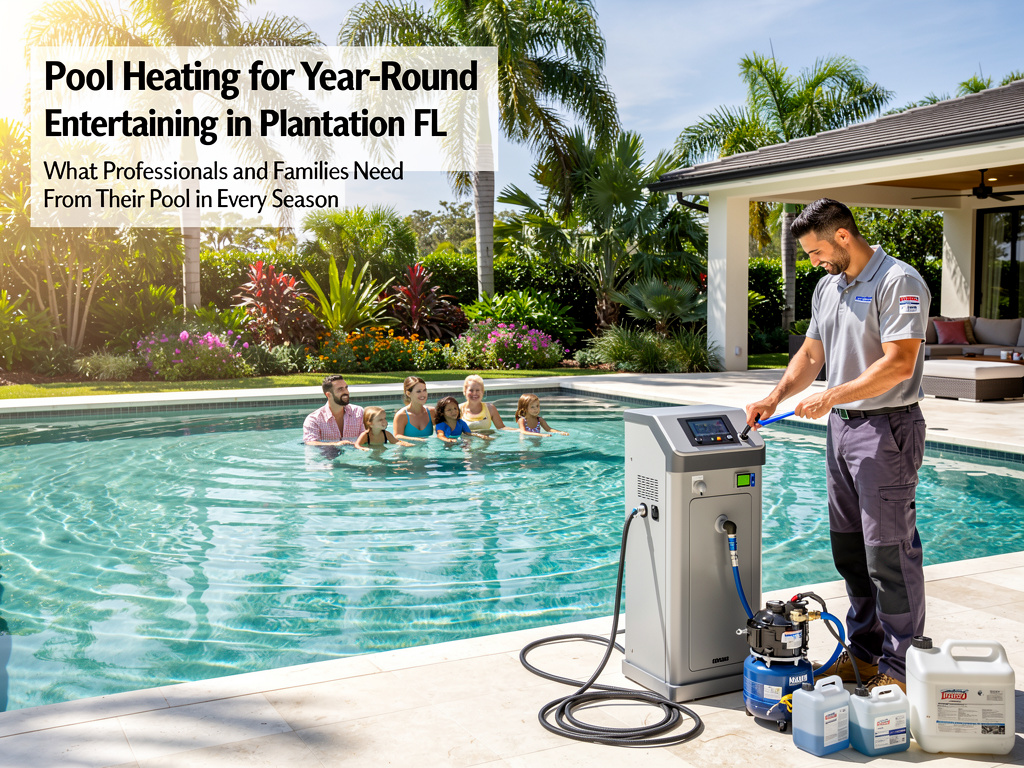
The Plantation Professional Entertaining Calendar
Plantation FL professional households entertain year-round. The pool is a central feature of the home’s outdoor living space — the backdrop for summer weekend gatherings, Thanksgiving and holiday parties, Super Bowl watch events, and impromptu Friday evening social events that happen throughout the year. For a Plantation executive whose social calendar includes frequent home entertaining, a pool that’s too cold to comfortably use in December, January, and February — or too warm to comfortably use in August and September — is a pool that fails its purpose during a significant portion of the calendar.
The temperature management challenge in Plantation FL is in some ways more demanding than in cold-climate markets where pools simply close in winter. A Plantation pool needs to be actively managed to stay in the comfortable 81–85°F range year-round: actively heated during Plantation’s mild winter (water temperatures drop to 68–74°F during cold fronts without heating) and actively managed for the opposite problem in late summer (water temperatures can reach 90–94°F in an unshaded pool, which is above the comfort range for vigorous swimming and entertainment use).
Heat Pump Sizing for Plantation’s Pool Stock
Heat pump pool heaters are the standard choice for residential pool heating in South Florida’s mild climate — they’re 5–6× more energy efficient than gas heaters because they move heat rather than generate it, and they perform well in the ambient temperature range Plantation experiences even during its mildest winter periods. The sizing question is more important than the brand selection: an undersized heat pump takes longer to recover temperature after a cold front, costs more in electricity for the recovery period (running continuously at 100% for extended periods), and may not maintain target temperature during Plantation’s coolest nights.
The standard heat pump sizing rule for South Florida: the heater’s BTU output should be at least 1.5–2× the pool’s surface area in BTU/hour. For a typical Plantation pool with 400 square feet of surface area, this means a 60,000–80,000 BTU/hour heat pump. For a larger Plantation pool at 600 square feet, an 85,000–120,000 BTU/hour unit. Going up one size tier (to the next larger heat pump model) during selection is advisable for pools in heavier shade — because shaded pools lose heat differently than sun-exposed pools and may have higher heating demands during winter cold fronts, despite the lower ambient temperatures.
Heat pump efficiency in Plantation’s mild winter is excellent — even on Plantation’s coldest January nights, ambient temperatures rarely drop below 50°F, and most residential heat pump models operate efficiently down to 45–50°F ambient. This means Plantation pool owners get the full efficiency benefit of heat pump technology (COP of 4.5–6.0 in mild temperatures, meaning 4.5–6.0 BTU of heat for every BTU of electricity consumed) without the performance degradation that affects heat pumps in colder climates.
Summer Temperature Management: The Overlooked Challenge
While most Plantation pool heating discussions focus on winter, summer temperature management is an equally relevant issue for the professional entertaining pool. An unshaded 400-square-foot Plantation pool can reach 90–94°F by late afternoon in August — a water temperature that’s uncomfortably warm for most adult swimmers and actually discourages pool use during the hottest months. Guests at a Plantation outdoor party who find the pool uncomfortably hot avoid using it, which defeats the purpose of the outdoor entertainment investment.
A heat pump with a reverse-cycle chilling mode (a pool heat pump that can also cool the water, using the same refrigeration cycle in reverse) is the most direct solution. These units can maintain a pool at a programmed maximum temperature, running the cooling cycle when water temperature exceeds the setpoint. Alternatively, running a pool fountain, aerator, or cascade water feature overnight allows natural evaporative cooling — water falling through air releases heat through evaporation, and an overnight aeration cycle can reduce water temperature by 4–6°F, bringing a 92°F daytime pool down to 86–88°F by morning.
Solar pool covers (bubble covers) reduce daytime heat gain in full-sun pools by reflecting some solar radiation rather than transmitting it to the water. For a Plantation pool that’s becoming too warm in summer, a solar cover installed during peak summer sun hours (11 AM – 3 PM) reduces the daytime temperature peak by 4–8°F compared to an uncovered pool at the same sun exposure level.
Solar Heating Integration in Plantation’s HOA Communities
Solar pool heating panels mounted on rear-facing roof sections that aren’t visible from the street are the standard HOA-compliant installation in Plantation’s established communities. Florida law (F.S. 163.04) prevents HOAs from prohibiting solar energy devices outright, and most Plantation HOA communities have a process for ARC approval of solar installations that emphasizes non-street-visible placement.
A solar heating system in Plantation provides free pool heating from approximately mid-March through mid-November — covering most of the year when the pool is most actively used. During December, January, and February, solar output in Plantation declines significantly (shorter days, lower sun angle, more frequent cloud cover from winter weather systems), and a backup heat pump or gas heater carries the heating load during this period. The hybrid solar+heat pump combination — solar for the 9-month warm season, heat pump for the 3-month mild winter — provides year-round comfortable temperatures at minimal operating cost and is the optimal solution for Plantation’s professional entertaining pool.
Operating Cost Comparison for Plantation
Plantation pool owners evaluating heating options typically compare three approaches. Gas heating: $150–$300 per month during the November–March heating season, with the advantage of fast heat recovery (a gas heater can raise water temperature by 10°F in 4–8 hours). Heat pump only: $60–$120 per month during the heating season, with slower recovery (12–24 hours for a 10°F rise) but dramatically lower operating cost. Solar + heat pump backup: $15–$40 per month during the winter heating season (backup heat pump runs occasionally on the coldest nights), with essentially free operation during the 9-month solar season.
For Plantation’s professional entertaining household that values consistent pool availability, the solar + heat pump combination provides the best combination of reliability and cost efficiency. The investment cost ($3,000–$6,000 for a solar system + an existing or new heat pump) pays back within 3–5 years compared to continued gas heating, and the residual operating cost of $15–$40 per month for winter backup heating is compatible with a high-use entertaining pool’s budget in Plantation’s market.
Pool Service Fort Lauderdale provides pool heating consultation and service throughout Plantation FL. Call (954) 501-2754, visit our Plantation pool service page, or see our full website. 9900 W Sample Rd, Coral Springs, FL 33065.
{“@context”:”https://schema.org”,”@type”:”FAQPage”,”mainEntity”:[{“@type”:”Question”,”name”:”What pool temperature is right for year-round entertaining in Plantation FL?”,”acceptedAnswer”:{“@type”:”Answer”,”text”:”82–84°F is the sweet spot for year-round entertaining use in Plantation FL. This is comfortable for adult swimmers and guests (not chilly in winter, not oppressively warm in summer), suitable for children’s active swimming, and achievable year-round with a heat pump or hybrid solar+heat pump system.”}},{“@type”:”Question”,”name”:”What size heat pump does a Plantation FL pool need?”,”acceptedAnswer”:{“@type”:”Answer”,”text”:”Size to 1.5–2× the pool’s surface area in BTU/hour capacity. A standard 400-square-foot Plantation pool needs a 60,000–80,000 BTU/hour heat pump. Going one size tier up is advisable for heavily shaded pools. Heat pump efficiency in Plantation’s mild winters (rarely below 50°F ambient) is excellent — full COP of 4.5–6.0 even on the coldest Plantation nights.”}},{“@type”:”Question”,”name”:”Is gas or heat pump heating more economical for a Plantation FL pool?”,”acceptedAnswer”:{“@type”:”Answer”,”text”:”Heat pump is more economical for Plantation’s mild winter conditions. Gas heating costs $150–$300 per month during the heating season; heat pump costs $60–$120 per month for the same pool. Gas heats faster (10°F rise in 4–8 hours vs. 12–24 hours for heat pump) but at 5–6× higher operating cost. For a pool that’s consistently maintained at temperature rather than heated from scratch, heat pump recovery speed is rarely an issue.”}},{“@type”:”Question”,”name”:”Can my Plantation FL pool get too warm in summer?”,”acceptedAnswer”:{“@type”:”Answer”,”text”:”Yes — unshaded Plantation pools can reach 90–94°F in August, which is uncomfortable for most swimmers. Solutions: a heat pump with reverse-cycle chilling mode maintains a maximum setpoint; overnight aeration (fountain, aerator, or cascade) provides 4–6°F of natural evaporative cooling; a solar cover during peak sun hours (11 AM–3 PM) reduces daytime heat gain by 4–8°F.”}},{“@type”:”Question”,”name”:”Does a solar heating system require HOA approval in Plantation FL?”,”acceptedAnswer”:{“@type”:”Answer”,”text”:”Yes — ARC approval is required, but Florida law (F.S. 163.04) prevents HOAs from prohibiting solar energy devices outright. Most Plantation HOA communities approve rear-facing roof installations not visible from the street. Submit an ARC application with panel placement diagram before contracting a solar installer — approval is typical for compliant placement.”}]}}