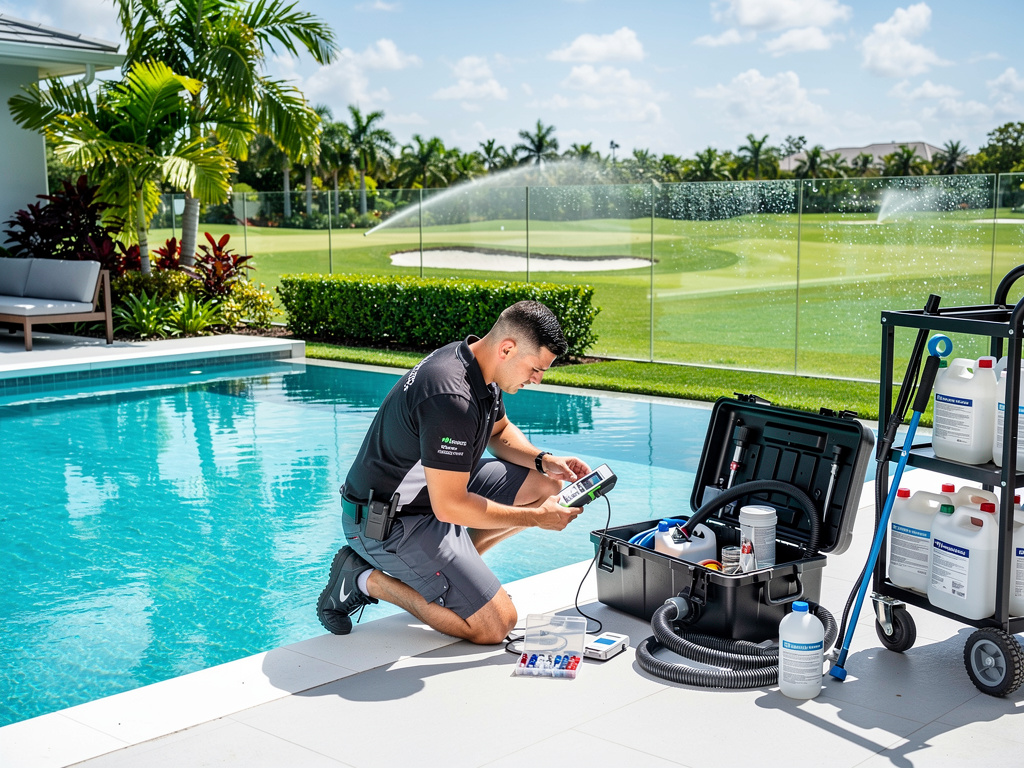
Golf Course Turf Management: A Different Chemical World
The Bonaventure Country Club golf course is one of Weston’s defining amenities — a beautifully maintained championship-caliber golf facility whose fairways, greens, and roughs back up to residential properties throughout the Bonaventure community. The course’s impeccable condition is the result of a professional turf management program that’s dramatically more intensive than any residential lawn care operation: greens receive multiple fertilizer applications per month, fairways are treated on schedules calibrated to championship turf standards, and the irrigation system that keeps this turf in playing condition operates at volumes and frequencies that far exceed typical residential irrigation.
From a chemistry perspective, professional golf course turf management means high-intensity phosphate application to a turf surface immediately adjacent to residential pool areas. Golf course fertilizer programs use specialized formulations — often with higher phosphate content than typical residential lawn products because golf greens require different nutrient ratios than home lawns — applied at frequencies and concentrations that maximize turf performance. The phosphate that isn’t absorbed by the turf before the next irrigation cycle, or that’s mobilized by heavy rainfall, moves toward lower-lying areas adjacent to the fairways — which in Bonaventure often means toward the rear of properties whose pools back up to the course.
Irrigation Volume and Phosphate Transport
Golf course irrigation systems apply water at rates and durations that residential irrigation rarely approaches. A typical golf course fairway irrigation cycle applies ½ to ¾ inch of water per cycle, multiple times per week — significantly more water volume than a residential drip or spray system. This high-volume irrigation serves two purposes: maintaining the deep root systems that championship turf requires, and washing recently applied fertilizer into the soil profile where it’s available to grass roots. The same irrigation volume that moves fertilizer into the soil also moves dissolved phosphate laterally in the soil profile toward adjacent properties.
Bonaventure properties adjacent to fairways that have pools positioned toward the rear of the lot — the common configuration in a community where golf course views were a design feature — have pool chemistry that’s influenced by this lateral phosphate transport. The effect is more pronounced during and after rainfall events, when surface runoff from fairways adds dissolved phosphate to the transport mechanism, and during periods of recent fertilization when soluble phosphate is present at higher concentrations in the turf surface environment.
Bonaventure pool owners who have struggled with recurring algae despite technically adequate chlorine levels — particularly following periods of golf course fertilization or heavy rain — are often experiencing phosphate-driven algae events that chlorine-based treatment cannot resolve. Phosphate removes algae’s nutrient limitation; when phosphate is available in abundance, algae can establish and grow faster than chlorine at normal maintenance concentrations can eliminate it. The diagnostic intervention is a phosphate test: if phosphate exceeds 200–300 ppb following an algae event in a Bonaventure pool, the phosphate is driving the algae, and phosphate removal is the treatment — not more chlorine.
Monthly Phosphate Management for Bonaventure Pool Owners
The practical response to Bonaventure’s golf-course-adjacent phosphate environment is a phosphate management protocol that treats the continuous input as a known environmental constant rather than an episodic event. Monthly phosphate testing (either through a pool supply store test or a comprehensive chemistry panel from the service company) establishes the baseline and trend. Monthly lanthanum-based phosphate remover at a maintenance dose prevents accumulation from reaching the algae-promoting threshold, even when individual input events elevate phosphate levels transiently.
The maintenance dose approach is more cost-effective and less disruptive than the reactive approach of testing only when algae appears and then treating an established elevated-phosphate condition with higher removal doses. At $15–$25 per month for a maintenance dose of quality phosphate remover, Bonaventure pool owners with golf-course-adjacent properties can maintain phosphate below 100 ppb continuously — the threshold at which algae is consistently nutrient-limited. This preventive investment is a fraction of the cost of a single remedial service call for an algae outbreak.
Pesticide and Herbicide Awareness
In addition to fertilizers, professional golf course turf management programs use pesticides and herbicides that are formulated for turf use and applied under licensed applicator supervision. These products are not typically a direct pool chemistry concern because they’re designed to bind to soil and biodegrade rather than remain in solution — but Bonaventure pool owners adjacent to fairways should be aware that they exist in the adjacent environment and should communicate with their pool service company if they observe unusual pool chemistry anomalies following golf course spray applications. Most turf pesticides at the dilutions that reach adjacent pools through normal transport mechanisms do not create measurable pool chemistry effects, but the awareness is worthwhile for any pool owner in direct fairway adjacency.
Golf Cart Path Proximity and Other Bonaventure-Specific Considerations
Some Bonaventure properties adjacent to the golf course have cart path access or service road proximity that creates occasional incidental inputs to the pool environment — diesel fumes from maintenance equipment that can deposit trace organic compounds, or dust from sand bunker maintenance that can enter pool water. These are minor inputs that normal pool chemistry management handles without any specific intervention, but they’re part of the environmental context of golf-course-adjacent pool ownership in Bonaventure that distinguishes these properties from non-golf-course Weston pools.
Pool Service Fort Lauderdale provides golf-course-adjacent pool chemistry management throughout Weston FL’s Bonaventure community. Call (954) 501-2754, visit our Weston pool service page, or see our full website. 9900 W Sample Rd, Coral Springs, FL 33065.
{“@context”:”https://schema.org”,”@type”:”FAQPage”,”mainEntity”:[{“@type”:”Question”,”name”:”Why does my Bonaventure Weston FL pool get algae after golf course fertilization?”,”acceptedAnswer”:{“@type”:”Answer”,”text”:”Professional golf course turf management applies high-phosphate fertilizers at frequencies and concentrations that far exceed residential lawn programs. Fairway irrigation and rainfall transport dissolved phosphate laterally to adjacent residential pool areas. Elevated phosphate removes algae’s nutrient limitation, allowing it to establish faster than maintenance chlorine levels can eliminate it. Monthly phosphate remover prevents accumulation; test phosphate (not just chlorine) when algae follows a fertilization event.”}},{“@type”:”Question”,”name”:”How much does phosphate testing and treatment cost for a Bonaventure pool in Weston?”,”acceptedAnswer”:{“@type”:”Answer”,”text”:”Monthly phosphate testing at a pool supply store: $5–$15 per test. Monthly lanthanum-based phosphate remover maintenance dose: $15–$25 per month. Total prevention cost: $20–$40 per month. This preventive investment prevents algae outbreaks that each require remedial service calls costing $100–$300 or more.”}},{“@type”:”Question”,”name”:”Does golf course irrigation water reach my pool in Bonaventure Weston FL?”,”acceptedAnswer”:{“@type”:”Answer”,”text”:”Not the irrigation water itself in most configurations, but dissolved fertilizer compounds transported laterally through the soil profile do reach adjacent pool areas in many Bonaventure properties. The transport mechanism is soil-water movement from the heavily irrigated fairway surface toward adjacent lower-lying residential areas — not spray reaching the pool directly.”}},{“@type”:”Question”,”name”:”What phosphate level should I maintain in my Bonaventure Weston FL pool?”,”acceptedAnswer”:{“@type”:”Answer”,”text”:”Below 100 ppb is the target for consistent algae prevention — at this level, algae is nutrient-limited and chlorine can maintain control easily. Treat when above 200 ppb. In Bonaventure’s golf-course-adjacent environment, monthly maintenance dosing to stay below 100 ppb is more effective than reactive treatment after algae establishes.”}},{“@type”:”Question”,”name”:”Is algae in my Bonaventure Weston FL pool a sign that something is wrong with my chlorine?”,”acceptedAnswer”:{“@type”:”Answer”,”text”:”Not necessarily — phosphate-driven algae occurs even when chlorine levels are technically adequate. The diagnostic question is: when did the algae appear relative to golf course fertilization or rainfall events? If the timing correlates, phosphate is the likely driver. Test phosphate before increasing chlorine dose — if phosphate is above 200 ppb, phosphate removal is the treatment, not higher chlorine.”}]}}