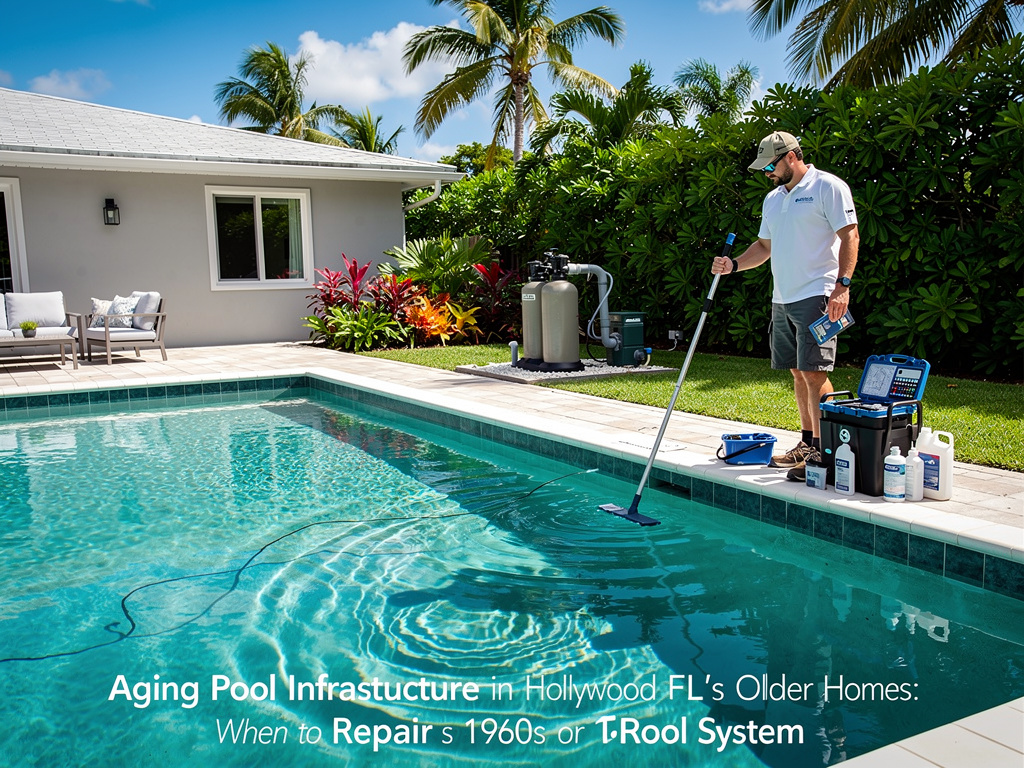
Hollywood’s Vintage Pool Stock
Hollywood was a boom town in the 1950s, 1960s, and 1970s. The post-war population surge in Broward County filled in Hollywood’s street grid with concrete block homes — many of them built with backyard pools as a standard feature of Florida living. That means a substantial portion of Hollywood’s residential pool inventory is between 45 and 70 years old. These are original gunite or concrete construction, often still running on second- or third-generation equipment fitted to the original plumbing infrastructure.
Vintage Hollywood pools were built well, but they were not built to last indefinitely without major renovation. The plumbing is a mix of galvanized steel, cast iron, and early-generation PVC. The pool shells are original gunite, likely replastered at least once but with shell deterioration that has been cosmetically covered. The equipment is almost certainly replacement equipment, but may be undersized for modern energy efficiency standards. Understanding what you have and what its remaining service life looks like is the first step in making intelligent maintenance decisions for an older Hollywood property.
The Underground Plumbing Problem
Underground plumbing is the most serious and most expensive aging infrastructure issue in Hollywood’s vintage pool stock. Original galvanized steel pipes from pools built before PVC became standard (mid-1960s to early 1970s) are now 50–60 years old. Galvanized steel was never intended for this service life in Florida’s corrosive soil and pool water chemistry environment. These pipes rust from the inside out, eventually developing pinhole leaks and then larger failures.
The challenge with underground plumbing leaks is that they’re invisible. A pool losing one to two inches of water per week might be losing it through the shell (structural crack), through a fitting (equipment leak), or through underground plumbing. The standard leak detection process involves pressure testing the plumbing lines to identify which lines hold and which don’t, followed by acoustic or tracer gas leak location to pinpoint the exact location before excavation. This process alone typically runs $300–$600. Repairing a confirmed underground plumbing leak involves excavation, often through the deck, at labor costs that typically run $1,500–$4,000 per repair depending on depth and access. Pipes that have failed in multiple places are generally better converted to new PVC via slip-lining or new plumbing runs than continued piecemeal repair.
Symptoms of underground plumbing leaks in older Hollywood pools include: consistently losing water faster than evaporation can explain (more than 1/4 inch per day), wet or spongy ground around the pool perimeter that doesn’t dry out, unexplained drops in circulation pressure, and air bubbles entering the pool through return jets (indicating a suction-side leak allowing air in).
Original Plaster: What 40-Year-Old Pool Surfaces Look Like
Standard white plaster has a design life of 10–15 years under normal maintenance conditions. A Hollywood pool that was originally plastered in 1970 and never resurfaced is now on borrowed time — and most have been replastered at least once, meaning the current surface may be layered plaster applied over the original. Layered plaster creates adhesion challenges because the bond between the new plaster and an existing rough or deteriorated plaster substrate is always weaker than plaster bonded to clean gunite.
Signs that an older Hollywood pool’s plaster needs immediate attention include: rough, sandpaper-like texture that tears swimsuits or irritates swimmers’ feet; visible calcium carbonate nodules poking through the surface (a structural indicator that the plaster is deteriorating from within); staining that doesn’t respond to acid washing or enzymatic treatment; and exposed aggregate or visible gunite at the water line or step edges.
When replastering an older Hollywood pool, the quality of surface preparation determines the lifespan of the new finish. A reputable plasterer will chisel away any loose or delaminated material, acid-etch the remaining surface, and apply a bond coat before the new plaster layer. Pools where this isn’t done correctly will see the new plaster delaminate within 3–5 years rather than lasting the full 10–15 year design life.
Single-Speed Pumps and Florida Energy Code
Florida energy code (Chapter 13 of the Florida Building Code) requires that any pool pump replacement use a variable-speed motor on systems over 1 horsepower, with a few narrow exceptions. Single-speed pumps from the 1990s and early 2000s — the generation that replaced the original equipment on most Hollywood vintage pools — are now at or past their typical 8–12 year service life, and when they fail, they must legally be replaced with variable-speed units.
Variable-speed pumps, despite costing $600–$1,100 more to purchase than a direct single-speed replacement, typically pay for themselves within 2–3 years through energy savings. A standard 1.5 HP single-speed pump running 8 hours per day consumes approximately 1,500–2,000 kWh per month. A properly programmed variable-speed pump covering the same circulation requirement uses 300–600 kWh per month. At FPL’s current residential rates, that’s a $100–$150 monthly reduction in operating cost.
If your Hollywood home’s pool is still running its original single-speed pump or an early replacement, plan for the transition to variable-speed proactively. Replacing a failed pump on an emergency basis always costs more than a planned replacement, and older single-speed pumps are increasingly difficult to source parts for.
The Repair vs Replace Decision Framework
The question Hollywood homeowners with vintage pools consistently face is: when do I stop repairing and start replacing? The answer depends on which components are failing and how their combined replacement cost compares to the value a functional pool adds to the property.
A useful heuristic: if your pool requires repairs totaling more than 30–40% of the cost of a full pool renovation in a single 12-month period, you are likely approaching the point where the renovation investment is better than continued piecemeal repair. A full Hollywood pool renovation — including new plaster, new equipment set, updated plumbing connections, and deck resurfacing — typically runs $15,000–$30,000 depending on size and scope. If you’re spending $5,000–$10,000 in a single year on leak repairs, equipment replacements, and plaster patches, that money could have been applied to a comprehensive renovation that restores the pool to a known-good condition for the next 15–20 years.
Pool Service Fort Lauderdale provides aging-pool assessments for Hollywood homeowners throughout the older Hollywood neighborhoods. Call (954) 501-2754, visit our Hollywood pool service area page, or see our full service site. 9900 W Sample Rd, Coral Springs, FL 33065.
{“@context”:”https://schema.org”,”@type”:”FAQPage”,”mainEntity”:[{“@type”:”Question”,”name”:”How long does pool plumbing last in Hollywood FL’s older homes?”,”acceptedAnswer”:{“@type”:”Answer”,”text”:”PVC plumbing lasts 25–30 years under normal conditions. Galvanized steel plumbing from pre-1970 Hollywood pools is now 50–60 years old and well past its service life. Signs of failure include unexplained water loss, air bubbles in returns, and wet soil around the pool perimeter.”}},{“@type”:”Question”,”name”:”When should I replaster an aging Hollywood pool?”,”acceptedAnswer”:{“@type”:”Answer”,”text”:”When the surface is rough enough to tear swimsuits, when calcium nodules are pushing through, when staining doesn’t respond to acid washing, or when exposed aggregate is visible at the water line. Plaster has a 10–15 year design life; Hollywood pools from the 1970s–1980s may be well past their last resurfacing cycle.”}},{“@type”:”Question”,”name”:”Do I legally have to replace an old single-speed pump with a variable-speed model?”,”acceptedAnswer”:{“@type”:”Answer”,”text”:”Yes. Florida energy code requires variable-speed pump replacements on systems over 1 HP. Single-speed replacements are only permitted for pools under specific size thresholds. A pool service company handling a permitted equipment replacement will automatically apply the current code requirement.”}},{“@type”:”Question”,”name”:”What does underground plumbing leak detection cost in Hollywood FL?”,”acceptedAnswer”:{“@type”:”Answer”,”text”:”Professional leak detection via pressure testing and acoustic or tracer gas location typically runs $300–$600 in the Hollywood area. Repair costs depend on depth and access but typically run $1,500–$4,000 per confirmed repair point when deck excavation is required.”}},{“@type”:”Question”,”name”:”At what point does it make sense to renovate rather than repair an old Hollywood pool?”,”acceptedAnswer”:{“@type”:”Answer”,”text”:”When repair costs in a single 12-month period exceed 30–40% of the cost of a full renovation, the renovation investment typically makes more sense. A full Hollywood pool renovation runs $15,000–$30,000 depending on scope; if you’re spending $6,000–$10,000 per year on repairs, comprehensive renovation is likely the better financial decision.”}]}}