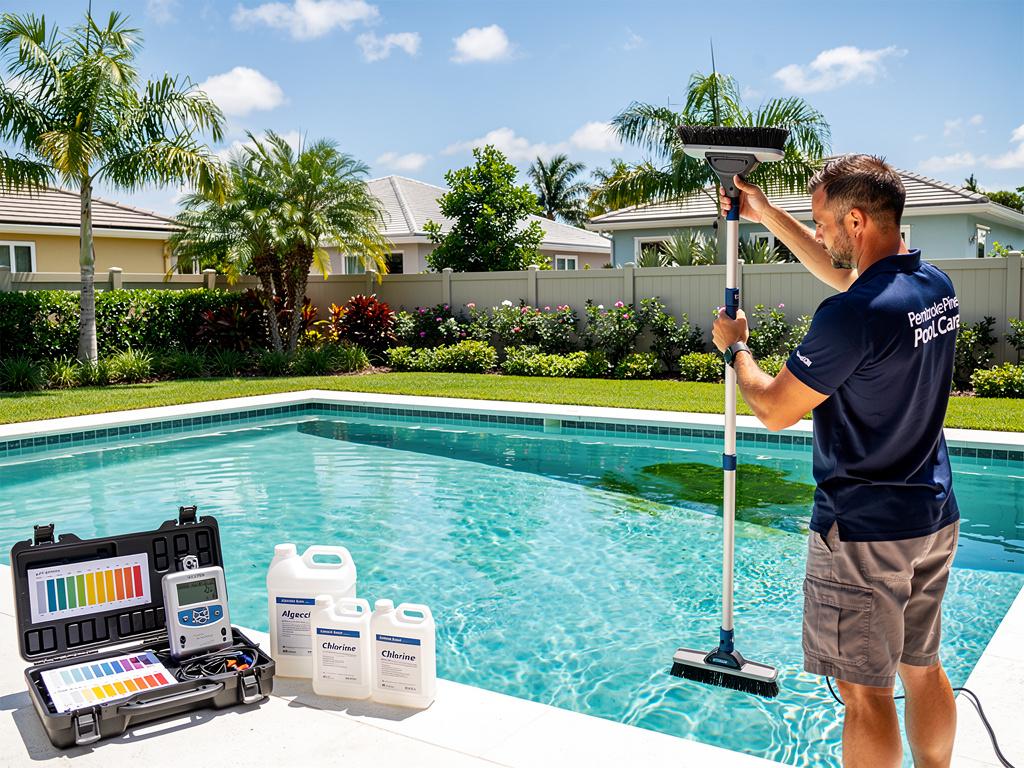
The Paradox of Well-Maintained Pembroke Pines Yards and Algae-Prone Pools
Pembroke Pines’ planned communities — Chapel Trail, Pembroke Falls, Silver Lakes, and surrounding neighborhoods — enforce rigorous property maintenance standards that keep lawns green, landscaping manicured, and community appearance consistent. This well-maintained aesthetic is achieved partly through regular professional lawn care service — which in South Florida’s aggressive grass-growing environment means fertilizer applications every 6–8 weeks during the growing season. The result is beautiful community appearance combined with a persistent, invisible pool chemistry problem that many Pembroke Pines pool owners spend years fighting without identifying the source.
Lawn fertilizers — particularly the granular fertilizers used by commercial lawn care companies to efficiently treat large turf areas — contain phosphate as a core nutrient component. Standard lawn fertilizer formulations include nitrogen, phosphorus (as phosphate), and potassium in ratios designed to support vigorous turf growth. The phosphate that’s not absorbed by the grass before an irrigation cycle or rainfall event runs off the turf surface, percolates through the soil, or is carried by irrigation overspray into the pool area — where it accumulates in the pool water and provides exactly the nutrient base that algae needs to establish and flourish.
How Fertilizer Phosphates Reach Your Pool
The pathway from lawn fertilizer to pool algae is direct and physically unavoidable without deliberate prevention. Granular fertilizer applied to turf adjacent to a Pembroke Pines pool area — even if the lawn care crew is careful about where they spread — sends phosphate to the pool through several mechanisms.
Irrigation overspray is the most direct route. Pembroke Pines planned communities typically have irrigation systems that run on fixed schedules — often early morning cycles that are not adjusted when the fertilizer has just been applied. The irrigation water dissolves surface granules and carries the dissolved phosphate in the spray arc, which in most yard configurations includes the pool deck and can reach the pool water directly. A single irrigation cycle after a fertilizer application can introduce a significant phosphate pulse into the pool.
Surface runoff after rain events carries dissolved fertilizer across hard surfaces (driveway, sidewalk, pool deck) and into any drain or low point — which in Pembroke Pines suburban lots often includes the pool area. The intense summer convective storms that Pembroke Pines experiences can mobilize surface fertilizer residue rapidly, even if the granules appeared well-embedded in the turf surface.
Soil percolation and splashout from rain hitting fertilized turf adjacent to the pool carries phosphate in suspension. If the pool area ground is within 10–15 feet of fertilized turf, soil moisture carrying dissolved phosphate can migrate toward the pool environment through normal surface water movement.
The Phosphate Testing Gap in Standard Pool Maintenance
Standard pool chemistry testing — what most Pembroke Pines pool service companies include in a weekly visit — covers free chlorine, total chlorine, pH, and sometimes total alkalinity and CYA. Phosphate is not included in standard testing panels because it’s not a safety parameter (it’s a nutrient, not a toxin or corrosive) and because standard test strips don’t measure it. This means that a Pembroke Pines pool can accumulate 300–500 ppb of phosphate over the course of a fertilizer season without any standard service visit detecting it.
The pool owner’s experience during this period is: algae that doesn’t respond normally to shock treatment, algae that reappears within a week of a successful treatment, recurring green tinges that the service company keeps treating without lasting success, and escalating chemical costs as the company adds more and more chlorine-based treatments to a phosphate-fueled algae problem that chlorine alone cannot solve. This pattern — recurring algae despite adequate chlorine, particularly in summer months when the lawn care program is most active — is the diagnostic indicator for phosphate-driven algae in Pembroke Pines planned community pools.
The Phosphate Management Protocol for Pembroke Pines
Breaking the fertilizer-phosphate-algae cycle in a Pembroke Pines planned community pool requires both chemistry management and source management.
Monthly phosphate testing: Request phosphate testing as part of your pool service’s monthly comprehensive panel, or test at a pool supply store that offers it (most do). Target below 100 ppb; treat when above 200 ppb.
Monthly phosphate remover maintenance dose: Even when below 200 ppb, a maintenance dose of lanthanum-based phosphate remover monthly prevents the accumulation from reaching treatment threshold levels during active fertilizer seasons. The cost ($10–$20 per month) is negligible compared to the chemical and service cost of treating a phosphate-fueled algae outbreak.
Zero-phosphate fertilizer request: In Pembroke Pines planned communities, HOA-mandated lawn care is often managed by a community lawn service that applies product to all common-area turf — but individual homeowners choose (or can request changes from) their own lawn care service. Request that your lawn care company use a phosphate-free fertilizer (often marketed as “0-0-7” or other formulations with zero as the middle number in the N-P-K ratio) within 20 feet of the pool area. Many Florida counties, recognizing the environmental impact of fertilizer runoff, have restrictions on phosphate-containing fertilizers during the summer rainy season, and many professional lawn care companies now stock zero-phosphate options for environmentally aware clients.
Buffer zone around the pool: Establish a 15–20 foot no-fertilizer buffer zone around the pool perimeter where only zero-phosphate products are used. This is the most reliable physical prevention of fertilizer phosphate reaching the pool — it’s faster and more complete than trying to intercept the phosphate after it’s already in the water.
Other Phosphate Sources in Pembroke Pines Planned Communities
Fertilizer is the dominant phosphate source for most Pembroke Pines planned community pools, but it’s not the only one. Fill water from Pembroke Pines’ municipal supply contains low-level phosphate from treatment additives (typically 0.5–1.0 ppm). Bird activity — ibises are extremely common in Pembroke Pines’ manicured neighborhoods — deposits phosphate-rich droppings. Organic debris from landscape plants decomposes to release phosphate. And some HOA-approved mulch products contain elevated organic phosphate that reaches the pool through runoff.
A comprehensive phosphate management approach addresses all of these sources through the monthly testing and remover maintenance protocol rather than trying to eliminate each source individually. The monthly remover dose keeps phosphate at or below 100 ppb regardless of source, which means algae is consistently nutrient-limited even when individual inputs (a bird landing, an irrigation cycle after fertilization, a mulch application) would otherwise push levels toward the treatment threshold.
Pool Service Fort Lauderdale provides phosphate testing, treatment, and algae prevention service throughout Pembroke Pines FL’s planned communities. Call (954) 501-2754, visit our Pembroke Pines pool service page, or see our full website. 9900 W Sample Rd, Coral Springs, FL 33065.
{“@context”:”https://schema.org”,”@type”:”FAQPage”,”mainEntity”:[{“@type”:”Question”,”name”:”Why does my Pembroke Pines pool keep getting algae even though the yard is well-maintained?”,”acceptedAnswer”:{“@type”:”Answer”,”text”:”Well-maintained yards in Pembroke Pines planned communities receive regular fertilizer applications containing phosphate. Irrigation overspray and surface runoff carry dissolved phosphate into pool water, providing the nutrient base for algae growth. Recurring algae despite adequate chlorine — especially during active fertilizer seasons — is the diagnostic indicator of phosphate-driven algae.”}},{“@type”:”Question”,”name”:”How does lawn fertilizer reach my pool in Chapel Trail or Pembroke Falls?”,”acceptedAnswer”:{“@type”:”Answer”,”text”:”Three routes: irrigation overspray dissolves and carries granular fertilizer in the spray arc that often reaches the pool deck or water; surface runoff after rain events mobilizes dissolved fertilizer across hard surfaces toward the pool area; and soil percolation from fertilized turf within 10–15 feet of the pool migrates dissolved phosphate toward the pool environment.”}},{“@type”:”Question”,”name”:”What is a zero-phosphate fertilizer and can I request it for my Pembroke Pines lawn?”,”acceptedAnswer”:{“@type”:”Answer”,”text”:”Zero-phosphate fertilizers have ‘0’ as the middle number in the N-P-K ratio (e.g., 15-0-7 or 28-0-10). They provide nitrogen and potassium without phosphorus. Most professional lawn care companies now stock these formulations. Requesting zero-phosphate product within 20 feet of your pool eliminates the dominant phosphate source for most Pembroke Pines planned community pools.”}},{“@type”:”Question”,”name”:”How often should I test phosphate in my Pembroke Pines pool?”,”acceptedAnswer”:{“@type”:”Answer”,”text”:”Monthly, particularly during the spring and summer fertilizer seasons when lawn care applications are most frequent. Standard pool test strips do not measure phosphate — test at a pool supply store or use a dedicated phosphate drop-test kit. Target below 100 ppb; apply lanthanum-based remover when above 200 ppb.”}},{“@type”:”Question”,”name”:”Does a phosphate remover prevent algae in Pembroke Pines pools?”,”acceptedAnswer”:{“@type”:”Answer”,”text”:”Yes, by limiting algae’s primary nutrient. Phosphate below 100 ppb deprives algae of the nutrient it needs to colonize surfaces faster than chlorine can eliminate it. Monthly maintenance doses of lanthanum-based remover keep phosphate at or below this threshold regardless of environmental inputs, making algae prevention proactive rather than reactive.”}]}}