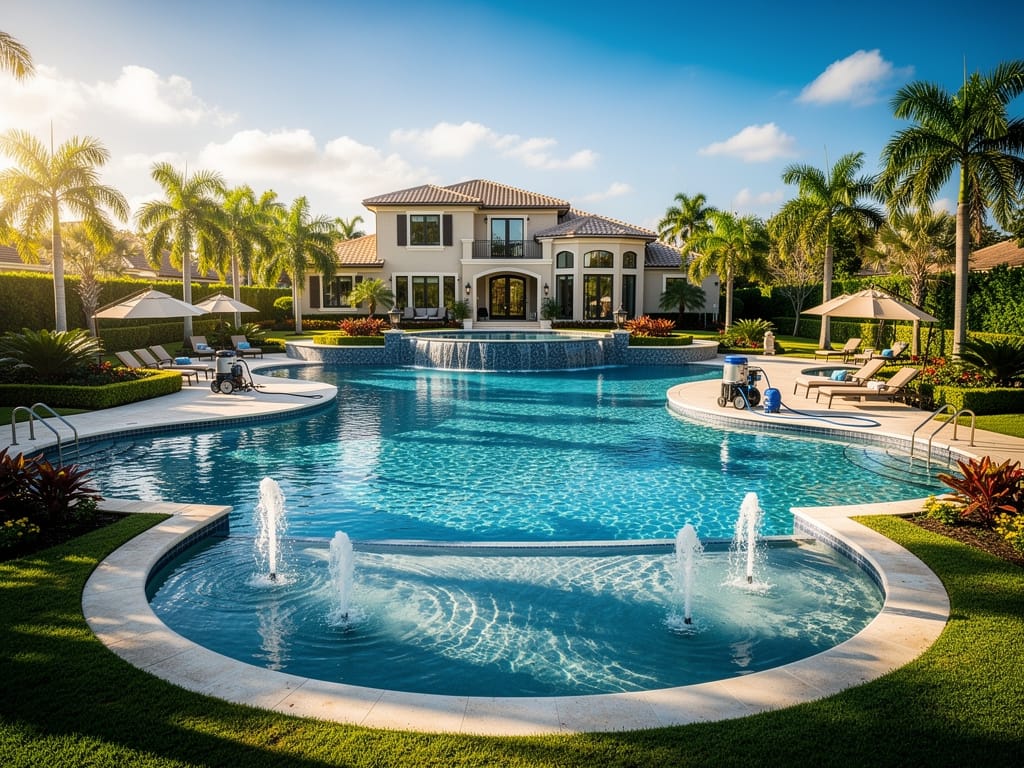
Parkland’s luxury market expects a level of precision and consistency from home systems that weekly manual chemistry management can’t fully deliver. Between service visits, a Parkland estate pool’s chemistry drifts — pH rises from normal pool dynamics, chlorine is consumed by bather load and UV — and the pool operates outside ideal parameters for days at a time. For premium pools used regularly, automated chemistry monitoring provides the continuous management that manual weekly service alone cannot.
At Pool Service Fort Lauderdale, we install, calibrate, and service automated chemistry systems for Parkland estate pools and integrate them with the professional oversight that maintains their accuracy. This guide covers what automated chemistry monitoring provides and what it requires.
What ORP and pH Sensors Measure
ORP (Oxidation-Reduction Potential): Measured in millivolts (mV), ORP is the electrochemical potential of pool water to oxidize contaminants — essentially, how effective the sanitizer is at its current concentration. At 650-750 mV ORP, pool water is effectively sanitized; below 600 mV, sanitization effectiveness drops; above 800 mV, chlorine is present in excess. ORP is a better real-time indicator of sanitization effectiveness than free chlorine alone because it accounts for the pH-dependent relationship between free chlorine and hypochlorous acid (the active sanitizing form).
pH sensor: Continuous pH monitoring allows the system to detect pH rise (from normal pool dynamics: CO₂ degassing, swimmer contamination) and automatically dose acid (CO₂ or muriatic acid) to maintain target pH. In a high-bather Parkland estate pool, pH can rise significantly between weekly service visits; continuous auto-dosing keeps pH at 7.4-7.6 rather than allowing it to drift to 7.8-8.0 between visits.
Leading Automated Chemistry Systems for Parkland Estate Pools
Pentair IntelliChem
Pentair’s fully integrated chemistry controller with ORP and pH sensors, liquid chlorine doser, and acid doser. Integrates natively with IntelliCenter and IntelliConnect automation for monitoring and alerts via the app. Displays real-time ORP and pH readings on the control panel and through the app. Can send alerts when chemistry drifts outside set parameters — particularly useful for Parkland homeowners who travel and want visibility into pool chemistry remotely. IntelliChem installation: $1,500-$2,500 including sensors and chemical tanks.
Hayward OmniLogic Chemistry Module
Hayward’s chemistry monitoring integration for OmniLogic automation. ORP and pH readings visible in the OmniLogic app alongside all other pool control functions. Auto-dosing capability with chemical feeder integration. Best choice for Parkland estate pools already on OmniLogic automation.
Autopilot Total Control (Standalone System)
A brand-agnostic chemistry controller that works with any pool regardless of existing automation brand. Particularly popular for Parkland retrofit installations where the existing automation is from a brand without a native chemistry module, or where the homeowner wants an advanced system beyond the automation manufacturer’s offering. Total Control includes ORP and pH sensing, automatic dosing, and detailed chemistry logging with trends over time.
What Automated Systems Still Require from Professional Service
Automated chemistry monitoring is not a replacement for professional service — it is a component of a complete professional service program:
- Sensor calibration (weekly-biweekly): ORP and pH sensors drift over time and must be calibrated against known reference solutions regularly. An uncalibrated sensor provides inaccurate readings — the automation system then doses incorrectly based on false readings, either over-dosing (wasted chemicals, potentially bleaching surfaces) or under-dosing (inadequate sanitization). Sensor calibration is a technician task, not a homeowner task.
- Chemical reservoir management: Auto-dosing tanks of liquid chlorine and acid must be refilled regularly. Running out of liquid chlorine in the dosing tank is a chemistry failure that the automation system cannot prevent — it can only alert that the tank is low.
- Full 7-parameter testing: ORP and pH sensors measure only two parameters. Calcium hardness, CYA, TDS, phosphate, and total alkalinity still require manual testing at each service visit. Automated systems supplement manual testing, they don’t replace it.
Pool Service Fort Lauderdale installs and maintains automated chemistry monitoring systems for Parkland estate pools, calibrating sensors at each service visit and integrating automated monitoring with comprehensive manual testing. Call (954) 501-2754 or visit our Parkland pool service page. Full coverage at poolservicefortlauderdale.us.
Frequently Asked Questions
{“@context”:”https://schema.org”,”@type”:”FAQPage”,”mainEntity”:[{“@type”:”Question”,”name”:”What does ORP measure in a Parkland pool and why is it better than just testing free chlorine?”,”acceptedAnswer”:{“@type”:”Answer”,”text”:”ORP (Oxidation-Reduction Potential) measures the electrochemical sanitization effectiveness of pool water in real time — not just the quantity of chlorine, but how effectively it can oxidize contaminants at the current pH. At pH 7.4, the same free chlorine concentration is significantly more effective (higher ORP) than at pH 7.8, because more chlorine exists in the active hypochlorous acid form at lower pH. ORP captures this pH-dependent effectiveness relationship that a free chlorine reading alone misses.”}},{“@type”:”Question”,”name”:”How much does an automated chemistry monitoring system cost for a Parkland estate pool?”,”acceptedAnswer”:{“@type”:”Answer”,”text”:”Pentair IntelliChem with ORP/pH sensors, dosing heads, and chemical tanks installed: $1,500-$2,500. Hayward OmniLogic chemistry module integration: $1,200-$2,000 installed. Autopilot Total Control standalone system: $2,000-$3,500 installed. All figures include installation and initial calibration. Annual ongoing cost for chemical reservoir refilling (liquid chlorine and acid) and sensor replacement (sensors have a 12-18 month service life): $400-$800/year.”}},{“@type”:”Question”,”name”:”Can I monitor my Parkland pool chemistry remotely with an automated system?”,”acceptedAnswer”:{“@type”:”Answer”,”text”:”Yes. Pentair IntelliChem integrated with IntelliCenter, Hayward OmniLogic chemistry module, and Autopilot Total Control all provide real-time ORP and pH readings accessible via smartphone app from anywhere. The systems can send push notification alerts when chemistry drifts outside set parameters — allowing Parkland homeowners who travel to receive alerts and coordinate remote service response before chemistry problems develop into visible water quality issues.”}},{“@type”:”Question”,”name”:”Does an automated chemistry system replace professional pool service for Parkland estate pools?”,”acceptedAnswer”:{“@type”:”Answer”,”text”:”No. Automated systems require weekly-biweekly sensor calibration by a trained technician — uncalibrated sensors provide inaccurate readings that result in incorrect dosing. Chemical reservoir tanks require refilling. The sensors measure only ORP and pH; calcium hardness, CYA, TDS, phosphate, and total alkalinity still require manual testing at each service visit. Automated chemistry monitoring is a component of a complete professional service program, not a replacement for it.”}},{“@type”:”Question”,”name”:”How long do ORP and pH sensors last in a Parkland pool?”,”acceptedAnswer”:{“@type”:”Answer”,”text”:”ORP and pH sensor probes typically have a service life of 12-18 months in a residential pool application. Sensors exposed to high chlorine levels, extreme pH events, or improper calibration may degrade faster. Regular calibration extends sensor life by preventing the drift buildup that causes premature failure. Factor sensor replacement (typically $150-$300 per probe) into the annual cost of automated chemistry monitoring.”}}]}
What does ORP measure and why is it better than just free chlorine? Electrochemical sanitization effectiveness in real time — accounts for the pH-dependent relationship between free chlorine concentration and active sanitizing power. Same chlorine concentration at pH 7.4 is significantly more effective than at pH 7.8.
System cost for Parkland estate pool? IntelliChem: $1,500-$2,500. OmniLogic module: $1,200-$2,000. Autopilot Total Control: $2,000-$3,500. Annual ongoing cost (chemical refills, sensor replacement): $400-$800/year.
Can I monitor remotely? Yes — all three platforms provide real-time ORP/pH via smartphone app with push notification alerts when chemistry drifts outside set parameters.
Does it replace professional service? No — sensors require weekly-biweekly calibration, reservoirs need refilling, and 5 additional parameters (calcium, CYA, TDS, phosphate, alkalinity) still require manual testing. Automated monitoring supplements service, doesn’t replace it.
How long do sensors last? 12-18 months. Regular calibration extends sensor life. Replacement cost: $150-$300 per probe.