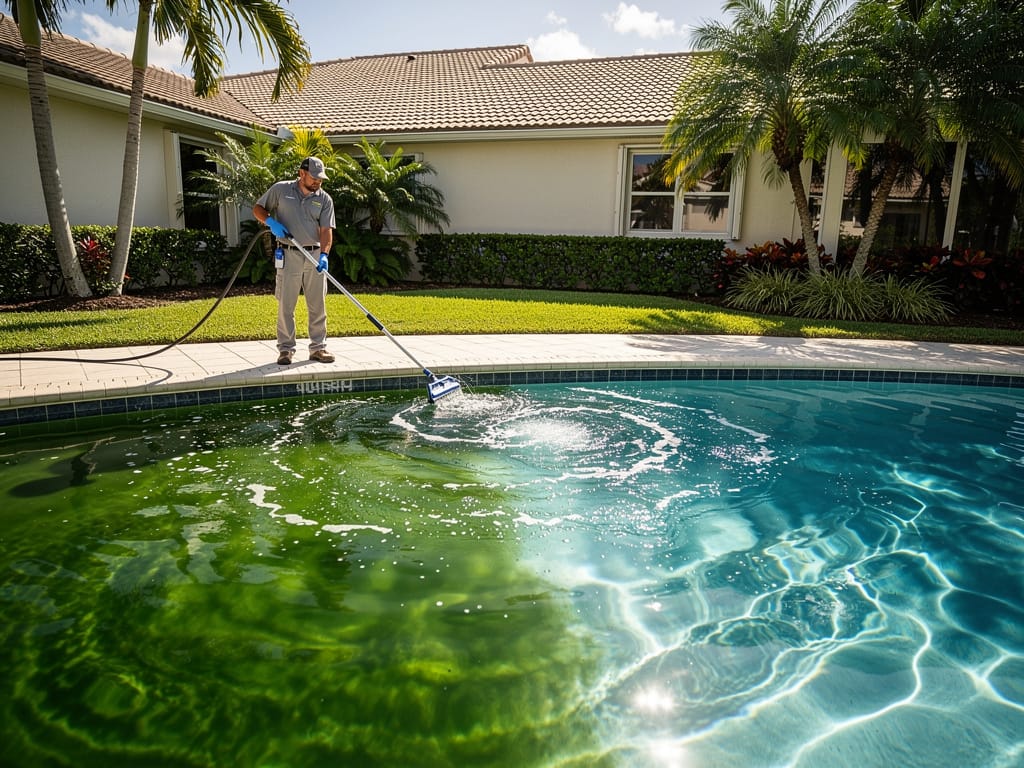
Green pools happen to good pool owners. It usually follows the same sequence: you skip a week of service, a few summer storms roll through, and you come home to water that looks like pea soup. In Coral Springs, where summer water temperatures stay above 84°F and phosphate levels in the tap water are already high, algae can colonize a pool remarkably fast once chlorine drops below 1 ppm.
The good news: a properly executed green pool recovery works. The frustrating news: most DIY recovery attempts fail, usually for the same handful of reasons. This guide covers the professional protocol for getting a Coral Springs green pool back to clear water in the shortest possible time.
Why Pools Turn Green in Coral Springs
Algae need three things to grow: warmth, sunlight, and nutrients — specifically phosphates and nitrogen. Coral Springs pools have all three in abundance. Water temperatures above 80°F are the norm for eight months of the year. South Florida sun provides intense UV exposure. And Broward County tap water arrives with natural phosphate levels between 300–600 ppb, which accumulates further from fertilizer runoff, rain, leaves, and sunscreen.
When chlorine drops — through insufficient service, heavy rain dilution, or heat-accelerated degradation — there’s nothing left to suppress the algae that are always present in pool water at low levels. Within 48–72 hours of chlorine falling below 0.5 ppm in summer conditions, visible green coloration appears. Within a week, the water can become opaque.
The most common cause in Coral Springs: a skipped weekly service visit during summer. Two weeks without service in July is usually all it takes.
Assessing the Severity Before You Start
Not all green pools are equal. Your recovery strategy depends on what you’re dealing with:
Light green, water visible: Early-stage algae bloom. You can still see the pool floor. This is the best-case scenario and typically clears in 3–4 days with proper treatment. Fastest and cheapest to fix.
Dark green, water partially visible: Established bloom. Algae is coating walls and floor surfaces. Recovery takes 5–7 days. Requires significant shocking and daily brushing.
Opaque/black-green, floor not visible: Severe bloom or black algae. Do not enter the pool — the chlorine level is near zero, and bacterial contamination may be present. Professional intervention is strongly recommended. Recovery takes 7–14 days.
Black spots on surfaces: Black algae is a different organism from green algae — it has a protective outer layer and root systems that penetrate plaster. It requires physical scrubbing with a stainless steel brush (not nylon) and repeated high-dose shocking over multiple days. Black algae in plaster surfaces can be extremely persistent.
The Professional Green Pool Recovery Protocol
Here’s the exact protocol our technicians use for Coral Springs green pool calls:
Step 1 — Test and assess: Before adding any chemicals, test the existing water chemistry. pH, alkalinity, stabilizer (CYA), phosphates, and existing chlorine all affect how to proceed. If CYA (cyanuric acid) is above 100 ppm, the pool may need partial draining before shocking — high CYA locks up chlorine and prevents effective killing even at high doses.
Step 2 — Phosphate treatment first: If phosphates are above 500 ppb (common in Coral Springs), apply phosphate remover before shocking. Phosphate remover doesn’t kill algae, but by eliminating their primary nutrient, it prevents immediate re-bloom after the chlorine clears. Skipping this step is the #1 reason DIY recoveries work briefly and then turn green again within a week.
Step 3 — Shock to 10–30 ppm: Using calcium hypochlorite (pool shock), dose the pool to reach free chlorine levels of 10–30 ppm depending on severity. This is 3–10 times the normal maintenance chlorine level. Calculate dose by pool volume — a standard 15,000-gallon Coral Springs pool requires 5–15 lbs of calcium hypochlorite shock for an initial treatment. Add shock in the evening to prevent UV degradation.
Step 4 — Add algaecide: Apply a copper-based or quaternary algaecide immediately after shocking. Algaecide attacks the algae’s cell walls while high chlorine is working through the water. Use the full recommended dose for the pool volume, not a maintenance dose.
Step 5 — Brush everything: Brush all walls, steps, floor, and corners with a pool brush before and after chemical addition. Brushing physically disrupts algae colonies and exposes them to the chlorinated water. This step is non-negotiable — chemicals alone won’t penetrate thick algae mats without physical disruption.
Step 6 — Run the filter 24/7: Keep the pump and filter running continuously until the water clears. Backwash or clean the filter every 24 hours — a heavy algae load will clog filter media quickly, reducing circulation and slowing recovery.
Step 7 — Daily monitoring and re-shocking: Test chlorine every 24 hours. If chlorine drops below 5 ppm before the water is clear, re-shock. The pool should progress from green → cloudy blue/grey → clear over 3–7 days.
Common DIY Mistakes That Extend Recovery Time
The most common reasons Coral Springs homeowners’ DIY attempts stretch from 3 days to 3 weeks:
- Under-shocking: Adding one bag of shock to a 20,000-gallon pool that needs five bags. The chlorine gets consumed by the algae load without clearing it.
- Skipping phosphate treatment: Green clears briefly, returns within 3–5 days when phosphates re-feed surviving algae.
- Not brushing daily: Chemicals can’t penetrate established algae mats without physical disruption.
- Not cleaning the filter: Clogged filter media kills circulation, slowing recovery significantly.
- Shocking during peak sun hours: UV rays destroy free chlorine rapidly. Always shock in the evening.
After Recovery: Preventing the Next Green Pool Event
Once your Coral Springs pool is clear, three things reduce re-occurrence risk: consistent weekly service (no skipped visits during summer), phosphate testing and treatment every 30–60 days, and maintaining CYA (stabilizer) at 30–50 ppm to protect chlorine from UV degradation. If you’ve had two green pool events in one season, evaluate whether your service frequency matches your pool’s actual needs.
For professional green pool recovery in Coral Springs, contact Pool Service Fort Lauderdale at (954) 501-2754. We service the Coral Springs area and can typically respond to green pool calls within 24–48 hours.
Frequently Asked Questions
How much does a green pool treatment cost in Coral Springs?
Professional green pool treatment in Coral Springs typically runs $150–$350 for a light-to-moderate case, including the chemical cost and labor for the initial treatment. Severe cases requiring multi-day returns, filter cleaning, and larger chemical volumes can reach $400–$800. This is why prevention through consistent service is almost always cheaper.
Can I swim in a slightly green pool?
No. A green pool has near-zero chlorine, which means bacteria including E. coli are not being controlled. Green water indicates algae bloom, which correlates with bacterial contamination risk. Do not allow swimming until the pool is clear and chemistry is balanced, with free chlorine back at 1–3 ppm.
How do I know if my green pool has black algae?
Black algae appears as dark green or black spots or patches on pool surfaces, particularly on the shaded north-facing wall, steps, and corners. Unlike green algae (which floats and disperses), black algae forms discrete colonies that feel rough and resist brushing with standard nylon pool brushes. If you see spots that won’t brush away easily, you have black algae.
Will my filter handle the algae load during recovery?
Your filter will handle it but will clog faster than normal. During green pool recovery, backwash a sand or DE filter every 24 hours, or rinse a cartridge filter every 24 hours. If the filter pressure gauge climbs more than 8–10 psi above its normal clean operating pressure, backwash or clean immediately — restricted flow dramatically slows recovery.
Why did my pool turn green again three days after I treated it?
Re-bloom after a brief clearance almost always means either insufficient shock dose, unaddressed high phosphates, or CYA that’s too high (above 100 ppm) blocking chlorine effectiveness. Test your CYA level — if it’s above 80 ppm, partial dilution is needed before re-shocking. And treat phosphates before the next attempt.