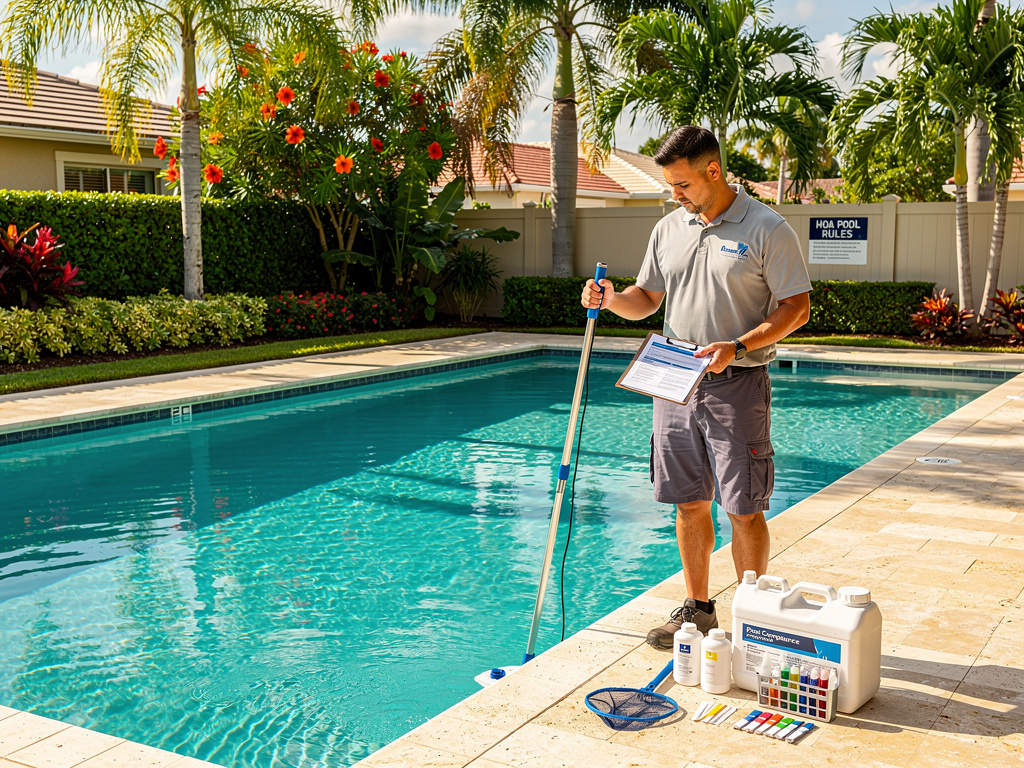
Plantation’s HOA Fabric: Decades of Established Governance
Plantation FL’s community associations are among the most established in Broward County. Communities like Plantation Midtown, Plantation Isles, Plantation Country Club, and the dozens of sub-communities within the city have HOA governing documents that in some cases date to the 1970s — developed when the community was new and refined through decades of enforcement and amendment. The result is a HOA governance environment that’s more deeply embedded in community culture and more procedurally developed than a newer Broward development where the HOA is just finding its footing.
This maturity shows in HOA expectations: Plantation’s established communities generally know exactly what they want, have enforcement procedures that work, and have dealt with enough pool-related issues over the decades to have specific standards addressing the problems they’ve actually encountered. The homeowner who purchases in an established Plantation HOA community is inheriting governance structures that aren’t going to be lenient about pool maintenance — and understanding what those structures actually require is a foundational responsibility of pool ownership in these communities.
Water Clarity Standards in Plantation HOA Communities
The most visible and most commonly enforced pool standard in Plantation HOA communities is water clarity. The typical standard — expressed in various ways across different communities’ governing documents — is that pool water must be clear and the pool drain (or pool bottom) must be visible from the deck. This standard has a practical rationale beyond aesthetics: a pool in which the drain is not visible to a lifeguard or responsible adult cannot be safely supervised for young swimmers, because a submerged child may not be visible until reaching the surface or the bottom of the pool.
Green water — indicating active algae bloom — is the most common violation trigger in Plantation’s HOA pool enforcement. The progression in well-run Plantation HOAs is typically: courtesy notice of visible water quality issue, formal notice with a compliance deadline (often 30 days), fine initiation if not corrected, and in extreme cases, authority for the HOA to arrange for pool treatment and charge the cost to the owner. Established Plantation HOAs have generally worked through these procedures enough times to operate them smoothly and consistently.
Yellow or tannin-stained water — common in Plantation’s canopy-environment pools — is treated differently across communities. Some Plantation HOAs treat visible tannin tinting as a maintenance issue requiring correction; others accept that a slight yellow cast is inherent to Plantation’s tree environment and don’t cite it as a violation unless the water is opaque. Knowing your specific community’s standard for tannin tinting before it becomes an enforcement question is worthwhile — and maintaining a clear-water standard through the enzyme and management protocols described in the tannin management approach prevents the question from arising.
Pool Deck and Coping Standards
Plantation’s established HOA communities typically address pool deck and coping appearance in their governing documents, reflecting the community’s emphasis on visual consistency and property value maintenance. Common requirements include: crack-free deck surfaces (surface cracks that allow weed growth or represent structural movement trigger notices), clean coping tiles free of calcium scale and staining, functional drainage that doesn’t allow deck water to pond for extended periods, and in some communities, specific deck material or color standards that must be maintained when resurfacing is done.
In Plantation’s older neighborhoods, deck resurfacing projects require ARC (Architectural Review Committee) approval before work begins. The ARC approval process in established Plantation communities is typically more detailed than in newer HOAs — some communities maintain reference documentation from past approved projects and compare new applications against that precedent. Homeowners planning pool deck work in Plantation’s established HOA communities should begin the ARC process well in advance of their planned work date, as review timelines of 30–60 days are common in well-established communities with active ARC oversight.
Equipment Standards: Noise, Screening, and Visual Impact
Pool equipment — pumps, filters, heaters, automation panels — is a HOA concern in Plantation’s established communities from both a noise and a visual impact standpoint. Communities that were developed before variable-speed pumps existed may have older governing documents that didn’t anticipate the noise implications of modern equipment, but HOA enforcement in this area has generally adapted to current equipment realities. Pool equipment that can be heard from the street or from adjacent properties during early morning or late evening hours is a common HOA complaint source in Plantation neighborhoods where properties are close enough together for equipment noise to travel.
Variable-speed pumps operate significantly more quietly than single-speed pumps at their typical operating speeds — this is an incidental benefit of the efficiency upgrade that also resolves many noise complaints in HOA communities. A Plantation pool owner with a noisy older single-speed pump who is receiving neighbor or HOA complaints about equipment noise will generally find the variable-speed replacement resolves the complaint as a natural side effect of the equipment upgrade.
Equipment screening — lattice, hedging, or equipment enclosures that prevent direct visual exposure of the pool equipment pad from public areas or neighboring properties — is required in many Plantation HOA communities. Standards for what constitutes adequate screening vary by community document, but the general principle is that pool equipment should not be the dominant visible feature of the pool area from outside the property.
Florida Pool Safety Law and HOA Fencing Requirements
Florida Statute 515 requires residential pool barriers for all pools with access from residential dwellings where children under five may be present. Plantation’s HOA communities also typically have their own pool barrier requirements in governing documents. The key nuance in established Plantation communities is that HOA barrier requirements and current Florida law may not be identical — community documents written in the 1980s or 1990s may reflect the safety standards of those periods, which were less stringent than current requirements.
When both HOA and Florida law apply, the more restrictive standard controls. A Plantation pool owner whose HOA document specifies a 4-foot fence but current Florida law requires a 5-foot barrier for new construction must meet the Florida law standard regardless of what the HOA document says. A professional pool contractor or permitting specialist can clarify which standard applies to any specific renovation or construction project in a Plantation HOA community.
Pool Service Fort Lauderdale provides professional pool maintenance that keeps Plantation FL HOA community pools in compliance. Call (954) 501-2754, visit our Plantation pool service page, or see our full website. 9900 W Sample Rd, Coral Springs, FL 33065.
{“@context”:”https://schema.org”,”@type”:”FAQPage”,”mainEntity”:[{“@type”:”Question”,”name”:”What pool water clarity does a Plantation FL HOA typically require?”,”acceptedAnswer”:{“@type”:”Answer”,”text”:”Most Plantation HOA communities require clear water with the pool drain or pool bottom visible from the deck. Green water (algae bloom) is the most common enforcement trigger. Some communities also require treatment of tannin-yellow water; others accept slight tinting from Plantation’s heavy oak canopy as inherent to the environment. Know your specific community’s standard before receiving a notice.”}},{“@type”:”Question”,”name”:”Do I need HOA ARC approval for pool deck resurfacing in Plantation FL?”,”acceptedAnswer”:{“@type”:”Answer”,”text”:”Yes, in established Plantation HOA communities. ARC review timelines in mature Plantation communities can be 30–60 days — begin the application well before your planned work date. Some communities maintain precedent documentation from past approved projects and compare new applications against that record. Confirm deck material and color requirements before selecting a contractor.”}},{“@type”:”Question”,”name”:”Can my Plantation FL HOA require me to screen my pool equipment?”,”acceptedAnswer”:{“@type”:”Answer”,”text”:”Yes. Many Plantation HOA governing documents require that pool equipment not be directly visible from public areas or neighboring properties. Acceptable screening methods vary by community — lattice panels, hedging, and equipment enclosures are common. Review your community’s specific document language and confirm with your property manager before installing screening.”}},{“@type”:”Question”,”name”:”What happens if my Plantation FL pool doesn’t meet HOA standards?”,”acceptedAnswer”:{“@type”:”Answer”,”text”:”Established Plantation HOAs typically follow a documented process: courtesy notice → formal notice with compliance deadline (often 30 days) → fine initiation → in extreme cases, HOA-arranged remediation billed to the owner. Plantation’s mature HOAs have refined these procedures through decades of enforcement and operate them consistently. Addressing notices promptly — before formal proceedings begin — is always less costly.”}},{“@type”:”Question”,”name”:”Does Florida law or HOA rules govern pool fencing requirements in Plantation FL?”,”acceptedAnswer”:{“@type”:”Answer”,”text”:”Both apply, and the more restrictive standard controls. Florida Statute 515 sets minimum residential pool barrier requirements that supersede HOA documents where more stringent. HOA governing documents written in the 1980s or 1990s may reference outdated standards. A permitted pool renovation will be inspected against current Florida law, not the older HOA document language.”}]}}