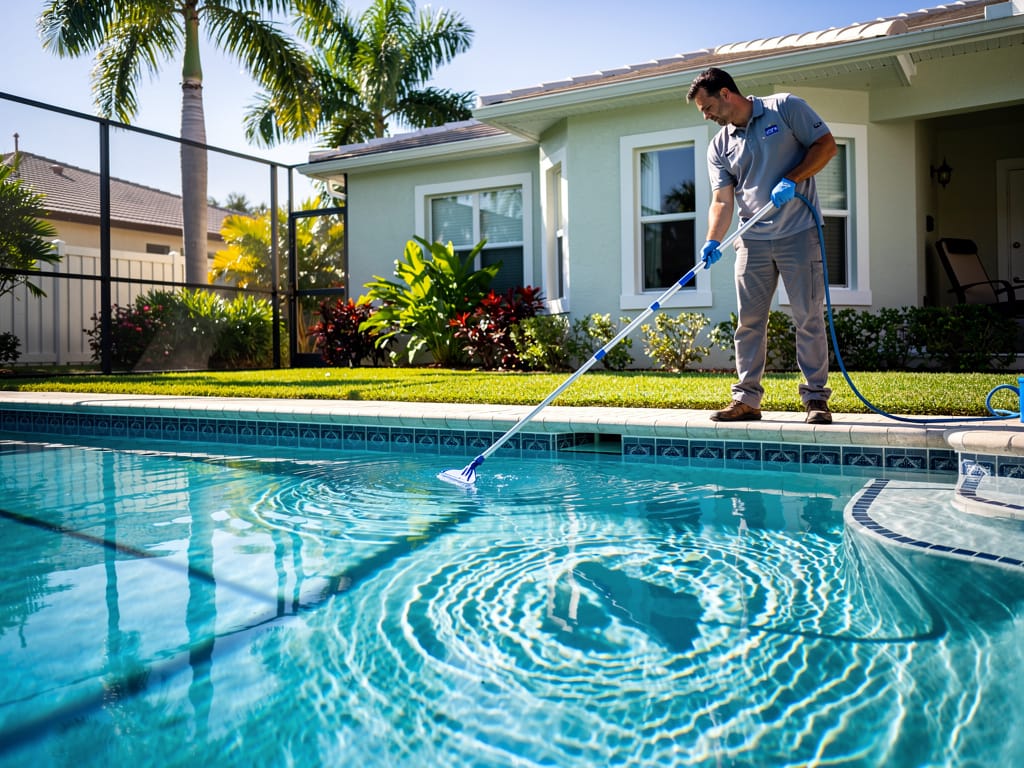
Margate’s established neighborhoods — particularly around Oriole Gardens, Oriole Park, and the older sections off Banks Road — feature mature tree canopy that’s been growing since the subdivisions were built in the 1970s and 1980s. These large trees provide shade, privacy, and aesthetic appeal. They also create ongoing pool chemistry challenges that homeowners with open-yard pools don’t face.
At Pool Service Fort Lauderdale, we service many Margate pools with heavy tree exposure and understand the specific chemistry management these pools require. This guide explains how tree canopy affects your pool’s chemistry and what it takes to stay ahead of it.
Chlorine Demand from Organic Load
Chlorine’s job is to oxidize and sanitize contaminants in pool water. Every organic molecule that enters the pool — leaf fragments, pollen, seed pods, bird droppings, bark tannins from rain-off — creates chlorine demand. The pool’s chlorine supply is consumed defeating these organic contaminants before it can reach the residual free chlorine level that provides ongoing sanitization.
A Margate pool under heavy tree canopy can have 2-3x the organic load of an equivalent pool in an open yard. This translates to 2-3x the chlorine consumption — the same amount of chlorine added to both pools leaves the tree-shaded pool with significantly lower free chlorine residual. Standard dosing that maintains 2-3 ppm in an open pool may only achieve 0.5-1.0 ppm in a pool with high organic loading.
Practical responses to high chlorine demand from tree load:
- Increase chlorine dosing to match the higher demand (increases chemical cost)
- Shock weekly or bi-weekly during peak organic loading seasons (spring budding, fall leaf drop, pollen season)
- Use a pool enzyme treatment monthly — enzymes break down non-living organic material (tannins, oils, leaf extracts) before it creates chlorine demand. Brands: Natural Chemistry Pool Perfect, Orenda CV-600, similar
- Install a pool skimmer sock or skimmer basket insert to catch fine organic material before it sinks to the floor
Phosphate Accumulation from Decaying Organic Matter
Decaying organic material releases phosphate into pool water. Leaves, plant matter, and organic debris that sit on the pool floor or in skimmer baskets decompose and release phosphates that then become dissolved in the pool water. Phosphate above 500 ppb provides the nutrient base for algae blooms — algae can establish and bloom even when free chlorine is maintained at 2-3 ppm if phosphate levels are high enough.
For Margate pools with significant tree exposure, monthly phosphate testing and phosphate removal treatment (lanthanum-based products: Natural Chemistry PHOSfree, Orenda PR-10,000) is the most cost-effective algae prevention strategy. Cost: $15-$30/month. Alternative cost: algae remediation after a bloom — $150-$500 per event.
pH Drift from Leaf Tannins
Oak trees — common in Margate’s older neighborhoods — produce tannin-rich leaves. When oak leaves land in pool water and begin decomposing, they release tannic acid, which drives pH downward. Extended pH below 7.2 is corrosive to pool equipment and pool interiors, causes eye irritation in swimmers, and reduces the effectiveness of chlorine sanitization.
Margate pools near oak trees or other tannin-rich species should be tested for pH at every service visit (weekly minimum) and pH-up (sodium carbonate) added proactively when pH drops toward 7.2. Pools with high leaf loads may need pH adjustment between service visits during periods of heavy leaf fall.
Tannins also cause persistent brownish/yellowish water staining and waterline staining on pool surfaces. If tannin staining is present, enzyme treatments (Pool Perfect, CV-600) help break down the tannin load, and clarifier helps aggregate staining particles for filter capture.
Debris Management Strategies
Beyond chemistry, physical debris management is critical for tree-canopy pools:
- Leaf net over the pool: Fine-mesh leaf nets (suspended above the water surface) catch falling debris before it enters the water — dramatically reducing organic load. Trade-off: aesthetic appearance and accessibility for casual pool use.
- Leaf bagger attachment for pool cleaners: Automatic pool cleaners with leaf bagger attachments collect large debris before it reaches the filter. Standard cleaner bags don’t capture large leaf fragments that bypass the pump basket.
- Skimmer basket emptied between visits: A full skimmer basket stops surface skimming — debris sinks to the floor rather than being removed. For heavy-canopy Margate pools, homeowners emptying the skimmer basket between service visits is one of the most impactful maintenance actions available.
Pool Service Fort Lauderdale provides high-frequency service for Margate’s tree-canopy pools and custom chemistry programs for high-organic-load conditions. Call (954) 501-2754 or visit our Margate pool service page. Full coverage at poolservicefortlauderdale.us.
Frequently Asked Questions
{“@context”:”https://schema.org”,”@type”:”FAQPage”,”mainEntity”:[{“@type”:”Question”,”name”:”Why does my Margate pool keep losing chlorine so fast with trees nearby?”,”acceptedAnswer”:{“@type”:”Answer”,”text”:”Organic material from trees — leaves, pollen, seed pods, bark tannins, bird droppings from tree-roosting birds — consumes chlorine as it decomposes. A pool under heavy tree canopy can have 2-3x the organic load of an open-yard pool, requiring 2-3x the chlorine dose to maintain the same free chlorine residual. Monthly enzyme treatment and more frequent shocking during high-debris seasons help manage chlorine demand.”}},{“@type”:”Question”,”name”:”How do trees increase algae risk in Margate pools?”,”acceptedAnswer”:{“@type”:”Answer”,”text”:”Decaying organic matter from trees releases phosphate into pool water. Phosphate above 500 ppb fuels algae growth even when chlorine is maintained at normal levels. Margate pools with significant tree canopy should test and treat for phosphate monthly using a lanthanum-based phosphate remover — this is the most cost-effective algae prevention strategy for high-organic-load pools.”}},{“@type”:”Question”,”name”:”Why does my Margate pool’s pH keep dropping with oak trees nearby?”,”acceptedAnswer”:{“@type”:”Answer”,”text”:”Oak leaves release tannic acid as they decompose in pool water. Tannic acid drives pH downward — toward and below the 7.2 minimum safe range. Margate pools with oak tree exposure need weekly pH testing and proactive pH-up addition to keep pH in the 7.4-7.6 target range. During heavy leaf fall periods, pH may drop between weekly service visits, requiring mid-week correction.”}},{“@type”:”Question”,”name”:”What is the most important thing a Margate homeowner can do between service visits for a tree-canopy pool?”,”acceptedAnswer”:{“@type”:”Answer”,”text”:”Empty the skimmer basket. A full skimmer basket stops surface skimming — debris that isn’t skimmed sinks to the floor, begins decomposing, creates chlorine demand, and releases phosphate. For tree-canopy pools, checking and emptying the skimmer basket 2-3 times per week (after leaf fall events especially) is the single most impactful between-visit action a Margate homeowner can take.”}},{“@type”:”Question”,”name”:”Should I cut trees back away from my Margate pool to reduce chemistry problems?”,”acceptedAnswer”:{“@type”:”Answer”,”text”:”Trimming overhanging branches reduces debris load measurably — branches over the pool are the primary debris source. However, root systems and wind-blown debris from adjacent trees still contribute. Trimming is worth doing (call a licensed arborist for large Margate trees — permits may be required for large removal), but it’s a reduction strategy, not a complete solution. Chemistry management for organic load remains necessary for any tree-adjacent Margate pool.”}}]}
Why does chlorine disappear so fast with nearby trees? Organic material from leaves, pollen, and debris consumes chlorine. Tree-canopy pools need 2-3x the dosing of open-yard pools. Monthly enzyme treatment helps.
How do trees increase algae risk? Decaying organic matter releases phosphate, fueling algae even with adequate chlorine. Monthly phosphate removal treatment is the most cost-effective prevention.
Why does pH keep dropping with oak trees nearby? Oak tannins release tannic acid as leaves decompose. Weekly pH testing and proactive pH-up addition is essential for oak-adjacent Margate pools.
Most impactful between-visit action? Empty the skimmer basket — 2-3 times per week for heavy canopy pools. A full basket stops skimming; debris sinks, decomposes, and compounds chemistry problems.
Should I trim trees back? Yes — trimming overhanging branches meaningfully reduces debris load. Not a complete solution; chemistry management for organic load remains necessary.