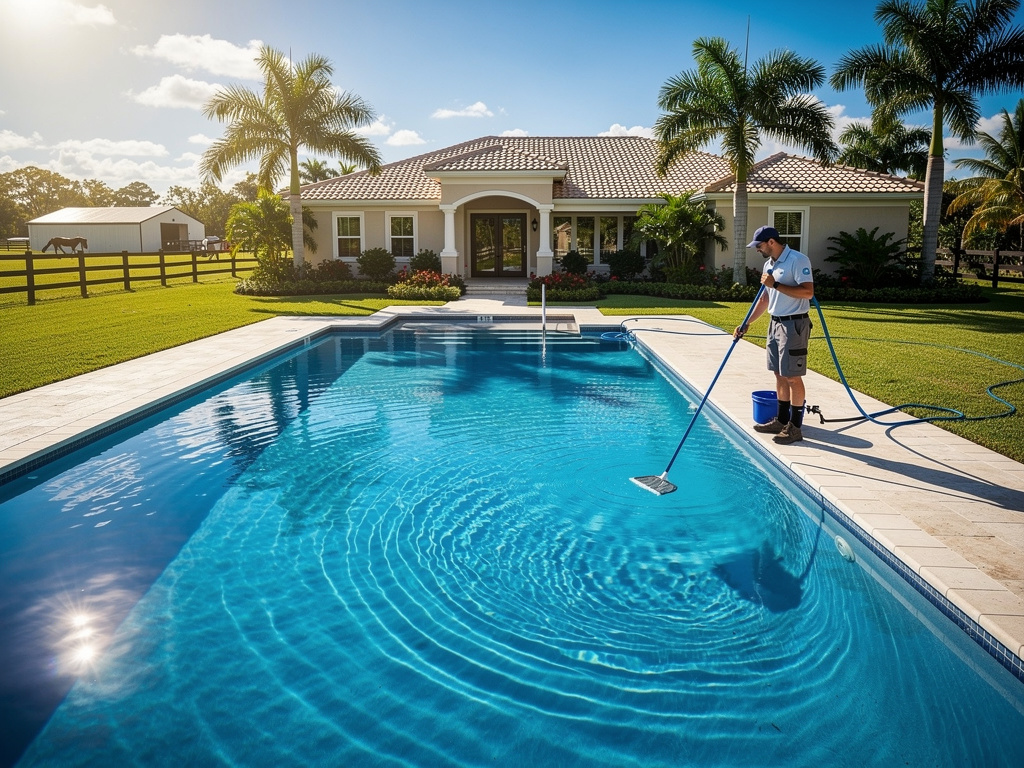
One of the genuine advantages of Davie’s large-lot character is the space to build pools that reflect how much outdoor living the property can accommodate. A 3-acre ranch property in Davie can support a pool with a genuine swim lane, a large shallow recreational zone, and a connected spa — the kind of pool that on a 9,000 square foot Plantation lot would cover the entire backyard. But as pool volume increases, management requirements scale accordingly.
At Pool Service Fort Lauderdale, we manage large-volume pools throughout Davie and apply volume-adjusted protocols that the pool’s actual size requires. This guide covers what changes when the pool is significantly larger than the suburban norm.
Volume-Adjusted Chemical Dosing
Every pool chemistry adjustment is calculated per-unit of pool volume. The key ratio: to raise or lower a chemistry parameter by a given amount, you need proportionally more chemical for more water. This is straightforward physics — but it is consistently misapplied by service providers who have intuitive “standard” dose amounts calibrated for 12,000-15,000 gallon residential pools.
Examples of volume-adjusted dosing for a 30,000 gallon Davie pool vs. a 15,000 gallon suburban pool:
- To raise free chlorine by 2 ppm: 15,000 gallon pool: 1 quart liquid chlorine (10% sodium hypochlorite). 30,000 gallon pool: 2 quarts. Applying 1 quart to the 30,000 gallon pool raises chlorine by only 1 ppm — under-treatment.
- Shock treatment for algae (target 10 ppm): 15,000 gallon pool: 2 lbs calcium hypochlorite. 30,000 gallon pool: 4 lbs. A service provider who shocks the 30,000 gallon pool with 2 lbs achieves only 5 ppm — insufficient to kill an established algae colony.
- pH adjustment (lower by 0.2 units): 15,000 gallon pool: 8 oz muriatic acid. 30,000 gallon pool: 16 oz. Under-dosing pH correction means the pH correction is incomplete and the process repeats at the next visit.
Turnover Rate and Pump Sizing
Pool turnover rate — the time required to filter the entire pool volume once — determines filtration effectiveness. Target: 8-hour turnover rate. For a 30,000 gallon Davie pool to achieve 8-hour turnover: minimum flow rate of 62.5 gallons per minute (30,000 ÷ 480 minutes = 62.5 GPM). A single standard 1.5 HP pump at typical operating head (40-50 feet) produces approximately 55-70 GPM — near the minimum adequate flow for this pool size. A 30,000 gallon pool with a single undersized pump has inadequate filtration — clarity and chemistry problems in low-circulation areas result.
VSP (variable-speed pump) sizing for large Davie pools: the higher-end VSP models (Pentair IntelliFlo3 VS, Hayward MaxFlo VS 2.7 HP) are designed to support the higher flow demands of larger residential pools. Running at the appropriately calibrated speed for the required GPM and operating head delivers the necessary turnover while capturing the VSP’s efficiency advantages over single-speed operation.
Filter Sizing for Large Davie Pools
A filter sized for a 15,000 gallon pool and a 60-80 GPM flow rate is undersized for a 30,000 gallon pool generating 62+ GPM of flow. Symptoms of an undersized filter on a large Davie pool: filter pressure climbs rapidly even after backwash; pool clarity is chronically poor despite adequate chemistry; filter backwash is required every 1-2 weeks rather than the 4-6 week interval that a properly-sized filter maintains. The correct solution is filter system sizing — not chemistry addition — for chronic clarity problems in large Davie pools where filtration is inadequate.
Balancing Chemistry Across the Full Pool Volume
In a very large Davie pool, chemical additions at the return jets may not distribute throughout the full pool volume before the next chemistry test is taken at the skimmer. On large pools, allow 30-60 minutes of pump operation after chemical additions before testing — this allows circulation to distribute the addition throughout the full pool volume and gives a representative test result rather than a reading influenced by the point of addition.
Pool Service Fort Lauderdale manages large-volume pools on Davie ranch properties with properly scaled protocols. Call (954) 501-2754 or visit our Davie pool service page. Full coverage at poolservicefortlauderdale.us.
Frequently Asked Questions
{“@context”:”https://schema.org”,”@type”:”FAQPage”,”mainEntity”:[{“@type”:”Question”,”name”:”How do I know how many gallons my large Davie pool holds?”,”acceptedAnswer”:{“@type”:”Answer”,”text”:”From pool construction documents (builder should have provided as-built specifications) or calculated from measurements. Rectangular/geometric pool: length × width × average depth × 7.48 = gallons. Freeform pools require the builder’s documented volume or a water meter approach during a controlled fill. Accurate volume is essential for correct chemical dosing — a 20% error in volume estimate translates to 20% under or over-dosing of every chemical addition. If construction documents are unavailable, contact the original pool builder or a pool service company for an estimation assessment.”}},{“@type”:”Question”,”name”:”What happens to a large Davie pool when chemical doses are too small for the volume?”,”acceptedAnswer”:{“@type”:”Answer”,”text”:”Consistent under-dosing in a large Davie pool produces: chlorine that drops to zero between service visits (insufficient dose for the volume) leading to algae growth; pH correction that’s incomplete (water remains acidic or basic after treatment); alkalinity and calcium adjustments that fall short of target; and shock treatments that don’t achieve the 10 ppm target needed to kill algae. The result looks like a pool that’s hard to maintain, but the actual problem is systematic under-dosing relative to actual volume.”}},{“@type”:”Question”,”name”:”Does a large Davie pool cost more to maintain than a standard pool?”,”acceptedAnswer”:{“@type”:”Answer”,”text”:”Yes — chemical costs scale with pool volume. A 30,000 gallon Davie pool requires approximately 2x the chemicals of a 15,000 gallon pool to achieve the same chemistry targets. Monthly chemical costs for a large Davie pool: $60-$120/month vs. $30-$60/month for a standard suburban pool. Service labor is typically similar (same visit frequency) but chemical costs are higher. The larger pool’s volume also means a partial drain for calcium or TDS correction is more expensive in water cost and time.”}},{“@type”:”Question”,”name”:”What pump is recommended for a 30,000 gallon pool in Davie?”,”acceptedAnswer”:{“@type”:”Answer”,”text”:”Pentair IntelliFlo3 VS (2.5 HP or 3 HP) or Hayward MaxFlo VS (2.7 HP) — high-flow VSP models rated for the 60-80+ GPM required for 8-hour turnover on a 30,000 gallon pool. The VSP must be programmed at the appropriate speed for the actual head pressure of the specific pool’s plumbing to achieve the target flow rate — not just set to ‘high’ and assumed to be providing adequate flow. A flow measurement at installation confirms the pump speed-to-GPM operating point.”}},{“@type”:”Question”,”name”:”Why does my large Davie pool look cloudy in some areas but clear in others?”,”acceptedAnswer”:{“@type”:”Answer”,”text”:”Localized cloudiness in a large pool (clear near returns, cloudy in the center or far end) typically indicates circulation dead spots — areas of the pool where water movement is insufficient for the return jet placement to reach. Chemistry additions circulate from return jets; areas not in the circulation path can have chemistry profiles that differ from the tested sample locations. Solutions: additional return jets to improve coverage; check that existing return jets are aimed to create circular circulation patterns; increase pump run time and speed to improve total flow. Pool circulation mapping by an experienced technician can identify dead spots.”}}]}
How to know how many gallons my large Davie pool holds? From construction documents or calculation: length × width × average depth × 7.48 = gallons for rectangular pools. Accurate volume is essential — 20% volume error = 20% dosing error on every chemical addition. Freeform pools: use builder’s documented volume or contact a pool service company for assessment.
What happens when chemical doses are too small for a large pool’s volume? Chlorine drops to zero between visits; pH correction is incomplete; shock treatments don’t reach algae-killing 10 ppm target. Looks like a pool that’s hard to maintain — the actual problem is systematic under-dosing relative to actual volume.
Does a large Davie pool cost more to maintain? Yes — chemical costs scale with volume. 30,000 gallon pool: $60-$120/month in chemicals vs $30-$60/month for a standard 15,000 gallon pool. Partial drain for calcium/TDS correction is also proportionally more expensive in water cost and time.
What pump for a 30,000 gallon Davie pool? Pentair IntelliFlo3 VS (2.5-3 HP) or Hayward MaxFlo VS (2.7 HP) — high-flow VSP models for 60-80+ GPM required for 8-hour turnover. Must be programmed at the correct speed for the actual head pressure to achieve target flow rate. Flow measurement at installation confirms the operating point.
Why is my large Davie pool cloudy in some areas but clear in others? Circulation dead spots — areas not in the return jet circulation path have different chemistry profiles than the tested sample location. Solutions: additional return jets, circulation pattern optimization, increased pump speed. Experienced technician can identify dead spots.