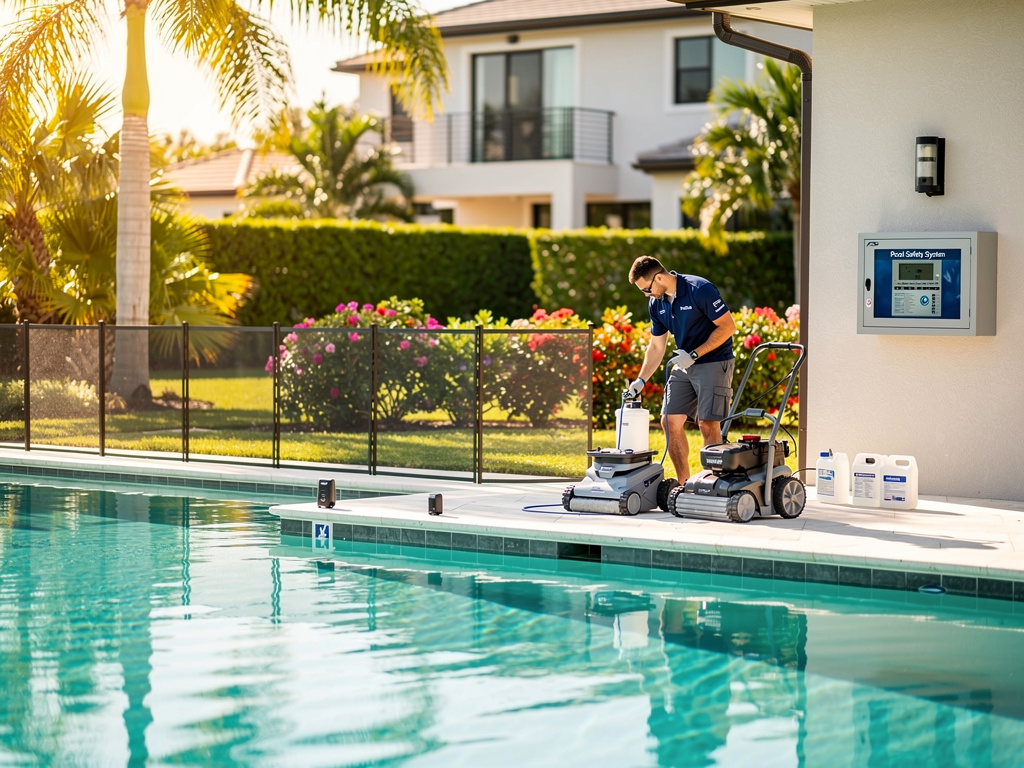
Child Safety in the Weston Family Culture
Weston FL’s family-oriented luxury community has one of the highest concentrations of children per household in South Florida’s affluent communities. The city specifically attracts young professional families who are at career peak earnings while raising children — and the community’s A-rated school district, family-focused amenities, and safe, master-planned environment reinforce this family demographic concentration. In practical terms, this means that Weston pools exist in an environment with a very high density of children of all ages — not just the pool-owning household’s children, but visiting children from neighbors, school friends, and extended family who gather regularly in Weston’s outdoor living environments.
Pool drowning is the leading cause of accidental death for children ages 1–4 in Florida, and Florida law reflects this reality: Florida Statute 515 requires residential pool barriers for pools where children under five may have access. In Weston’s family community, where young children are present in virtually every social gathering, pool safety measures are not just a legal requirement — they’re a community norm that Weston’s responsible parent culture takes seriously independent of the legal mandate.
Florida Pool Barrier Law in the Weston Context
Florida Statute 515 requires that residential pools have at least one of the following barrier types: a non-climbable fence or barrier at least 4 feet high enclosing the pool area, with self-closing and self-latching gates; a safety cover meeting ASTM F1346 standards; an approved pool alarm system; or direct access to the pool from the home only through self-closing, self-latching doors with alarms. In practice, most Weston homes use a combination of these layers — a barrier that meets the legal minimum plus additional alarm systems — because the layered approach provides redundancy that the single-barrier minimum cannot.
The minimum legal barrier in Weston is a 4-foot fence around the pool area with self-closing and self-latching gate. This standard is met by standard aluminum pool fencing — a product that is functional, code-compliant, and visually incompatible with Weston’s resort-quality pool aesthetic. A standard aluminum fence around a $150,000 custom pool installation in The Ridges reads as an aesthetic failure — and in Weston’s ARC-governed communities, the fence design and material are subject to ARC approval as a visible modification to the property’s outdoor environment.
Frameless Glass Pool Fencing: The Weston Aesthetic Solution
Frameless glass pool fencing — tempered glass panels set in stainless steel spigot or channel base fittings with minimal frame visibility — provides the same structural barrier as aluminum or wrought iron fencing while maintaining essentially complete visual openness through and around the pool barrier. A frameless glass pool barrier compliant with Florida Statute 515’s height and gate requirements satisfies the legal mandate entirely while preserving the visual continuity of the pool environment — guests entering the outdoor living space see the pool, not a fence.
Cost for frameless glass pool fencing in Weston’s market: $250–$400 per linear foot installed, depending on panel thickness, hardware specification, and site conditions. A typical 80-linear-foot pool barrier perimeter runs $20,000–$32,000 — a significant investment compared to $8,000–$12,000 for standard aluminum fencing of the same perimeter, but the visual difference is the difference between a resort pool environment and a suburban backyard. In Weston’s luxury property market, the $10,000–$20,000 premium for frameless glass fencing over aluminum is consistent with the overall investment philosophy of the property.
ARC approval for frameless glass pool fencing in most Weston communities is straightforward — the material is aesthetically superior to the alternatives and community ARCs generally receive it positively. The ARC application should include the glass specification (minimum 12mm tempered glass for pool barriers is typical), the hardware specification (316-grade marine stainless steel is appropriate for pool environments), and the installation contractor’s license and certification.
Motorized Safety Covers: The Premium Layer of Protection
A motorized automatic pool safety cover — Coverstar, CoverStar Eclipse, or similar — provides ASTM F1346-rated child protection (capable of supporting the weight of two adults and a child walking on the cover without submersion) while being completely invisible when not deployed. The cover stores in a recessed housing at one end of the pool and deploys in 30–90 seconds at the touch of a button, completely covering the pool surface. When the cover is open (stored), the pool looks exactly as it was designed to look; when the cover is closed, the pool is inaccessible and protected.
For Weston households who want the highest level of child protection without any visible barrier around the pool, a motorized safety cover combined with a pool alarm system (subsurface motion sensor) provides layered protection that exceeds any single-barrier approach. The cover prevents access entirely when closed; the alarm provides notification if the cover is inadvertently not deployed and someone enters the water. This combination is the safest and most aesthetically compatible configuration available for a Weston luxury pool.
Motorized safety cover cost: $8,000–$18,000 installed depending on pool size and cover mechanism configuration. This investment is entirely compatible with the Weston luxury pool budget and provides functionality (clean pool when not in use, reduced chemical demand from UV blocking when covered) beyond the safety benefit.
In-Pool and Perimeter Alarm Systems
Florida Statute 515 accepts approved pool alarm systems as one of the required barrier layers. Subsurface wave sensors (Safety Turtle, Lifebuoy) detect water disturbance when an object enters the pool and trigger both an in-pool alert and an audible alarm in the home. Perimeter alarms (Safety Turtle wristband systems for small children) trigger when the wristband-wearing child enters the pool area or pool. Both technologies provide notification-based protection — they alert adults that an entry has occurred, rather than physically preventing entry as a cover or barrier does.
In Weston’s family-luxury context, pool alarms serve best as supplemental layers alongside a primary physical barrier — frameless glass fencing or safety cover — rather than as the sole protection mechanism. The combination of physical barrier (which prevents entry) and alarm (which alerts if the barrier is somehow bypassed) provides redundant protection appropriate to the actual risk in a community with Weston’s family demographics.
Pool Service Fort Lauderdale provides pool safety consultation and compliance guidance throughout Weston FL. Call (954) 501-2754, visit our Weston pool service page, or see our full website. 9900 W Sample Rd, Coral Springs, FL 33065.
{“@context”:”https://schema.org”,”@type”:”FAQPage”,”mainEntity”:[{“@type”:”Question”,”name”:”What pool barrier options meet both Florida law and Weston FL’s aesthetic standard?”,”acceptedAnswer”:{“@type”:”Answer”,”text”:”Frameless glass pool fencing ($250–$400 per linear foot) satisfies Florida Statute 515’s barrier requirements while maintaining visual openness through and around the pool. Motorized automatic safety covers (Coverstar) provide ASTM F1346-rated child protection with zero visual impact when open and complete pool coverage when deployed. Both options meet Florida law; both are aesthetically compatible with Weston’s luxury pool standard. Standard aluminum fencing meets the law but not Weston’s visual expectations.”}},{“@type”:”Question”,”name”:”Does Florida law require a fence around my Weston FL pool?”,”acceptedAnswer”:{“@type”:”Answer”,”text”:”Florida Statute 515 requires residential pool barriers where children under five may have access. At least one barrier layer is required: a non-climbable fence (4+ feet, self-closing/latching gates); a safety cover meeting ASTM F1346; an approved alarm system; or direct home access only through alarmed, self-latching doors. Most Weston safety-conscious households use multiple layers — a physical barrier plus alarm systems — for redundancy.”}},{“@type”:”Question”,”name”:”What does a motorized pool safety cover cost in Weston FL?”,”acceptedAnswer”:{“@type”:”Answer”,”text”:”$8,000–$18,000 installed depending on pool size and cover mechanism configuration. The cover stores in a recessed housing and deploys in 30–90 seconds, completely covering the pool. ASTM F1346-rated — capable of supporting the weight of two adults and a child without submersion. Provides child protection with zero visual impact when open, and reduces chemical demand by blocking UV when the pool is not in use.”}},{“@type”:”Question”,”name”:”What is frameless glass pool fencing and do Weston FL HOAs approve it?”,”acceptedAnswer”:{“@type”:”Answer”,”text”:”Frameless glass pool fencing uses tempered glass panels (typically 12mm minimum) in stainless steel hardware with minimal frame visibility, providing a structural pool barrier that’s visually transparent. Most Weston ARCs receive glass fencing positively — it’s aesthetically superior to alternatives. ARC application should include glass specification, hardware spec (316-grade marine stainless), and installer certification.”}},{“@type”:”Question”,”name”:”What pool alarm systems are appropriate for Weston FL family pools?”,”acceptedAnswer”:{“@type”:”Answer”,”text”:”Subsurface wave sensors detect water disturbance and trigger in-pool and home alarms. Perimeter wristband systems (Safety Turtle) alarm when a wristband-wearing child enters the pool or pool area. Both work best as supplemental layers alongside a primary physical barrier (frameless glass fence or safety cover) — they provide notification if the barrier is bypassed, not physical prevention of entry.”}]}}