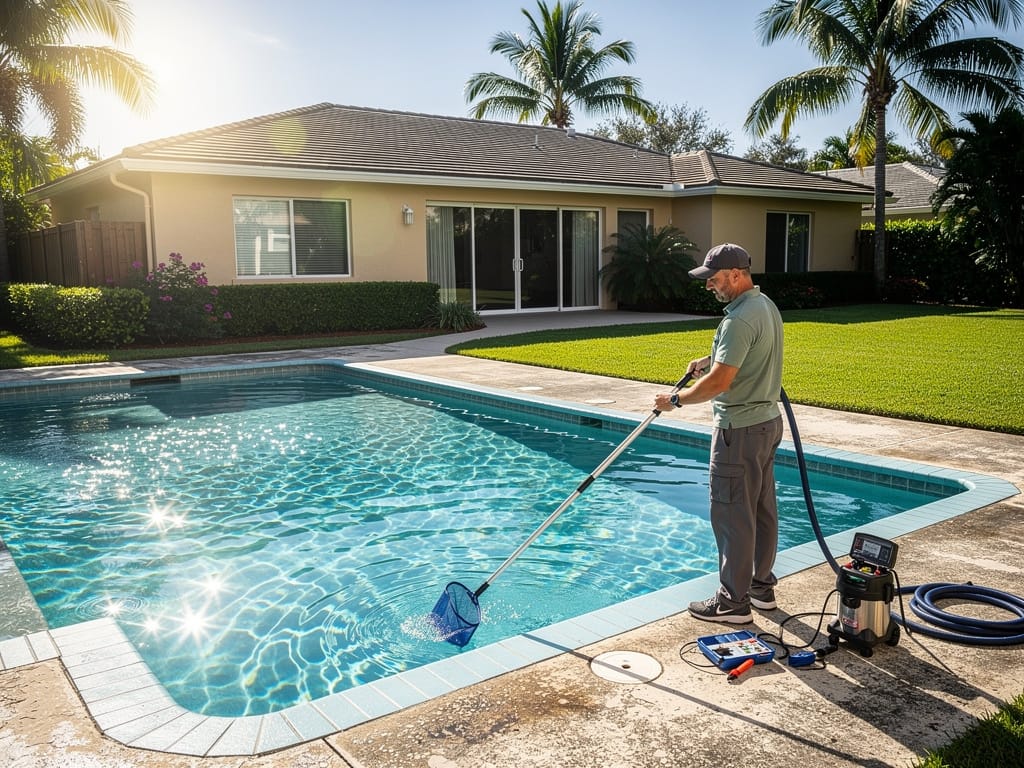
Parkland’s estate pool market features pools that by volume dwarf typical South Florida residential installations. When pools include multiple water bodies (main pool, spa, wading area, catch basin for negative edge), the total managed water volume can reach 60,000-70,000 gallons — comparable to a small commercial pool. Yet these pools are serviced within residential pool service frameworks that may not account for the volume-scaling differences that this scale requires.
At Pool Service Fort Lauderdale, we manage large-volume pool systems for Parkland estate properties and understand the technical requirements that distinguish large-volume service from standard residential maintenance. This guide covers the key differences.
Turnover Rate — The Foundation of Large-Volume Pool Management
Pool turnover rate is the time required for the entire pool volume to pass through the filtration system once. For residential pools, the standard target is 6-8 hour turnover (the complete pool volume filtered in 6-8 hours). This ensures adequate filtration efficiency and chemistry distribution.
Turnover rate is determined by: pool volume (gallons) ÷ pump flow rate (gallons per minute × 60). For a 40,000 gallon pool to achieve 8-hour turnover, the system needs to move: 40,000 ÷ 480 minutes = 83.3 gallons per minute through the filter. A standard 2.0 HP pump produces approximately 65-90 GPM at typical head — near the minimum for this turnover requirement, and that’s without accounting for head loss from long plumbing runs, multiple return lines, and water features.
Large Parkland estate pools may require:
- Multiple pumps in parallel to achieve adequate combined flow rate
- Oversized filter systems (multiple cartridge or DE filter units) matched to the required flow rate
- Careful hydraulic engineering during construction to minimize head loss and maximize pump efficiency at the required GPM
Chemical Dosing for Large-Volume Parkland Pools
Chemical doses for pool water adjustments are calculated per 10,000 gallons of pool volume. Service providers who memorize a “standard” amount per treatment without adjusting for actual pool volume will consistently under-dose large Parkland estate pools — adding 1 lb of chemical to a 40,000 gallon pool achieves 1/3 the concentration change that the same 1 lb produces in a 13,000 gallon pool.
Practical implications:
- Chlorine dosing: A 40,000 gallon pool needs 4x the liquid chlorine to achieve the same ppm increase as a 10,000 gallon pool. Maintaining adequate chlorine in a large-volume pool requires accurately scaled dosing, not estimates.
- pH adjustment: Muriatic acid to lower pH by 0.2 units in a 40,000 gallon pool: approximately 32 oz (1 quart). In a 10,000 gallon pool: 8 oz. Under-dosing pH correction in large pools is the most common chemistry maintenance error.
- Shock treatment: A meaningful shock treatment in a 40,000 gallon pool requires 4 lbs of calcium hypochlorite (or equivalent) to achieve a 10 ppm chlorine elevation — service providers accustomed to standard pool volumes may add 1 lb and consider it done, achieving only 2.5 ppm elevation.
Filter Sizing and Maintenance for Large-Volume Pools
A filter sized for a 15,000 gallon pool running at its rated capacity becomes undersized when servicing a 40,000 gallon pool — the filter doesn’t turn over the full volume on schedule, debris accumulates in the water rather than being captured in the filter, and filter backwash frequency increases disproportionately as the filter processes more volume per cycle. Large Parkland estate pools require filter systems specifically sized and paired to the total pool volume and target flow rate.
Filter inspection for large-volume pools should include: current operating pressure, comparison to clean-filter baseline, flow rate verification (at the pump), and scheduled backwash or cleaning regardless of pressure if the pool has seen significant bather load or debris events.
Volume Tracking and Partial Drains
Large-volume pools accumulate TDS, calcium, and CYA more slowly than small pools in absolute terms, but the cost of correction (partial drain) scales with volume. A 30% partial drain on a 40,000 gallon pool removes and replaces 12,000 gallons — a meaningful water disposal and refilling expense. Proactive chemistry management that prevents calcium and TDS from exceeding threshold levels is particularly important for large Parkland estate pools where the correction is expensive and disruptive.
Pool Service Fort Lauderdale manages large-volume pool systems for Parkland estate properties with properly scaled chemistry protocols and equipment sizing. Call (954) 501-2754 or visit our Parkland pool service page. Full coverage at poolservicefortlauderdale.us.
Frequently Asked Questions
{“@context”:”https://schema.org”,”@type”:”FAQPage”,”mainEntity”:[{“@type”:”Question”,”name”:”How do I know how many gallons my Parkland estate pool holds?”,”acceptedAnswer”:{“@type”:”Answer”,”text”:”Pool volume can be calculated from construction documents (pool builder should have provided as-built dimensions) or estimated from measurements. For a rectangular pool: length × width × average depth × 7.48 = gallons. For freeform pools, the calculation is more complex and may require the builder’s records or a water meter approach (measuring water added during a controlled fill). Accurate pool volume is essential for correct chemical dosing and turnover rate calculation — estimate errors in large pools translate to significant dosing errors.”}},{“@type”:”Question”,”name”:”What pump and filter setup is needed for a 40,000 gallon Parkland estate pool?”,”acceptedAnswer”:{“@type”:”Answer”,”text”:”For a 40,000 gallon pool achieving 8-hour turnover: minimum flow rate of 83 GPM required. This typically requires: one or two high-flow VSPs (2-3 HP each, with variable speed to optimize the GPM vs head pressure operating point), and filter capacity matched to the flow rate — typically two large cartridge or DE filter units in parallel, each rated for 100+ GPM. Single standard residential pump and filter configurations are typically insufficient at this volume.”}},{“@type”:”Question”,”name”:”How much chlorine does a 40,000 gallon Parkland estate pool need per week?”,”acceptedAnswer”:{“@type”:”Answer”,”text”:”Chlorine demand scales with pool volume. For a 40,000 gallon pool with regular family use in South Florida summer: weekly free chlorine maintenance typically requires 2-4 gallons of liquid chlorine (10% sodium hypochlorite) or equivalent, compared to 0.5-1 gallon for a 10,000 gallon pool. Actual demand varies by bather load, sun exposure (UV degradation), and whether the pool has a saltwater chlorine generator supplementing manual dosing.”}},{“@type”:”Question”,”name”:”Why does my large Parkland estate pool seem to need constant chemistry correction?”,”acceptedAnswer”:{“@type”:”Answer”,”text”:”If chemistry corrections seem insufficient in a large Parkland pool, the most likely cause is under-dosing relative to pool volume. Service providers accustomed to 15,000 gallon pools may apply standard doses that achieve 1/3 to 1/4 the intended concentration change in a 40,000-50,000 gallon pool. Request that your service provider document their dose calculations based on your actual pool volume and confirm the dosing schedule is volume-adjusted, not estimated from standard residential experience.”}},{“@type”:”Question”,”name”:”How often should a large Parkland estate pool be partially drained?”,”acceptedAnswer”:{“@type”:”Answer”,”text”:”Typically every 2-3 years for a large-volume estate pool with good chemistry management, vs every 1-2 years for a standard 15,000 gallon pool. Large-volume pools accumulate TDS and calcium more slowly per gallon (slower concentration rate), but the partial drain event itself is more expensive and water-intensive at 30,000+ gallon scale. Proactive chemistry management that tracks calcium and TDS monthly and identifies drift trends early is particularly cost-effective for large Parkland estate pools.”}}]}
How to know pool volume? From construction documents (as-built specs) or measurement: length × width × average depth × 7.48 = gallons for rectangular pools. Freeform pools require construction records or a water meter fill measurement. Accurate volume is essential for correct chemical dosing.
What pump/filter setup for a 40,000 gallon pool? Minimum 83 GPM for 8-hour turnover. Typically requires two high-flow VSPs (2-3 HP each) and two large DE or cartridge filter units in parallel rated 100+ GPM each. Single standard residential configurations are insufficient.
How much chlorine does a 40,000 gallon pool need weekly? 2-4 gallons of liquid chlorine (10% sodium hypochlorite) in South Florida summer — vs 0.5-1 gallon for a 10,000 gallon pool. Scales proportionally with volume and bather load.
Why does chemistry seem to need constant correction? Most likely under-dosing relative to actual volume. Service providers calibrated for 15,000 gallon pools apply doses that achieve 1/4 the intended effect in a 40,000-50,000 gallon pool. Require volume-adjusted dose documentation from your service provider.
How often to partially drain a large estate pool? Every 2-3 years with good chemistry management — large volume accumulates TDS and calcium more slowly per gallon. Partial drain at this scale is expensive and water-intensive; proactive monthly TDS/calcium monitoring makes it avoidable for longer periods.