Where Miramar’s Water Comes From
Miramar’s drinking water is supplied by the City of Miramar Utilities, which draws from the Biscayne Aquifer — one of the most productive freshwater aquifers in the United States and the primary water source for most of South Florida’s municipalities. The Biscayne Aquifer is a shallow, unconfined aquifer embedded in the porous limestone formations that underlie Broward County. Because the aquifer sits within and draws from limestone, the water it produces is naturally hard — calcium and magnesium ions leach into the water as it percolates through the aquifer’s carbonate rock formations.
After drawing from the aquifer, Miramar’s water utility treats the water to meet Safe Drinking Water Act standards before distribution. Treatment includes filtration, disinfection, and pH adjustment. By the time the water reaches a residential tap, the calcium hardness typically runs 200–350 ppm — on the higher end of what pool chemistry professionals consider the “comfortable” baseline range of 150–400 ppm, but within it. Total alkalinity similarly runs on the moderate-to-high side.
What Hard Fill Water Means for Your Miramar Pool
Calcium hardness is important in pool chemistry because water seeks equilibrium — it will either deposit calcium onto pool surfaces (scaling) or strip calcium from pool surfaces (etching) depending on the relationship between its calcium content, pH, alkalinity, and temperature. The Langelier Saturation Index (LSI) is the standard measure of this equilibrium: a positive LSI means the water is scale-forming; a negative LSI means it’s corrosive.
Fill water with calcium hardness of 300 ppm, total alkalinity of 100 ppm, and a pH of 7.5 at Miramar’s warm water temperatures has a positive LSI — meaning it tends toward scaling from day one. As the pool evaporates through Miramar’s hot, sunny summers and the fill water is topped off repeatedly without replacing the dissolved minerals that don’t evaporate with the water, calcium and alkalinity concentrations rise. A pool that started at 300 ppm calcium hardness in January may reach 450–500 ppm by September without any deliberate calcium addition, simply from evaporative concentration.
At calcium hardness above 400 ppm, scale deposits on tile grout, plaster surfaces, and equipment heat exchangers become significantly more likely. The tile line is the first place to show calcium scale in Miramar pools — the white or gray mineral crust at the water line that requires periodic acid washing to remove. Equipment scaling — inside heater heat exchangers and salt cell plates — reduces efficiency and shortens equipment life.
Sequestrant at Fill: A Miramar Best Practice
When filling or significantly refilling a Miramar pool, adding a sequestering agent (sometimes called a chelating agent or scale inhibitor) before adding any chlorine is a best practice that prevents early mineral precipitation. Sequestrants work by chemically binding to dissolved calcium and metal ions, keeping them in solution rather than allowing them to precipitate onto surfaces when pH or temperature changes create favorable scaling conditions.
The sequestrant dose at fill is based on pool volume and the specific product’s instructions. Common pool sequestrants include brands marketed as “Scale and Stain Prevent,” “Metal Out,” “Natural Chemistry Scale Free,” or similar names. The active ingredient category is phosphonic acid derivatives. One caveat: phosphonate-based sequestrants can raise pool phosphate readings temporarily after dosing, which in a Miramar lakefront pool where phosphates are already a concern should be taken into account when scheduling a phosphate test.
After the initial fill dose, a maintenance dose of sequestrant monthly — particularly through Miramar’s dry season when evaporation and concentration rates are highest — maintains the sequestrant’s protection as it gradually breaks down. Sequestrant is consumed over time (by UV, by chlorine, and by natural degradation) and needs regular replenishment to remain effective.
TDS Accumulation Over Time
Total Dissolved Solids (TDS) is the cumulative measure of all dissolved minerals, salts, and compounds in pool water. In a pool that is never partially drained, TDS rises over time as fill water is added to replace evaporation. The minerals that come in with the fill water stay in the pool even as water molecules evaporate — a classic concentration mechanism. In Miramar’s climate where evaporation rates are high year-round, TDS can rise significantly over 2–3 years.
High TDS (above 2,000–2,500 ppm in a non-salt pool; above 6,000 ppm in a saltwater pool) creates several problems: the water becomes a less efficient reaction medium for chemicals, chlorine effectiveness is slightly reduced, and the water can develop a “flat” taste and reduced visual clarity even when chemistry parameters are otherwise correct. The standard remedy is a partial drain-and-refill — replacing 20–30% of the pool volume with fresh fill water once per year. This dilutes accumulated TDS, calcium, CYA, and other accumulating compounds without requiring a full drain that risks pool shell hydrostatic issues.
In Miramar, the best time for a partial drain-and-refill is during the October–November period, after the rainy season has ended and before water restrictions that sometimes accompany dry-season drought conditions. This timing also provides a reset on CYA levels before the winter months, which is useful for pools on tablet programs that have been accumulating CYA through the summer season.
Testing Practices for Miramar’s Higher-Mineral Water
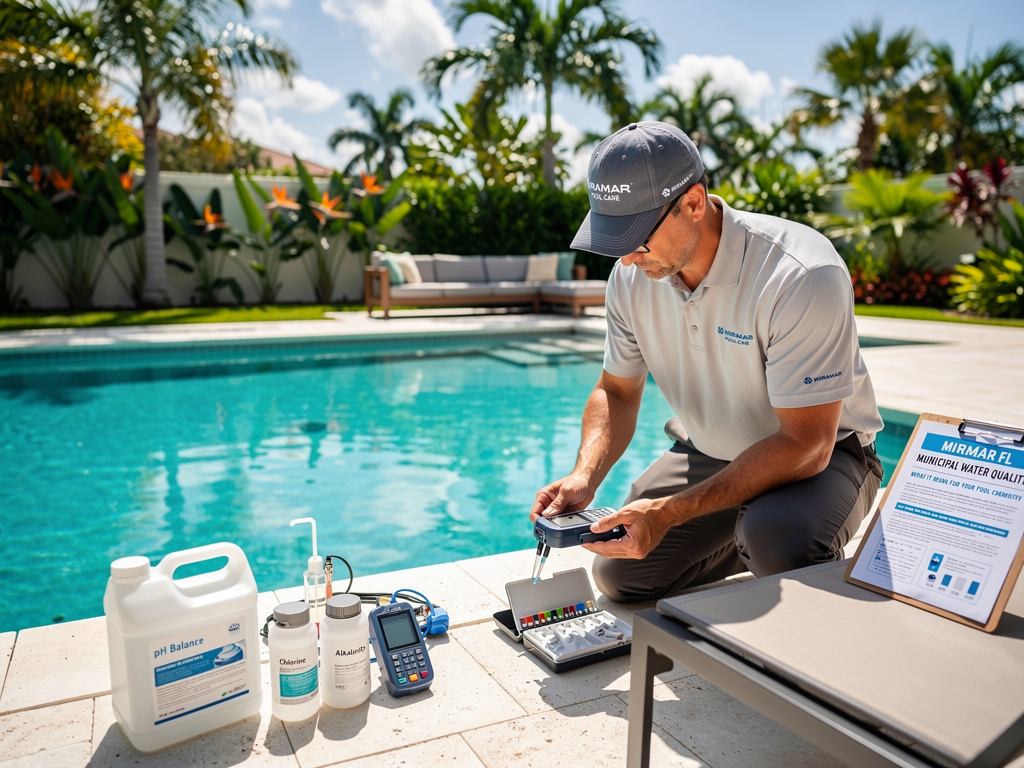
Because Miramar’s fill water has higher baseline mineral content than many homeowners expect, more complete chemistry testing is appropriate here than in regions with softer water. Standard basic test strips measure chlorine and pH but do not measure calcium hardness, TDS, or cyanuric acid. For Miramar pool owners, monthly testing at a pool supply store that offers comprehensive water analysis (or using a five-way or six-way drop test kit at home) provides the complete picture needed to manage scaling tendency and CYA accumulation proactively.
The specific parameters to track monthly for a Miramar pool are: free chlorine, total chlorine, pH, total alkalinity, calcium hardness, and cyanuric acid. Twice yearly, adding a metals test (iron, copper) and a TDS reading provides a fuller picture of water quality trends. Some pool supply stores in the Miramar area provide free comprehensive water testing — the investment of 15 minutes twice per year to get a full panel prevents the much larger investment of correcting advanced scaling or replacing damaged equipment.
Pool Service Fort Lauderdale provides water chemistry consulting and management throughout Miramar FL. Call (954) 501-2754, visit our Miramar pool service page, or see our main website. 9900 W Sample Rd, Coral Springs, FL 33065.
{“@context”:”https://schema.org”,”@type”:”FAQPage”,”mainEntity”:[{“@type”:”Question”,”name”:”Is Miramar FL’s tap water hard and does it affect pool chemistry?”,”acceptedAnswer”:{“@type”:”Answer”,”text”:”Yes. Miramar’s water from the Biscayne Aquifer typically has calcium hardness of 200–350 ppm, which is moderate-to-high for pool fill water. This creates a positive Langelier Saturation Index (scale-forming tendency) from the first fill, which is why sequestrant at fill and monthly maintenance doses are recommended for Miramar pools.”}},{“@type”:”Question”,”name”:”What is TDS and why does it build up in Miramar pools?”,”acceptedAnswer”:{“@type”:”Answer”,”text”:”Total Dissolved Solids (TDS) is the cumulative measure of all dissolved minerals in pool water. In Miramar’s high-evaporation climate, water molecules leave the pool but dissolved minerals don’t — concentrating over time. Annual partial drain-and-refill (20–30% of water volume) dilutes TDS accumulation without requiring a full drain.”}},{“@type”:”Question”,”name”:”What is a sequestrant and when should I add it to a Miramar pool?”,”acceptedAnswer”:{“@type”:”Answer”,”text”:”A sequestrant (chelating agent) keeps dissolved calcium and metals in solution rather than letting them precipitate onto surfaces. Add it when filling or significantly refilling a Miramar pool before adding chlorine, and as a monthly maintenance dose during the dry season when evaporative concentration is highest.”}},{“@type”:”Question”,”name”:”When is the best time for a partial drain-and-refill in Miramar FL?”,”acceptedAnswer”:{“@type”:”Answer”,”text”:”October–November, after the rainy season ends and before potential dry-season water restrictions. This also resets CYA levels after a summer of tablet chlorination, and refreshes calcium hardness and TDS that has concentrated through the summer evaporation period.”}},{“@type”:”Question”,”name”:”What pool chemistry tests are most important in Miramar FL?”,”acceptedAnswer”:{“@type”:”Answer”,”text”:”Monthly: free chlorine, pH, total alkalinity, calcium hardness, and cyanuric acid. Semi-annually: add iron/copper metals panel and TDS reading. Standard basic test strips (chlorine + pH only) are insufficient for Miramar’s higher-mineral water environment — calcium hardness and CYA need to be tracked separately.”}]}}