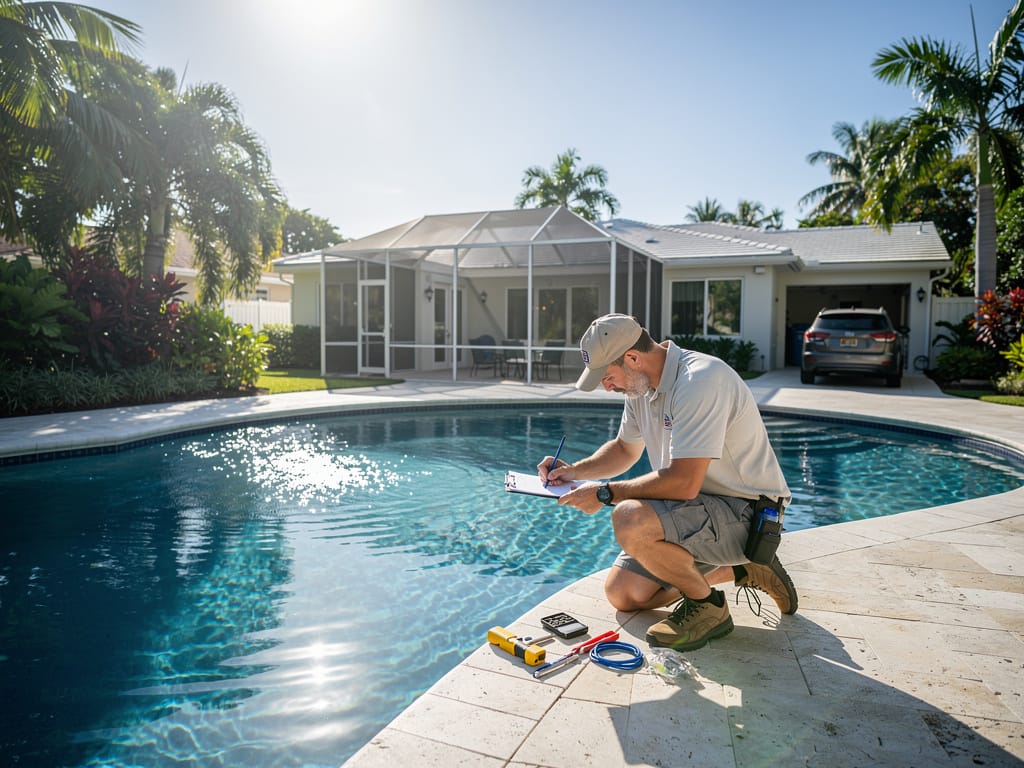
Hallandale Beach draws buyers from across the country and internationally — drawn by the beach, Gulfstream Park’s entertainment and racing destination, the Aventura proximity, and the appeal of A1A condo living. For buyers unfamiliar with South Florida pool ownership, the coastal environment and climate create pool maintenance demands and equipment wear patterns that differ significantly from northern markets.
At Pool Service Fort Lauderdale, we perform pre-purchase pool assessments throughout Hallandale Beach and work with buyers’ agents who refer clients purchasing in the Gulfstream Park area, the A1A corridor, and the established neighborhoods west of US-1. This guide covers what to look for before you close on a Hallandale Beach property with a pool.
The Hallandale Beach Pool Market: What Buyers Find
Hallandale Beach’s pool stock divides roughly into two categories:
Condo and high-rise shared pools: If you’re buying into one of Hallandale’s A1A towers, the pool is the building’s responsibility — maintained and operated under commercial pool code by the HOA. Your due diligence here is evaluating the building’s HOA pool compliance (current operating permit, last inspection date, reserve fund adequacy for equipment replacement).
Private residential pools: Single-family homes and townhomes throughout Hallandale Beach’s west side — neighborhoods around Gulfstream Park, the Hollywood Hills border communities, and the residential areas south toward Aventura — have private in-ground pools ranging from recent construction to 40+ year-old installations. These pools warrant individual inspection before purchase.
What Accelerates Wear in Hallandale Beach Pools
Three factors make pool condition assessment in Hallandale Beach different from non-coastal markets:
Salt Air Corrosion
As covered in our equipment corrosion guide, Hallandale Beach’s coastal location accelerates wear on pump motors, control boards, electrical connections, and heater components. A 6-year-old pump motor in Hallandale Beach may have the condition of a 10-year-old motor in an inland suburb. When inspecting pool equipment, the age listed in a disclosure is less informative than the current condition assessment — particularly for corrosion-sensitive components.
Hard Water Chemistry History
Broward County’s hard water (200-350 ppm calcium hardness) combined with South Florida’s high evaporation rate creates chronic calcium scaling pressure on pool surfaces and tile. Pools with a history of poor pH management tend to show calcium scale buildup on tile and surfaces, or alternatively (if pH was chronically low) etched and roughened plaster. Surface condition indicates the chemistry management history and the remaining service life before resurfacing is needed.
Year-Round Operation
Florida pools run year-round — there’s no winter rest period where evaporation, UV, and chemical demand pause. This means Hallandale Beach pool equipment and surfaces accumulate operational hours faster than northern pools of the same calendar age. A 15-year-old Hallandale Beach pool has been running continuously for 15 years; a 15-year-old Minnesota pool has been drained and dormant for half that time.
Key Inspection Points for Hallandale Beach Pool Purchases
Structural Shell and Leak Assessment
Ask about water loss history. Losing more than 1/4 inch per day (beyond normal evaporation of about 1/4 inch per day) indicates a structural or plumbing leak. Sellers may not know their pool leaks if they’ve had continuous water auto-fill — the fill unit compensates automatically and the loss isn’t obvious. Request that the auto-fill valve be closed for 48-72 hours before your inspection to assess water loss without the fill masking it.
Surface Condition and Remaining Life
Run your hand along the pool wall below the waterline. Smooth texture indicates a surface in reasonable condition; sandpaper-rough texture indicates significant etching or calcium buildup. Both indicate accelerated service life consumption. For Hallandale Beach pools older than 10 years, ask specifically about resurfacing history — if the pool has never been resurfaced and the surface looks worn, budget $5,000-$12,000 for resurfacing in your purchase calculation.
Equipment Age and Corrosion Condition
Look at pump motor housing for rust streaking, visible corrosion at conduit fittings, and oxidation on panel enclosure interiors. A motor showing visible external corrosion is typically within 1-3 years of failure. Check automation panel internals — if accessible without disassembly, look for green oxidation on circuit board components. Budget $1,000-$2,500 for equipment that is visibly corroding if you’re comfortable with the property otherwise.
Electrical Safety and Bonding
Request that the inspector test pool bonding continuity. Bonding system failures are common in older Hallandale Beach pools and create electric shock risk in the water. Verify GFCI protection at pool circuit breakers and confirm VGB-compliant drain covers are installed and in good condition — required by federal law.
HOA Compliance Documentation (Condo Purchases)
For condo purchases, request the most recent Broward County Health Department pool inspection report, the current operating permit, and evidence of recent drain cover replacement. A well-run building can produce these immediately. Gaps in documentation are a due diligence concern.
Pool Service Fort Lauderdale performs pre-purchase pool assessments throughout Hallandale Beach and delivers written reports suitable for purchase negotiations. Call (954) 501-2754 or visit our Hallandale Beach service page. Coverage areas at poolservicefortlauderdale.us.
Frequently Asked Questions
{
“@context”: “https://schema.org”,
“@type”: “FAQPage”,
“mainEntity”: [
{
“@type”: “Question”,
“name”: “Do I need a pool inspection separate from the general home inspection in Hallandale Beach?”,
“acceptedAnswer”: {
“@type”: “Answer”,
“text”: “Yes. General home inspectors perform only a surface-level pool evaluation. For Hallandale Beach purchases, a qualified pool inspector specifically assesses structural integrity, surface condition and remaining life, equipment wear from salt air corrosion, electrical bonding safety, and compliance requirements — none of which a general inspection covers adequately.”
}
},
{
“@type”: “Question”,
“name”: “What is the most common deferred maintenance finding in Hallandale Beach pool purchases?”,
“acceptedAnswer”: {
“@type”: “Answer”,
“text”: “Pool surface deterioration needing resurfacing is the most common significant finding ($5,000-$12,000). Salt air corrosion-related equipment wear (pump motor, control board) is the second most common. Bonding system deficiencies are less frequent but represent the most significant safety risk when found.”
}
},
{
“@type”: “Question”,
“name”: “How do I check if a Hallandale Beach pool has a leak before closing?”,
“acceptedAnswer”: {
“@type”: “Answer”,
“text”: “Ask the seller to close the auto-fill valve for 48-72 hours before your pool inspection. Without auto-fill compensating, water loss beyond normal evaporation (about 1/4 inch per day) becomes visible. A professional leak detection test can then identify whether the leak is in the shell, plumbing, or equipment connections.”
}
},
{
“@type”: “Question”,
“name”: “What should I ask about a Hallandale Beach condo pool before buying?”,
“acceptedAnswer”: {
“@type”: “Answer”,
“text”: “Request: the most recent Broward County Health Department pool inspection report, the current operating permit, evidence of recent VGB drain cover replacement, and the HOA’s reserve fund balance for pool equipment replacement. A well-managed building produces these immediately. Missing documentation is a due diligence concern.”
}
},
{
“@type”: “Question”,
“name”: “How much should I budget for pool costs when buying a home in Hallandale Beach?”,
“acceptedAnswer”: {
“@type”: “Answer”,
“text”: “Annual operating costs: $1,200-$2,000 for weekly professional service. Immediate deferred maintenance (if any): resurfacing $5,000-$12,000, equipment replacement $1,000-$3,000 per component. Salt air corrosion inspection and protection: $200-$500 annually. Budget these into your purchase financial model before closing.”
}
}
]
}
Do I need a separate pool inspection? Yes — general inspectors don’t cover bonding safety, surface life, salt air equipment wear, or condo pool compliance adequately.
Most common deferred maintenance finding? Pool surface deterioration needing resurfacing ($5,000-$12,000), followed by equipment corrosion damage.
How to check for a leak before closing? Ask seller to close the auto-fill valve for 48-72 hours before inspection — water loss beyond evaporation becomes visible without the fill masking it.
What to ask about a condo pool? Request the last county inspection report, current operating permit, drain cover replacement records, and HOA pool reserve balance.
What are annual pool costs in Hallandale Beach? $1,200-$2,000/year for weekly service. Budget separately for deferred maintenance findings and salt air corrosion protection.