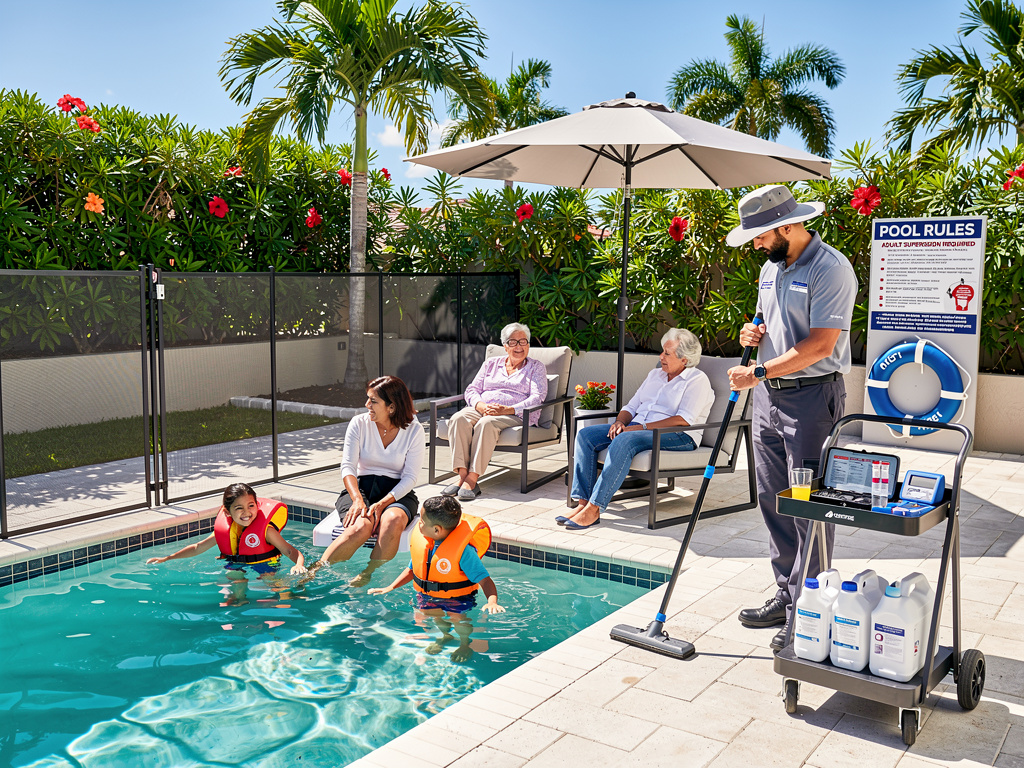
The Multigenerational Pool Safety Challenge
Pembroke Pines’ demographic mix — large families with children and a significant retiree population, often in the same household through the multigenerational living arrangements common in Venezuelan and Colombian, Haitian, and other immigrant communities — creates a pool safety challenge that is rarely addressed in standard pool safety guidance. Most pool safety education focuses on one demographic at a time: drowning prevention for young children, or accessibility and fall prevention for older adults. In a Pembroke Pines multigenerational household, both risk categories are present simultaneously, and the safety measures that address one don’t automatically address the other.
The statistical risk profile differs significantly by age. For children under 5, the primary pool hazard is drowning — silent, rapid, and possible with just a few inches of water and a few minutes of unsupervised access. For adults over 65, the primary pool hazards are falls (at deck level during entry and exit, where wet surfaces and fatigue combine), cardiac events (particularly during vigorous aquatic exercise in warm water), and the general challenge of pool entry and exit for users with reduced strength and balance. Both risk categories are serious; neither is rare in the Pembroke Pines pool environment.
Child Protection: The Passive Barrier Layer
Passive barriers — physical obstacles that protect regardless of whether anyone is actively watching — are the foundation of child drowning prevention in any Pembroke Pines pool household. In a multigenerational family where adult attention may be divided between caregiving responsibilities at multiple ends of the age spectrum (caring for toddlers while also attending to an elderly parent’s needs), passive barriers provide the protection layer that supervision alone cannot guarantee.
The minimum Florida-compliant barrier — a 48-inch fence with self-closing, self-latching gate — provides the baseline protection. For Pembroke Pines multigenerational households, additional layers are worthwhile: a pool alarm that triggers when the pool surface is broken (adds approximately $200–$400), a door alarm on any home door that accesses the pool area (required by Florida law if using the door alarm compliance option; worthwhile as an additional layer even with a perimeter fence), and pool surface safety covers for any extended period when the pool is not in active use by a supervised party.
Gate latch height and complexity deserve attention in households with older toddlers. Standard self-latching gates are designed to prevent access by toddlers under approximately 3 years old. A determined 4- or 5-year-old can sometimes defeat a standard spring latch if they can reach it. In households where the children are in the 3–6 year range — old enough to be curious about the pool but not old enough to be safe without supervision — a double-action latch (requiring two simultaneous movements to open) or a latch with a combination code provides additional security against determined young climbers.
Senior Safety: Falls, Entry, and Emergency Response
The fall risk for older adults at a Pembroke Pines pool is highest at three specific locations: the transition from the home’s interior floor to the exterior deck (often a threshold step), the deck surface immediately adjacent to the pool edge, and the pool steps themselves. Non-slip surface treatment at each of these locations — particularly the pool deck, where wet feet and wet concrete create the highest-friction-deficit condition — is the most cost-effective structural fall prevention investment for a senior-use pool.
Full handrails at pool steps — not merely a standard two-post railing but a continuous handrail on both sides of the steps from deck level to the bottom step — allow seniors to control their descent and ascent with both hands when needed. The standard one-post pool handrail requires the user to transfer between the rail and the pool edge with one hand free — a maneuver that’s trivial for healthy adults but challenging for someone with reduced grip strength, balance issues, or joint pain. Installing the second handrail on existing pool steps is a straightforward project for any pool service company or handyman, typically costing $300–$600.
Cardiac event response planning is appropriate for any Pembroke Pines household where elderly adults use the pool for vigorous exercise. Water aerobics in warm water (85°F) elevates heart rate; the combination of warm water, exertion, and the dehydration risk of exercising outdoors in South Florida’s climate creates meaningful cardiac stress for older adults with any cardiovascular risk factors. A pool-adjacent phone (not just a phone inside the house), clear posting of the address for 911 dispatch (visible from the pool area for a caller who may not know the exact address), and ideally an AED on the property if the household includes anyone with known cardiac risk factors provides the emergency response infrastructure that makes the difference in serious medical events.
The Water Watcher Protocol for Multigenerational Settings
The “water watcher” designation — a sober adult whose sole responsibility for a specified time period is to watch the pool — is the most evidence-supported behavioral drowning prevention intervention for residential pool settings. In multigenerational Pembroke Pines households where pool gatherings involve multiple children and multiple adults who are all simultaneously attending to social interaction, food preparation, and family conversation, the water watcher protocol provides the structured supervision that the diffuse social attention of a large gathering cannot.
Water watcher cards — laminated cards that designate the assigned watcher for each 15- or 30-minute rotation — are available free from the American Red Cross and the National Drowning Prevention Alliance. The card goes to whoever is on duty; when the rotation changes, the card transfers. This simple system creates social accountability: it’s visible to everyone at the gathering who is responsible for the pool at any given moment, rather than the ambiguous situation where everyone assumes someone else is watching and no one actually is.
The water watcher system is particularly valuable in the Venezuelan and Colombian household social context where pools are used during large family gatherings — exactly the context where drowning risk for young children is statistically highest. Multiple adult eyes and animated conversations create the false impression of supervision while actually reducing per-child monitoring intensity as the number of adults and children grows.
Pool Chemistry Adjustments for Older Adults with Health Conditions
Older swimmers in Pembroke Pines who have respiratory conditions — mild COPD, asthma, or allergies — are more sensitive to combined chlorine (chloramines) than healthy young adults. The characteristic “pool smell” that most people accept as normal is evidence of chloramine accumulation that causes acute respiratory irritation in sensitive individuals and mild irritation in most others. For a Pembroke Pines pool serving elderly users with respiratory conditions, maintaining combined chlorine below 0.1 ppm (half the CDC’s 0.2 ppm standard) is the appropriate target. This requires more frequent breakpoint chlorination than a typical residential pool, but the result is a nearly odor-free pool that is genuinely more comfortable for the household’s most vulnerable users.
Pool Service Fort Lauderdale provides comprehensive pool safety assessments for Pembroke Pines FL’s multigenerational households. Call (954) 501-2754, visit our Pembroke Pines pool service page, or see our full website. 9900 W Sample Rd, Coral Springs, FL 33065.
{“@context”:”https://schema.org”,”@type”:”FAQPage”,”mainEntity”:[{“@type”:”Question”,”name”:”How do I protect both young children and elderly grandparents at a Pembroke Pines pool?”,”acceptedAnswer”:{“@type”:”Answer”,”text”:”Address both risk profiles simultaneously: for children, a secure perimeter fence with self-closing/self-latching gate, pool surface alarm, and door alarms. For elderly adults, non-slip deck surface treatment, full handrails on both sides of pool steps, and an accessible emergency phone at the pool. These measures protect different populations from different risks and should be implemented together.”}},{“@type”:”Question”,”name”:”What is a double-action pool gate latch and when do I need one?”,”acceptedAnswer”:{“@type”:”Answer”,”text”:”A double-action latch requires two simultaneous movements to open (e.g., push and lift, or squeeze and turn) rather than a single motion. Standard spring latches can be defeated by determined children aged 3–6 who can reach the latch. Double-action latches provide additional security for Pembroke Pines multigenerational households where older toddlers are present.”}},{“@type”:”Question”,”name”:”What is the water watcher protocol and how does it work at a family gathering?”,”acceptedAnswer”:{“@type”:”Answer”,”text”:”A water watcher is a designated sober adult whose sole responsibility for a specific time interval (typically 15–30 minutes) is to watch the pool — no phone, no conversations, no other tasks. A physical water watcher card transfers between rotations to create visible social accountability. Free cards are available from the American Red Cross and National Drowning Prevention Alliance.”}},{“@type”:”Question”,”name”:”How do I prevent falls for elderly pool users in Pembroke Pines?”,”acceptedAnswer”:{“@type”:”Answer”,”text”:”Non-slip deck surface treatment at the pool approach and around the perimeter, full handrails on both sides of pool steps (not just the standard one-post railing), and a shallow tanning ledge for gradual entry are the highest-impact structural fall-prevention investments. Falls at pool entry and exit account for the majority of serious senior pool injuries.”}},{“@type”:”Question”,”name”:”Should I have an AED at my Pembroke Pines pool for elderly family members?”,”acceptedAnswer”:{“@type”:”Answer”,”text”:”If the household includes someone with known cardiac risk factors who exercises in the pool, an AED (automated external defibrillator) on the property is a worthwhile investment. Residential AEDs are available for $1,200–$2,000 and are designed for untrained users. Also post the home address visibly at the pool for emergency dispatch, and keep a phone accessible at the pool rather than only inside the house.”}]}}