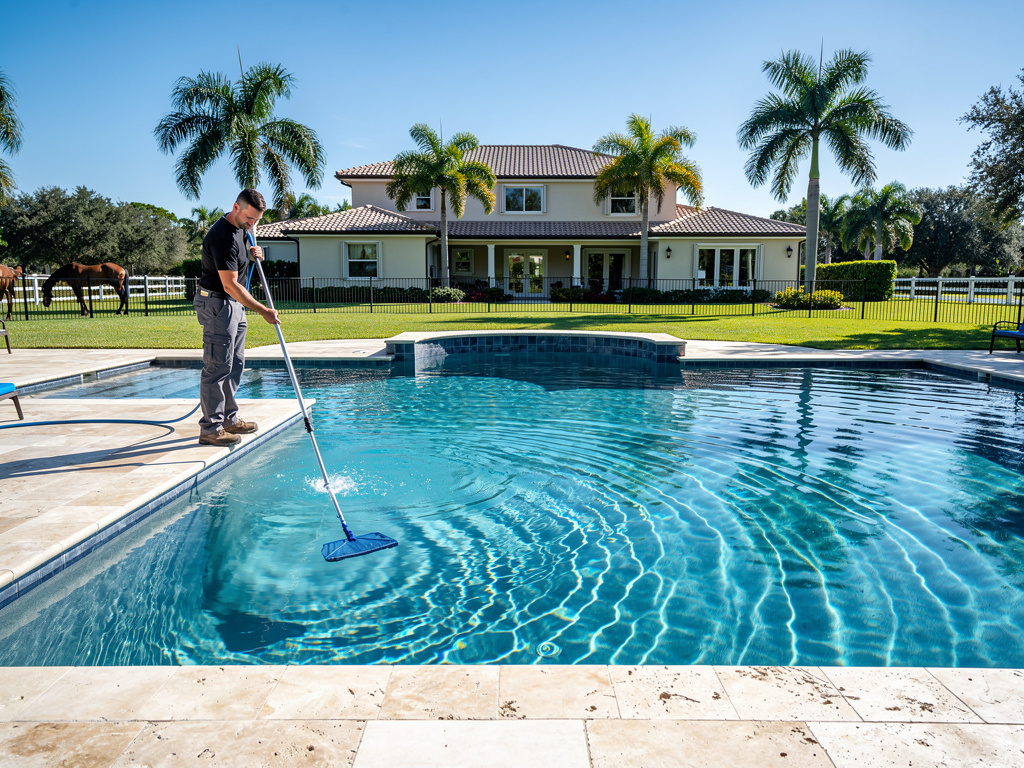
Davie’s oldest residential areas — the large lots along Griffin Road, Stirling Road, and the ranch areas west of I-595 — have mature tree canopy that suburban Broward communities can’t match. A Davie property with 20-year-old live oaks overhanging a pool is a beautiful outdoor environment and a significant debris management challenge simultaneously. Understanding what that tree canopy does to pool chemistry — and service protocol — helps Davie pool owners set realistic expectations and get appropriate service.
At Pool Service Fort Lauderdale, we service pools on Davie’s wooded rural properties and have developed service protocols calibrated for heavy organic debris environments. This guide covers the chemistry impacts and the management approach.
What Oak and Palm Debris Does to Pool Chemistry
Tannins — The Yellow-Brown Staining Problem
Live oak leaves, laurel oak leaves, and similar organic matter decompose in pool water and release tannin compounds — the same compounds that make tea or coffee brown. In pool water, tannins create a yellow-brown discoloration that can range from a slight warmth in the water color to a distinctly brown-tinted pool in severe cases. Tannins are not harmful to swimmers, but they’re chemically resistant to standard chlorine oxidation — high chlorine alone will not clear tannin discoloration. Treatment: enzyme-based organic removal products (Natural Chemistry Pool Perfect, BioGuard Smart Enzyme) break down tannin compounds more efficiently than chlorine alone; clarifiers that flocculate tannin particles for filter capture can help; and prevention through rapid debris removal (netting within 24 hours of significant fallout) minimizes decomposition.
Chlorine Demand from Organic Load
Every unit of organic matter in pool water requires chlorine to oxidize it — this is called chlorine demand. A pool under heavy oak canopy in Davie during fall leaf drop season can have such high chlorine demand that the weekly chlorine addition is entirely consumed by organic oxidation before any free chlorine remains for sanitization. This creates a deceptive situation: the service provider adds a full standard chlorine dose, but by the next visit the pool tests at zero free chlorine because all the chlorine was consumed by organic oxidation rather than sanitization. The solution is calibrating chlorine dose to the actual organic load — not standard suburban volume-based dosing.
Phosphate from Decomposing Organic Matter
Decomposing plant matter releases phosphate into the water as it breaks down. A pool with significant accumulation of leaf litter on the floor — particularly if left for several days between service visits — contributes measurable phosphate to the water. Combined with environmental phosphate from soil and fertilizer runoff on large Davie lots, organic debris decomposition can push a Davie wooded-property pool to phosphate levels that support persistent algae growth.
The Debris Management Protocol for Davie Wooded Properties
Frequent Basket Clearing
Skimmer baskets on heavily-wooded Davie properties fill faster than weekly service visits allow. Homeowner participation in between-visit basket clearing (every 2-3 days during heavy leaf drop season) prevents filled baskets from cutting suction and allowing debris to settle on the pool floor. A filled skimmer basket is a pool chemistry problem, not just an aesthetic issue — it stops surface skimming and allows debris to remain in the water and decompose.
Enzyme Treatment
Monthly enzyme treatment (Natural Chemistry Pool Perfect or equivalent) breaks down organic compounds (oils, leaf compounds, tannins) that chlorine oxidizes inefficiently. Enzymes don’t replace chlorine — they reduce the chlorine demand from organic matter so that more of the added chlorine remains available for sanitization. On heavily-wooded Davie properties, enzyme treatment is not optional — it is a standard part of the maintenance protocol.
Robotic Cleaner Use and Leaf Catchers
Robotic pool cleaners with large debris baskets or dedicated leaf catcher bags are appropriate for Davie wooded properties. Standard fine-filter robotic cleaners fill their debris bags quickly on high-debris Davie pools and require more frequent emptying than their design assumes. Leaf catcher nets (large mesh bags that pre-filter before the main filter) can extend run times on high-debris pools.
Pool Service Fort Lauderdale provides debris-load-adjusted service for Davie’s large-lot wooded properties. Call (954) 501-2754 or visit our Davie pool service page. Full coverage at poolservicefortlauderdale.us.
Frequently Asked Questions
{“@context”:”https://schema.org”,”@type”:”FAQPage”,”mainEntity”:[{“@type”:”Question”,”name”:”Why does my Davie pool with oak trees stay cloudy or yellowish even with regular service?”,”acceptedAnswer”:{“@type”:”Answer”,”text”:”Yellow-brown water in a Davie pool under significant oak canopy is tannin discoloration — organic compounds from decomposing oak leaves that chlorine doesn’t easily oxidize. Standard shock treatment clears algae but not tannins. Treatment: enzyme-based organic removal products (Natural Chemistry Pool Perfect, BioGuard Smart Enzyme) + clarifier + aggressive debris removal. Prevention: net the pool within 24 hours of significant leaf fall to prevent decomposition from beginning.”}},{“@type”:”Question”,”name”:”How often should I net my Davie pool during oak leaf drop season?”,”acceptedAnswer”:{“@type”:”Answer”,”text”:”Daily or every other day during peak oak leaf drop (typically October-December in South Florida, with a second lighter drop in spring). Leaves that sit on the pool floor for 3-4 days begin to decompose, releasing tannins, phosphate, and organic compounds that affect water chemistry and require significantly more chemical treatment to remediate than leaves that are removed within 24 hours. Rapid removal is the most cost-effective debris management strategy.”}},{“@type”:”Question”,”name”:”Should I trim the oak trees over my Davie pool to reduce debris?”,”acceptedAnswer”:{“@type”:”Answer”,”text”:”Tree trimming to reduce pool debris is an option, but live oaks and laurel oaks that overhang Davie pools are typically significant mature trees — heavy trimming affects the health of the tree and the aesthetic of the property. A consultation with a certified arborist (ISA-certified) can identify whether selective canopy trimming reduces debris impact without damaging the tree. Alternatively, adjusting service protocols to handle the debris load rather than removing the trees is often the better long-term decision for Davie properties where the mature tree canopy is part of the property’s character.”}},{“@type”:”Question”,”name”:”Does pool debris from trees affect my pool equipment in Davie?”,”acceptedAnswer”:{“@type”:”Answer”,”text”:”Yes. Heavy debris loads clog skimmer baskets faster, increasing the risk of pump loss-of-prime (pump runs dry when the basket is full and suction is lost). Debris that passes through to the filter shortens filter service intervals and increases backwash frequency. Leaves accumulating on the floor before robotic cleaner pickup can restrict bottom drain flow in suction-side cleaners. Proactive basket clearing between weekly service visits (homeowner-performed) prevents the cascade of problems that a full, ignored skimmer basket creates.”}},{“@type”:”Question”,”name”:”What is the best robotic pool cleaner for a heavily-wooded Davie property?”,”acceptedAnswer”:{“@type”:”Answer”,”text”:”Robotic cleaners with the largest debris baskets are most appropriate for Davie wooded properties — look for models with top-load access and large debris cartridges (Dolphin Nautilus CC Plus, Dolphin Premier, Polaris 9650iQ Sport). Some Davie pool owners add a leaf catcher net between the robotic cleaner’s intake and its debris bag for longer run times between empties on very high-debris properties. Clean the robotic cleaner’s debris basket after every run during heavy leaf drop season rather than the standard 3-4 run interval.”}}]}
Why does my Davie pool under oak trees stay yellow even with regular service? Tannin discoloration from decomposing oak leaf organic compounds. Chlorine doesn’t easily oxidize tannins. Treat with enzyme-based organic removal products + clarifier. Prevent by netting within 24 hours of significant leaf fall — before decomposition begins.
How often to net during oak leaf drop season? Daily or every other day during peak drop (October-December in South Florida, secondary drop in spring). Leaves on the floor for 3-4 days begin releasing tannins and phosphate — rapid removal dramatically reduces chemistry remediation cost.
Should I trim oak trees over the pool to reduce debris? Consult an ISA-certified arborist for selective trimming without damaging the tree. For most Davie properties, adjusting service protocol to manage the debris load is better long-term than removing or heavily trimming mature trees that define the property’s character.
Does tree debris affect pool equipment? Yes — fills skimmer baskets faster, risks pump loss-of-prime; debris in filter shortens service intervals. Between-visit homeowner basket clearing prevents the cascade of problems from full, ignored skimmer baskets.
Best robotic cleaner for a heavily-wooded Davie pool? Largest debris basket models — Dolphin Premier, Dolphin Nautilus CC Plus, Polaris 9650iQ Sport. Leaf catcher nets extend run time on very high-debris properties. Empty debris basket after every run during heavy leaf drop season.