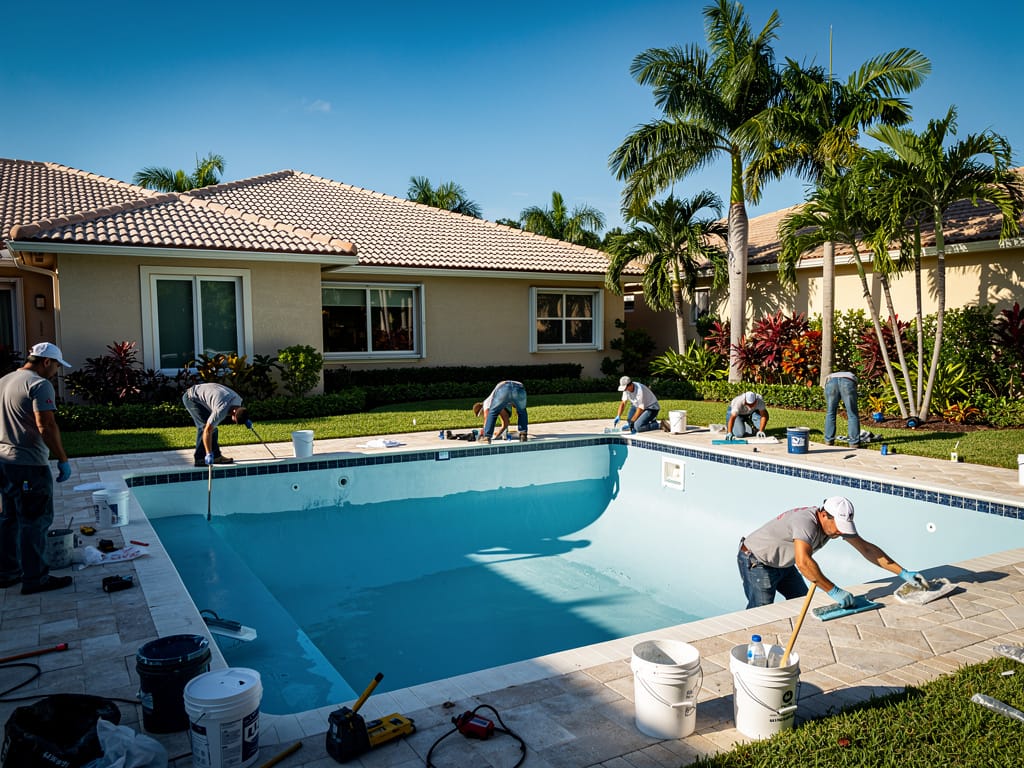
The pool deck at a Hallandale Beach home faces a more aggressive environment than pool decks in most U.S. markets. Salt air corrodes metal anchors for ladder rails and handrails. UV radiation bleaches and surface-chalks concrete finishes within a few seasons. The freeze-thaw cycles that create most deck spalling in northern climates don’t exist here, but salt crystallization in surface pores (salt spray deposits that absorb water, then dry in cycles) creates a similar mechanical degradation effect at coastal properties.
At Pool Service Fort Lauderdale, we work with pool deck contractors serving Hallandale Beach and understand how material selection and maintenance requirements differ in the coastal Broward environment. This guide covers what happens to common deck materials in Hallandale Beach’s conditions and what your options are when a deck reaches the end of its serviceable life.
How Hallandale Beach’s Environment Attacks Pool Deck Materials
Salt Crystallization in Concrete Pores
Bare concrete and concrete-based deck coatings are porous materials. Salt aerosol and salt water splash deposits on concrete surfaces are absorbed into surface pores in solution. When that solution evaporates, salt crystals form inside the pores. As salt crystals grow, they exert expansive pressure on the pore walls — a process called subflorescence that physically degrades the concrete matrix over repeated cycles.
At Hallandale Beach beachfront and near-beach properties, this mechanism progressively spalls, pits, and roughens concrete deck surfaces. What begins as surface chalking and light roughening accelerates into visible pitting and eventually surface delamination of coated finishes or chipping of uncoated concrete. The timeline depends on salt exposure intensity — severe at A1A-adjacent properties, moderate in western Hallandale Beach neighborhoods.
UV Bleaching and Thermal Cycling
South Florida receives more direct UV radiation than most of the continental U.S., and Hallandale Beach’s coastal location provides minimal shade or buffer. Concrete deck coatings (acrylic deck paint, Kool Deck, rubberized coatings) fade and surface-chalk within 3-5 years of application, requiring recoating or replacement. Natural stone surfaces (travertine, limestone) are more UV-stable but accumulate surface grime and require periodic cleaning and resealing.
The thermal cycle in Hallandale Beach — afternoon temperatures reaching 90-95°F in summer, cooling to 70-75°F at night — creates daily expansion and contraction stress on deck surfaces and particularly on coping (the cap stone along the pool edge). Grout joints and coping mortar joints that aren’t properly sealed develop cracks that admit salt water and accelerate deterioration from the inside.
Metal Anchor Corrosion
Pool handrail anchors, ladder anchors, and light fixture conduit fittings embedded in the deck are typically standard 304 stainless steel or galvanized steel. In Hallandale Beach’s salt air environment, standard 304 stainless corrodes visibly within 5-8 years and begins to expand as it oxidizes, cracking the concrete around the anchor socket. Marine-grade 316 stainless steel is significantly more corrosion-resistant and is the appropriate specification for any anchor replacement in coastal Hallandale Beach installations.
Deck Surface Options for Hallandale Beach Pools
Concrete Resurfacing (Overlay Coatings)
For existing concrete decks that are structurally sound but surface-degraded, overlay coatings — acrylic or cementitious overlays, knockdown texture finishes, or spray-applied deck coatings — can restore the surface appearance and texture at lower cost than full deck replacement. Typical cost: $2,500-$5,000 for a standard residential pool deck.
In Hallandale Beach’s coastal environment, overlay coatings require sealing every 2-3 years to prevent salt infiltration into the coating seams and maintain surface integrity. An overlay that’s never been sealed in a beachfront installation may look deteriorated within 5 years despite proper initial application.
Travertine and Natural Stone Pavers
Travertine is the premium deck material choice throughout South Florida for good reason: it’s naturally porous (providing slip resistance even when wet), UV-stable (doesn’t bleach like concrete coatings), stays cooler underfoot than concrete in direct sun, and ages gracefully rather than degrading visibly. For Hallandale Beach coastal properties, travertine is the most durable and aesthetically stable deck material available.
The coastal caveat: travertine’s natural porosity that provides slip resistance also admits salt water into the surface if not properly sealed. Travertine decks at Hallandale Beach beachfront properties require annual sealing of both the tile surface and the grout joints to prevent salt crystallization inside the stone. Unsealed travertine at a beachfront property develops surface pitting within 3-5 years that is difficult to repair without replacement.
Typical installation cost for travertine over existing concrete: $6,000-$12,000+ depending on deck area. The material and labor premium is justified for properties where the deck will receive heavy use and the coastal environment demands the most durable option.
Concrete Pavers
Manufactured concrete pavers (Belgard, Unilock, and similar brands with Florida-rated mixes) provide a durable alternative to poured concrete. Paver installations flex slightly at individual unit seams rather than cracking as monolithic poured concrete does. For Hallandale Beach properties where ground movement from root growth or slight soil variation is a concern, pavers handle this better than a solid slab.
Paver grout (polymeric sand between pavers) requires reapplication every 3-5 years in salt air environments to prevent joint failure and salt infiltration. Typical installation: $4,500-$9,000 for a standard residential deck.
Coping Replacement
Pool coping — the capstone that transitions from deck surface to pool wall at the water’s edge — takes the most intense salt spray and UV exposure of any deck element. In Hallandale Beach, coping joints typically require regrouting every 5-7 years, and full coping replacement (when the mortar substrate fails or the coping units themselves crack) is a common project at older Hallandale Beach pools.
Travertine coping is the most popular choice for Hallandale Beach pools currently being recopied — it matches the durability advantages described for deck installations and has a polished edge profile that holds up well aesthetically. Typical coping replacement: $1,500-$4,500 depending on pool perimeter and material.
Pool Service Fort Lauderdale can refer Hallandale Beach homeowners to licensed pool deck contractors familiar with coastal Broward County conditions and HOA approval requirements. Call (954) 501-2754 or visit our Hallandale Beach service page. All service areas at poolservicefortlauderdale.us.
Frequently Asked Questions
{
“@context”: “https://schema.org”,
“@type”: “FAQPage”,
“mainEntity”: [
{
“@type”: “Question”,
“name”: “Why is my Hallandale Beach pool deck deteriorating faster than expected?”,
“acceptedAnswer”: {
“@type”: “Answer”,
“text”: “Hallandale Beach’s coastal salt air causes salt crystallization inside concrete deck pores, mechanically degrading the surface over time. Combined with intense UV radiation that bleaches and chalks concrete coatings, and thermal cycling that stresses grout joints, deck materials in Hallandale Beach’s environment degrade faster than in inland or non-coastal markets.”
}
},
{
“@type”: “Question”,
“name”: “What is the best pool deck material for Hallandale Beach’s coastal environment?”,
“acceptedAnswer”: {
“@type”: “Answer”,
“text”: “Travertine is the most durable and aesthetically stable choice for Hallandale Beach pools. It’s UV-stable, stays cooler than concrete in direct sun, provides natural slip resistance, and ages gracefully. It requires annual sealing of both surface and grout joints in coastal exposures to prevent salt infiltration.”
}
},
{
“@type”: “Question”,
“name”: “How much does pool deck resurfacing cost in Hallandale Beach?”,
“acceptedAnswer”: {
“@type”: “Answer”,
“text”: “Concrete overlay resurfacing: $2,500-$5,000. Concrete paver installation: $4,500-$9,000. Travertine paver installation: $6,000-$12,000+. Coping replacement adds $1,500-$4,500 depending on pool perimeter and material choice. Pricing depends on deck size, surface condition, and material selected.”
}
},
{
“@type”: “Question”,
“name”: “Do I need HOA approval for pool deck resurfacing in Hallandale Beach?”,
“acceptedAnswer”: {
“@type”: “Answer”,
“text”: “For condo associations, yes — any alteration to common areas or unit exteriors typically requires HOA architectural review committee approval. For single-family homes in HOA communities in Hallandale Beach, check your CC&Rs. Work done within the pool enclosure generally requires fewer approvals than changes visible from the street, but submittal requirements vary by community.”
}
},
{
“@type”: “Question”,
“name”: “How often should travertine pool deck grout be resealed in Hallandale Beach?”,
“acceptedAnswer”: {
“@type”: “Answer”,
“text”: “Annual sealing is recommended for travertine pool decks at Hallandale Beach coastal properties. Both the tile surface and the grout joints should be sealed with a penetrating stone sealer. Without annual sealing, salt crystallization inside the travertine pores and grout causes pitting and joint failure within 3-5 years.”
}
}
]
}
Why is my deck deteriorating fast? Salt crystallization inside concrete pores + UV bleaching + thermal cycling on grout joints — the coastal Hallandale Beach environment accelerates all of these.
Best deck material here? Travertine — UV stable, stays cool, naturally slip-resistant, ages well. Requires annual sealing in coastal exposure.
What does resurfacing cost? Concrete overlay: $2,500-$5,000. Concrete pavers: $4,500-$9,000. Travertine: $6,000-$12,000+. Coping replacement: $1,500-$4,500 additional.
Need HOA approval? Condo pools: always. Single-family HOA: check your CC&Rs. Enclosure work typically requires fewer approvals than street-visible changes.
How often to seal travertine? Annually at Hallandale Beach coastal properties — both surface and grout joints. Skipping sealing causes pitting and joint failure within 3-5 years.