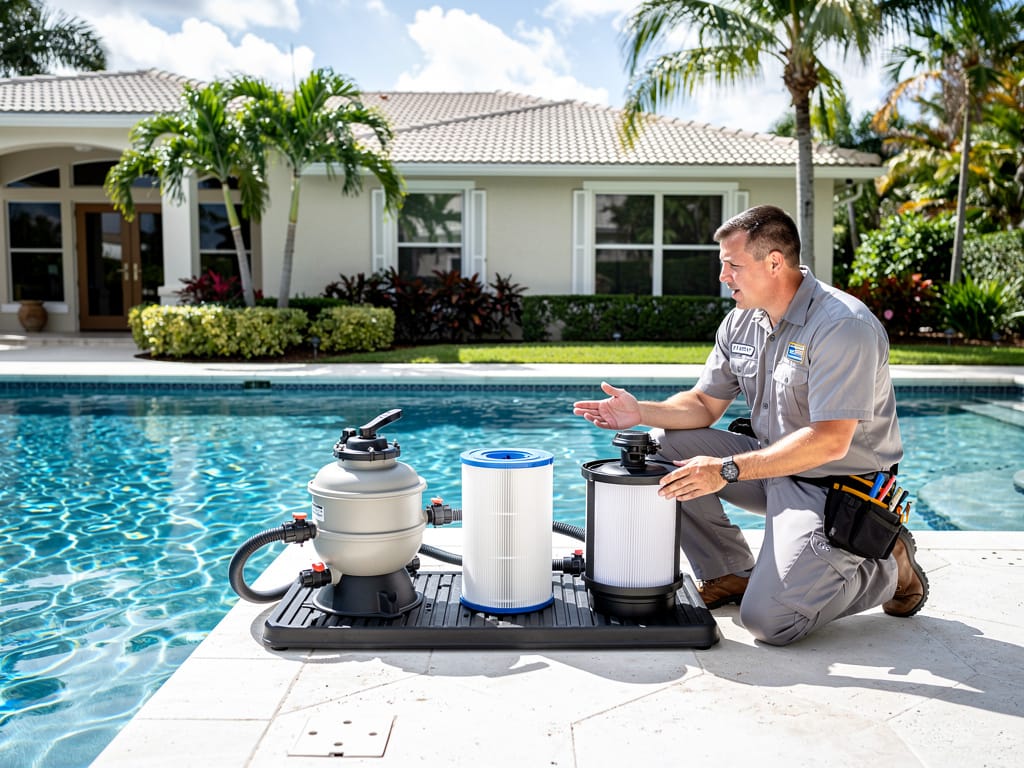
Pompano Beach homeowners replacing or upgrading pool filter equipment frequently encounter the sand vs. cartridge vs. DE decision. It’s one of the more consequential equipment choices for a pool owner because the filter type affects water clarity, maintenance routine, backwash frequency, and the overall chemistry profile of the pool. In Pompano Beach’s pool environment — outdoor debris from mature landscaping, hard Broward County water, year-round operation — the filter type matters more than in less demanding climates.
Sand Filters: The Standard Choice in Pompano Beach’s Older Pools
Sand filters are the most common filter type in Pompano Beach’s established pool stock — particularly in Crystal Lake, Palm Aire, and Ramblewood Estates homes from the 1970s–1990s. They use a bed of pool-grade sand (or alternative media like glass bead or ZeoSand) to trap particles as water passes through.
How they work: Water enters at the top of the filter tank, passes down through the sand bed, and exits clean through laterals at the bottom. Particles get trapped in the sand. When the filter pressure gauge climbs 8–10 psi above its clean operating baseline, you backwash — reverse the water flow for 2–3 minutes to flush trapped debris out to the waste line.
Filtration capability: Standard sand filters capture particles down to 20–40 microns. Fine particles — pollen, algae cells, and some types of cloudiness-causing particles — can pass through. This is the most significant limitation of sand filters in Pompano Beach’s environment, where pollen and fine organic material are constant.
Media replacement: Pool sand should be replaced every 5–7 years in Florida’s year-round operation environment. Old sand becomes rounded and channeled over time, reducing filtration efficiency. Glass bead alternative media lasts longer and filters slightly finer than standard sand.
Maintenance: Backwash when pressure climbs (typically every 7–14 days in Pompano Beach active-use seasons). Annual inspection of the valve and laterals. Sand replacement every 5–7 years.
Cost: Sand filter replacement for a standard Pompano Beach pool: $400–$700 installed.
Cartridge Filters: Better Filtration, No Backwashing
Cartridge filters have become the most popular choice for new Pompano Beach pool installations over the past decade. They use pleated polyester filter cartridges (similar in principle to an automotive air filter) that capture particles down to 10–15 microns — significantly finer than standard sand.
How they work: Water flows through the pleated cartridge, and particles are trapped in the filter media. Unlike sand filters, cartridge filters don’t backwash — when pressure climbs, you remove the cartridge, hose it down (a garden hose is sufficient), and reinstall. No backwash valve, no water waste from backwashing.
Benefits for Pompano Beach pools: The no-backwash design is particularly attractive in Florida, where water conservation matters and Pompano Beach pools are filled with treated municipal water. Cartridge filters also run at lower operating pressure than sand filters, reducing strain on the pump.
Limitations: Cartridge cleaning is more labor-intensive than a simple backwash cycle — you need to physically remove, clean, and reinstall the cartridge. In Pompano Beach’s debris-heavy environment (heavy organic load from mature landscaping), cartridges may need cleaning every 3–6 weeks during peak seasons. DE filters offer finer filtration for pools with persistent clarity issues.
Cartridge replacement: Cartridges last 2–4 years in Pompano Beach’s year-round use environment and cost $50–$200 per cartridge depending on the filter model.
Cost: Cartridge filter replacement for a standard pool: $500–$900 installed.
DE Filters: The Finest Filtration Available
Diatomaceous earth filters provide the finest filtration of the three types — capturing particles down to 3–5 microns. This makes them the best choice for Pompano Beach pools with persistent cloudiness, fine particle contamination, or pools that need to present at the highest visual standard (community pools, pools with adjacent spas, pools with lighting systems that make water clarity very visible at night).
How they work: A set of fabric grids inside the filter tank is coated with DE powder — the fossilized remains of microscopic algae. Water passes through the DE-coated grids, and the DE media traps particles far finer than sand or cartridge can capture.
Backwashing and recharging: DE filters do require backwashing when pressure climbs. But unlike sand filters, backwashing flushes out both the trapped debris and the DE media. After backwashing, you must add fresh DE powder (through the skimmer, with the pump running) to recoat the grids. This extra step is the main maintenance distinction from sand.
Annual DE refresh: Once per year, a full DE filter disassembly and cleaning (removing and hosing off each grid individually) resets filter performance. This is more involved than cartridge cleaning or sand backwashing, but the clarity results justify it for the right pool.
Cost: DE filter replacement for a standard pool: $600–$1,100 installed. DE powder costs approximately $20–$40 per recharge.
Which Filter Type Is Right for Your Pompano Beach Pool?
Choose sand if: you have an older pool already equipped with a sand filter, your water clarity is consistently good, and you prefer the simplest possible backwashing maintenance routine.
Choose cartridge if: you’re doing a new filter installation or replacement, you value water conservation (no backwash waste), and your pool has moderate organic debris load.
Choose DE if: you want the best possible water clarity, your pool has persistent cloudiness that other filter types haven’t resolved, or you manage a community or high-visibility pool where presentation matters.
For guidance on filter replacement and maintenance in Pompano Beach, contact Pool Service Fort Lauderdale at (954) 501-2754.
Frequently Asked Questions
How do I know when my pool filter needs cleaning or replacement?
The primary indicator for all filter types: pressure gauge reading. A clean sand or DE filter runs at its baseline pressure (note this when freshly cleaned). When pressure climbs 8–10 psi above baseline, service is needed. For cartridge filters, do the same — track baseline clean pressure and clean when pressure rises 8–10 psi. If cleaning doesn’t restore baseline pressure, the filter media (sand, cartridge, or DE grids) may need replacement.
Can I switch from a sand filter to a cartridge filter on my Pompano Beach pool?
Yes. Switching filter types is a common pool equipment upgrade. The new filter connects to existing plumbing, though some plumbing modification may be needed depending on filter size and connection type. The labor for a filter swap on a Pompano Beach pool is typically 2–4 hours. Some homeowners make this switch when their original sand filter reaches the end of its service life and they want to upgrade to better filtration.
My pool is always slightly cloudy. Will changing my filter fix it?
Cloudiness that persists despite proper chemistry is often a filtration issue — either filter media that needs replacement, insufficient run time (pump not running enough hours per day), or a filter that’s too small for the pool volume. Switching to DE will provide finer filtration, which often resolves persistent fine-particle cloudiness. But first rule out chemistry (check calcium, phosphates, and chlorine) — a chemistry issue won’t be resolved by a filter upgrade.
How often do I need to backwash my sand filter in Pompano Beach?
In Pompano Beach’s active season (May–September), sand filters typically need backwashing every 7–14 days due to the organic debris load from year-round outdoor use. During cooler months with less debris input, backwashing every 2–4 weeks may be sufficient. Always go by pressure gauge, not calendar — when pressure climbs 8–10 psi above the clean baseline, backwash regardless of the schedule.
Is DE safe? I’ve heard diatomaceous earth is a health concern.
Pool-grade DE is the same basic material as food-grade DE but in a different particle size. The concern is with inhalation of dry DE powder during filter recharging — the fine silica particles can irritate lungs. When adding DE to a pool filter, wear a dust mask during the brief period of handling the dry powder. Once mixed with water and inside the filter, DE is completely safe for swimmers. This is a standard precaution, not a serious health risk with normal handling.