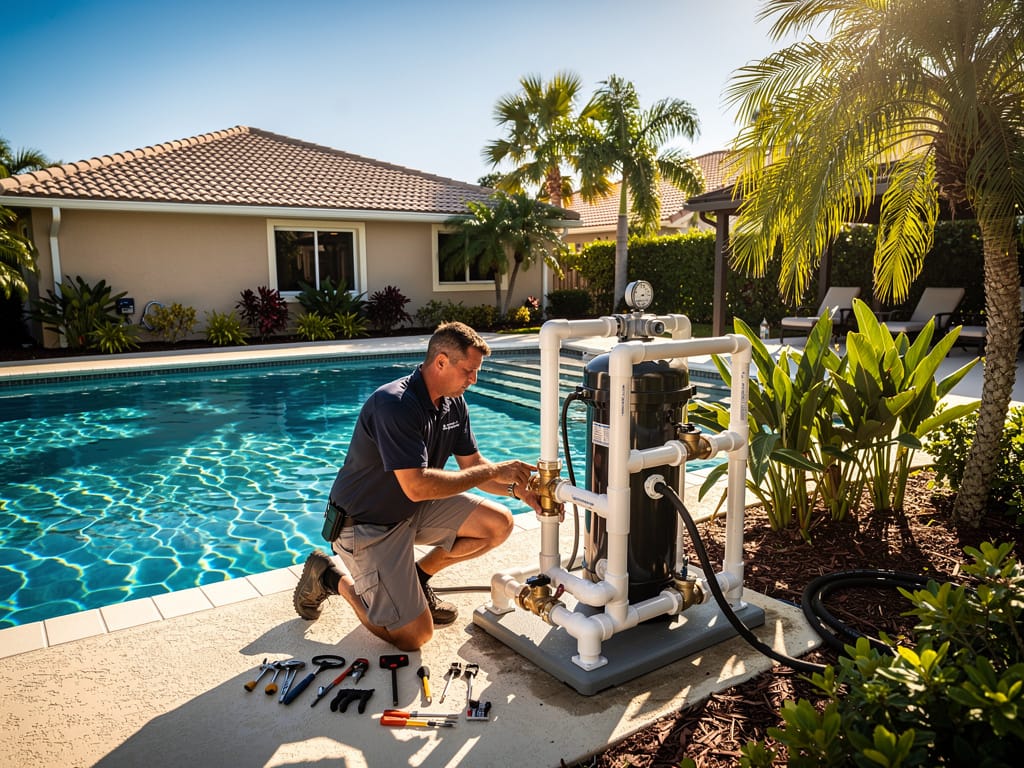
Heating a Deerfield Beach pool is practical for extending comfortable swimming from November through March — the months when water temperatures without heating drop into the low-to-mid 70s°F or lower. The two primary heating options for residential Deerfield Beach pools are heat pumps (electric) and gas heaters (natural gas or propane). The decision affects your upfront cost, monthly operating expense, and how you use your pool across the season.
How Heat Pumps Work in Deerfield Beach’s Climate
A pool heat pump works like an air conditioner in reverse: it extracts heat from the ambient air and transfers it into the pool water. For every unit of electricity consumed, a heat pump delivers 4–6 units of heat energy — a Coefficient of Performance (COP) of 4–6. This efficiency ratio is what makes heat pumps dramatically cheaper to operate than gas heaters.
The critical caveat: heat pump efficiency declines when ambient air temperature drops below 50–55°F. In most northern U.S. climates, this makes heat pumps impractical for cold months. In Deerfield Beach, average low temperatures in December and January are 55–60°F — still within the efficient operating range for most heat pumps, though performance does decrease on the coldest nights. For Deerfield Beach’s mild winters, heat pumps remain the efficient choice year-round without the climate limitations that make gas heaters preferable in northern states.
How Gas Pool Heaters Work
Gas heaters burn natural gas or propane in a combustion chamber, heating pool water as it passes through a copper or cupro-nickel heat exchanger. They are not affected by ambient air temperature — they heat equally well whether it’s 45°F or 85°F outside.
The key advantage of gas over heat pump: speed. A gas heater with adequate BTU capacity can raise pool temperature by 1°F per hour (roughly 10–15°F in a day). A heat pump in the same conditions raises temperature by about 1°F per 4 hours — a pool that needs to heat from 70°F to 84°F might take 24–48 hours with a heat pump vs. 12–18 hours with gas. This matters for pools used impulsively (“heat the pool for a party this weekend”) vs. pools maintained at a consistent temperature.
Operating Cost Comparison for Deerfield Beach
The operating cost difference is dramatic and is the primary reason most Deerfield Beach homeowners prefer heat pumps for year-round use:
Heat pump: Maintaining a pool at 82–84°F in Deerfield Beach’s winter typically requires 6–10 hours of heat pump operation per day in the cooler months. At 5–6 kW draw and FPL’s residential rate (~$0.13/kWh): approximately $50–$80/month in winter heating costs. Annual heating cost (Nov–Mar active season): $200–$400.
Gas heater (natural gas): A 400,000 BTU gas heater maintaining 82–84°F in a similar Deerfield Beach winter pool uses approximately $100–$200/month in natural gas at current rates. Annual heating cost (Nov–Mar): $500–$1,000. For propane-fueled heaters (which Deerfield Beach properties without natural gas mains use), costs run 2–3x higher: $1,000–$3,000 per heating season.
The break-even on heat pump vs. gas upfront cost difference: at $600/year in operating cost savings, a heat pump that costs $1,500 more to install pays back within 2.5 years. Over the heater’s 10–15 year lifespan, the operating cost savings are substantial.
When Gas Makes Sense in Deerfield Beach
Gas heaters are the right choice for specific Deerfield Beach scenarios:
Spa-focused use: Spas require rapid heating — getting from 70°F to 102°F in 30–45 minutes is a realistic expectation for a gas heater, but not for a heat pump (4+ hours). Many Deerfield Beach pools with spas use a gas heater (for spa use) and a heat pump (for pool maintenance temperature) in a dual-heater configuration.
Infrequent or seasonal use: If you only heat your pool for a few weekends per season, gas’s faster heat-up time may justify its higher operating cost for the reduced hours of use.
Properties without heat pump compatibility: Properties where ambient temperatures drop below 50°F enough to impair heat pump efficiency — rare in Deerfield Beach but possible during unusual cold fronts — may benefit from gas as a backup or primary option.
Installation Considerations for Deerfield Beach
Heat pump installation requires adequate electrical service to the equipment pad. Most heat pumps require a dedicated 240V circuit — verify your existing electrical service can accommodate this before purchasing. Heat pumps also require clearance space for airflow around the unit (typically 24–36 inches on all sides) and operate more quietly than gas heaters but do produce noise from the fan motor.
Gas heater installation requires a gas line to the equipment pad (natural gas service or propane tank siting) and proper venting. Deerfield Beach homes in western neighborhoods typically have natural gas service; eastern and canal-front neighborhoods may not, requiring propane.
For pool heater installation, replacement, and service throughout Deerfield Beach, contact Pool Service Fort Lauderdale at (954) 501-2754.
Frequently Asked Questions
What pool temperature can I maintain in Deerfield Beach in January with a heat pump?
A properly sized heat pump can maintain 82–86°F in a covered or screened Deerfield Beach pool even in January — the coldest month, with average lows around 57°F. Without a pool cover, heat loss overnight is significant (pools can drop 5–10°F overnight in January), requiring the heat pump to work harder to maintain temperature. A solar or thermal pool cover that retains heat overnight dramatically reduces heating costs in winter months.
How long do pool heat pumps last in Deerfield Beach?
Quality heat pumps (Pentair UltraTemp, Hayward HeatPro, Rheem) last 10–15 years in Deerfield Beach’s year-round operation environment. The titanium heat exchanger (standard on quality brands) resists salt water and chlorine. The compressor and fan motor are the primary wear components; annual inspection of refrigerant level and coil condition extends service life. Heat pumps in eastern Deerfield Beach neighborhoods near the coast should have titanium heat exchangers confirmed — not all units include this as standard.
Can I get a pool heater rebate in Deerfield Beach?
Florida Power and Light has historically offered energy efficiency rebates on heat pump water heaters; pool heat pump rebate availability varies by program year. Check FPL’s current rebate programs before purchase — the pool heat pump category may have rebates available that reduce upfront cost. No rebates are typically available for gas pool heaters through utility programs.
My gas heater stopped working. Should I repair it or replace it with a heat pump?
If your gas heater is over 10 years old, replacement with a heat pump is worth serious consideration. Comparing repair cost (typically $300–$800 for common gas heater repairs — ignitor, heat exchanger header, board) vs. the operating cost savings of a heat pump over the next 10–15 years: the break-even math usually favors replacement rather than repair for an aging unit. Get a repair estimate and compare it to the heat pump payback calculation for your specific situation.
Do I need a pool cover to use a heat pump efficiently in Deerfield Beach?
A pool cover is not required for heat pump operation, but it significantly improves efficiency in cooler months. In January and February, an uncovered Deerfield Beach pool can lose 5–10°F overnight through evaporation and convection. A solar or liquid pool cover reduces these losses, meaning the heat pump runs less frequently to maintain target temperature. The cover pays for itself quickly in reduced electricity costs and extends swim comfort on cooler days.
{
“@context”: “https://schema.org”,
“@type”: “FAQPage”,
“mainEntity”: [
{
“@type”: “Question”,
“name”: “What pool temperature can I maintain in Deerfield Beach in January with a heat pump?”,
“acceptedAnswer”: {
“@type”: “Answer”,
“text”: “A properly sized heat pump can maintain 82-86°F in a covered or screened Deerfield Beach pool even in January. Without a pool cover, overnight heat loss (5-10°F) requires more heat pump operation. A solar or thermal cover dramatically reduces heating costs in winter months.”
}
},
{
“@type”: “Question”,
“name”: “How long do pool heat pumps last in Deerfield Beach?”,
“acceptedAnswer”: {
“@type”: “Answer”,
“text”: “Quality heat pumps last 10-15 years in Deerfield Beach’s year-round operation. The titanium heat exchanger resists salt water and chlorine. Annual inspection of refrigerant level and coil condition extends service life. Confirm titanium heat exchangers for eastern Deerfield Beach coastal locations.”
}
},
{
“@type”: “Question”,
“name”: “Can I get a pool heater rebate in Deerfield Beach?”,
“acceptedAnswer”: {
“@type”: “Answer”,
“text”: “FPL has historically offered efficiency rebates on heat pump water heaters; pool heat pump rebate availability varies by program year. Check FPL’s current rebate programs before purchase. No rebates are typically available for gas pool heaters through utility programs.”
}
},
{
“@type”: “Question”,
“name”: “My gas heater stopped working. Should I repair it or replace it with a heat pump?”,
“acceptedAnswer”: {
“@type”: “Answer”,
“text”: “If your gas heater is over 10 years old, replacement with a heat pump is worth serious consideration. Comparing repair cost ($300-$800) vs. operating cost savings over the next 10-15 years usually favors replacement rather than repair for an aging unit.”
}
},
{
“@type”: “Question”,
“name”: “Do I need a pool cover to use a heat pump efficiently in Deerfield Beach?”,
“acceptedAnswer”: {
“@type”: “Answer”,
“text”: “A pool cover is not required but significantly improves efficiency. In January and February, an uncovered pool can lose 5-10°F overnight. A solar or liquid pool cover reduces these losses, meaning the heat pump runs less frequently to maintain target temperature.”
}
}
]
}