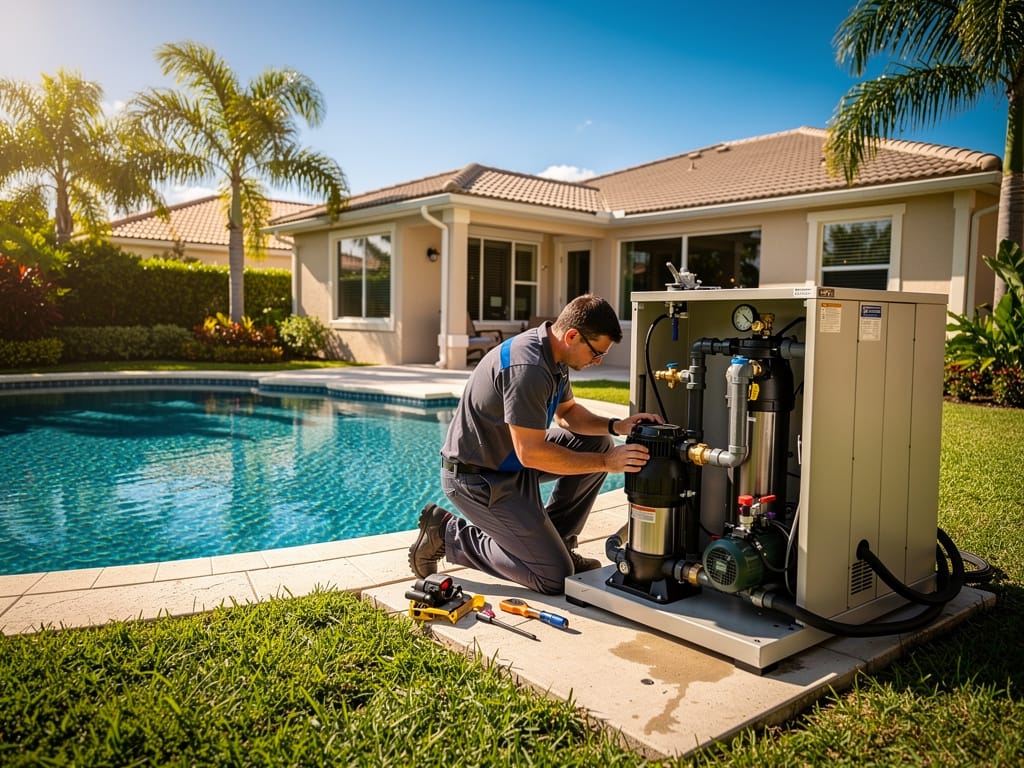
Cooper City’s A-rated schools and family-focused community culture create a pool usage pattern that differs from adult-only or resort properties — Cooper City families want the pool available for after-school use, weekend family time, and year-round entertaining. That means pool temperature that children will actually swim in throughout the November-March window when South Florida water cools below comfortable levels.
At Pool Service Fort Lauderdale, we install and service pool heating equipment throughout Cooper City and help families size and select the right heating approach for their pool size and usage goals. This guide covers the heating options and what the season actually costs.
Cooper City’s Heating Season — What the Temperature Actually Does
Cooper City pool water temperature by month (approximate, unheated, covered at night):
- October: 80-84°F — comfortable for most swimmers, no heating needed
- November: 74-80°F — cooler than most children prefer; heating extends comfortable use
- December: 68-74°F — cold for children; adults who swim year-round accept it, families with children need heating for regular use
- January: 65-70°F — cold fronts can push below 65°F; uncomfortable for all but the most cold-tolerant swimmers
- February: 68-74°F — warming trend begins mid-month; warm stretches alternate with cold front dips
- March: 75-82°F — rapidly warming; heating only needed for cold front weeks
- April onward: 82°F+ — comfortable without heating for most swimmers
Heat Pump Pool Heating — The Standard Choice for Cooper City
A heat pump pool heater extracts heat from ambient air and transfers it to pool water — essentially an air conditioner running in reverse. At Cooper City’s winter temperatures (55-75°F ambient during heating season), a heat pump operates at 400-600% efficiency (Coefficient of Performance 4.0-6.0) — meaning $1 of electricity produces $4-$6 of heat. This is dramatically more efficient than gas heating and more cost-effective than electric resistance heating.
Sizing for Cooper City pools:
- 15,000 gallon pool, screen enclosure, pool cover used at night: 140,000-200,000 BTU heat pump
- 20,000 gallon pool, screen enclosure, pool cover used at night: 200,000-300,000 BTU
- Larger pools or no pool cover: 300,000-400,000 BTU
Operating cost example (Cooper City, 18,000 gallon pool, 250,000 BTU heat pump):
- Heat pump COP at 65°F ambient: 4.5
- Electrical input to produce 250,000 BTU: ~55,600 watts = 55.6 kW/hr
- Runtime per day to maintain temperature: 4-8 hours depending on overnight temperature and cover use
- Daily cost at $0.13/kWh: $2.89-$5.78/day
- Monthly cost (30 days): $87-$173/month
Using a pool cover overnight dramatically reduces heat pump runtime — a pool without a cover loses 1-3°F on cool nights and requires additional heat pump runtime to recover. A solar cover (bubble wrap style) retains heat at low cost and is the most effective single addition to reduce heat pump operating cost.
Solar Pool Heating — Zero Operating Cost, Cooper City’s Best Value
Roof-mounted solar collectors (polypropylene or EPDM panels) heat pool water using sun energy with no electricity consumption beyond the existing pump. In Cooper City’s climate:
- Solar can maintain 80-84°F on most clear winter days
- Solar doesn’t help on cloudy days or nights — this is where the hybrid approach matters
- A solar-plus-heat-pump system uses solar for sunny daytime heating and activates the heat pump only on cloudy days and for overnight temperature recovery during cold fronts
Hybrid system operating cost (Cooper City, solar + heat pump backup):
- Heat pump runtime: 15-25% of what a heat-pump-only system runs (cold snap days and cloudy recovery periods only)
- Monthly heating cost November-March: $15-$45/month vs $87-$173/month for heat pump only
- Solar installation cost: $3,000-$5,500. Payback vs heat-pump-only heating: 3-5 years
For Cooper City families planning to stay in the home for 5+ years, solar is almost always the better long-term investment. For families with shorter horizons, a well-sized heat pump alone is simpler and fully adequate.
Pool Service Fort Lauderdale installs and services pool heating systems for Cooper City families. Call (954) 501-2754 or visit our Cooper City pool service page. Full coverage at poolservicefortlauderdale.us.
Frequently Asked Questions
{“@context”:”https://schema.org”,”@type”:”FAQPage”,”mainEntity”:[{“@type”:”Question”,”name”:”What months do Cooper City pool owners typically need to heat their pool?”,”acceptedAnswer”:{“@type”:”Answer”,”text”:”Cooper City pools generally need heating November through March for comfortable family swimming. November and March are mild — pool water is 74-82°F and light heating extends comfortable use. December through February are the core heating months when unheated pool water drops to 65-74°F, which most children find too cold for extended swimming. April onward, pool water naturally reaches 82°F+ without heating.”}},{“@type”:”Question”,”name”:”How much does it cost to heat a Cooper City pool per month?”,”acceptedAnswer”:{“@type”:”Answer”,”text”:”A heat pump heating a typical 18,000 gallon Cooper City pool during the heating season (November-March): $80-$175/month in FPL electricity at current rates. Actual cost depends on pool size, heat pump size and efficiency (COP), ambient temperature, pool cover use, and target temperature. Using a pool cover overnight reduces heat pump runtime and monthly cost significantly. A solar-plus-heat-pump hybrid reduces monthly heating cost to $15-$45/month by handling most of the load from free solar energy.”}},{“@type”:”Question”,”name”:”Is a solar pool heater worth it in Cooper City?”,”acceptedAnswer”:{“@type”:”Answer”,”text”:”For Cooper City families planning to stay in the home 5+ years, yes. Solar pool heating costs $3,000-$5,500 to install and has essentially no operating cost beyond the existing pump electricity. Compared to heat-pump-only heating ($80-$175/month during the heating season), payback is 3-5 years. Solar handles most of the heating load on sunny winter days; a heat pump backup handles cloudy periods and cold snaps. The hybrid approach is the most cost-effective long-term pool heating strategy in Cooper City’s climate.”}},{“@type”:”Question”,”name”:”What size heat pump does a Cooper City pool need?”,”acceptedAnswer”:{“@type”:”Answer”,”text”:”A properly sized heat pump for a Cooper City residential pool: 140,000-200,000 BTU for a 15,000 gallon pool with a pool cover used at night; 200,000-300,000 BTU for a 20,000 gallon pool; 300,000-400,000 BTU for larger pools or pools without covers. Undersizing a heat pump means it runs continuously during cold periods without reaching target temperature — correct sizing is critical for performance during Cooper City’s January-February cold front weeks.”}},{“@type”:”Question”,”name”:”Does a pool cover help reduce heating costs in Cooper City?”,”acceptedAnswer”:{“@type”:”Answer”,”text”:”Significantly. A pool without a cover loses 1-3°F overnight on cool nights, requiring additional heat pump runtime to recover to target temperature each morning. A solar cover (bubble wrap style reel cover) placed on the water overnight retains heat, reduces temperature loss to 0.3-0.5°F overnight, and can reduce heat pump runtime by 40-60%. At Cooper City heat pump electricity costs, a $150-$400 solar cover pays for itself within one heating season.”}}]}
Heating season in Cooper City? November-March. November and March are mild (light heating). December-February are the core months — 65-74°F unheated, too cold for most children.
Monthly cost to heat a Cooper City pool? Heat pump only: $80-$175/month. Solar + heat pump hybrid: $15-$45/month.
Is solar worth it? Yes for homeowners planning 5+ year stays. $3,000-$5,500 install, 3-5 year payback vs heat pump alone. Handles most load on sunny days; heat pump handles cold snaps.
What heat pump size? 140K-200K BTU for ~15K gallon pool with cover; 200K-300K BTU for ~20K gallon; 300K-400K BTU for larger pools without covers.
Do pool covers reduce heating costs? Yes — reduces overnight temperature loss from 1-3°F to 0.3-0.5°F, cutting heat pump runtime 40-60%. A solar cover pays for itself in one season.