Pool water loss is one of the most misunderstood issues Pompano Beach pool owners deal with. South Florida evaporation is real and significant — a pool in Pompano Beach summer heat can lose 1/4 to 1/2 inch per day to evaporation and splash-out alone. But when water loss climbs above that, you have a leak, and finding it before it becomes a bigger problem requires the right approach.
This guide walks through how to tell if your Pompano Beach pool is leaking, where leaks commonly occur, and what professional leak detection involves.
The Bucket Test: Distinguishing Evaporation From a Leak
The bucket test is the standard, free first step for any Pompano Beach homeowner suspecting a pool leak:
- Fill a 5-gallon bucket with pool water and place it on a pool step (or on the pool deck if it has a wide enough base)
- Mark the water level inside the bucket with tape or a marker
- Mark the pool water level on the pool wall with tape
- Turn off the auto-fill (if you have one)
- Wait 24 hours and compare
If the pool lost more water than the bucket, you have a leak — the bucket accounts for evaporation conditions, so the difference between the two represents actual water loss beyond evaporation. If both dropped the same amount, it’s evaporation only.
Run the test twice: once with the pump running and once with it off (allow 24 hours for each). If the pool loses more water with the pump running, the leak is in the plumbing or equipment. If loss is equal with pump on and off, the leak is in the shell, skimmer, or main drain.
Where Pool Leaks Are Most Commonly Found in Pompano Beach
Pompano Beach’s older housing stock — particularly in Crystal Lake, Palm Aire, and Ramblewood Estates — means older pool plumbing, fittings, and surfaces. The most common leak locations in Pompano Beach pools:
Equipment pad fittings and unions: The most common finding in professional leak detection. PVC unions at the pump, filter, and heater degrade over time, particularly in the UV exposure and temperature cycling of South Florida’s outdoor equipment pads. A union fitting with a minor drip can lose surprising amounts of water over weeks. These are typically the least expensive leaks to fix — $100–$250 for union replacement.
Skimmer body and throat: Skimmer bodies in concrete deck pools are prone to developing cracks where the plastic skimmer body meets the concrete. This is a Pompano Beach market issue because many pools from the 1970s–80s have original skimmer bodies that have been through 40+ years of thermal expansion and contraction. Skimmer repair costs $200–$500 depending on complexity.
Return line fittings: Wall return fittings can develop leaks at the fitting-to-plumbing connection or at the fitting-to-shell interface. A dye test (squirting leak detection dye near suspected fittings) can confirm these leaks visually.
Main drain: Main drain plumbing at the floor of the pool can develop leaks at the fitting connections. Main drain leaks often manifest as a pool that loses water at a consistent rate regardless of pump status.
Underground plumbing: True underground pipe failures — cracked PVC from root intrusion or soil movement — are less common but more expensive to repair when they occur. They require electronic detection and pressure testing to locate, followed by excavation. In Pompano Beach, mature landscaping in older neighborhoods can create root intrusion pressure on underground pool plumbing.
What Professional Leak Detection Involves
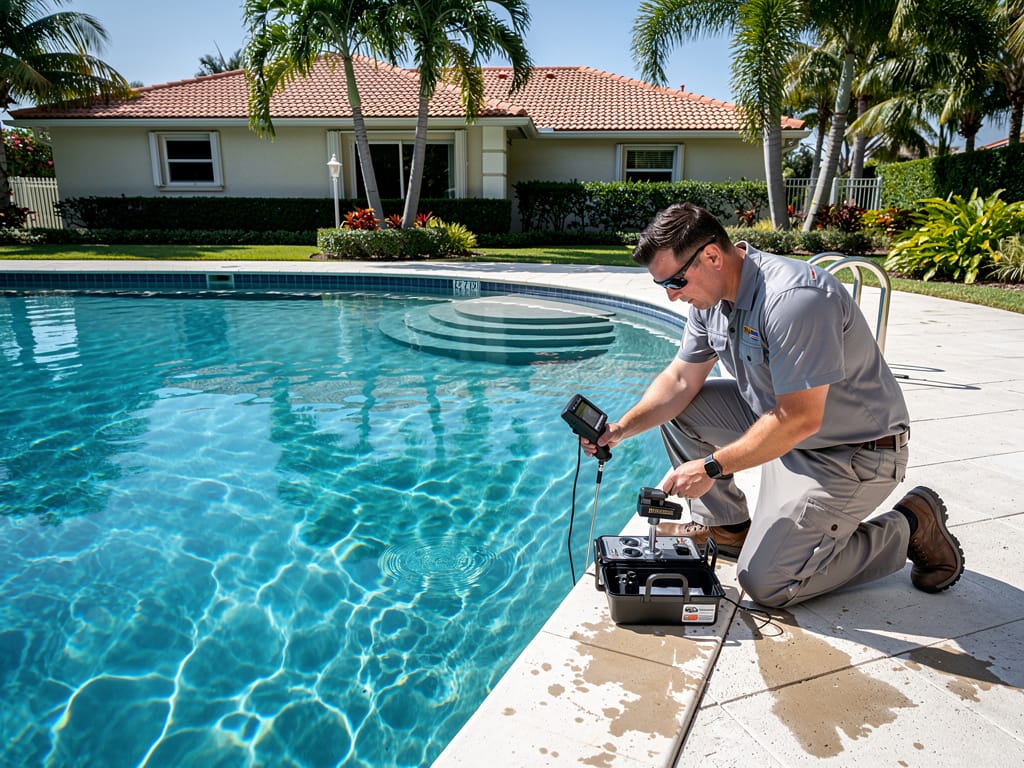
Professional pool leak detection in Pompano Beach uses a combination of tools and techniques:
Pressure testing: Individual plumbing lines (main drain, skimmer suction, return lines) are pressure tested — plugged at one end and pressurized with air. A line that doesn’t hold pressure has a leak somewhere in that run. Pressure testing identifies which line is leaking before any digging occurs.
Electronic listening: Specialized acoustic equipment can detect the sound of water escaping through a leaking underground pipe. This narrows the leak location before excavation, significantly reducing the area that needs to be opened.
Dye testing: At suspected leak points — fittings, skimmer throats, main drain covers, return fittings — a syringe of colored dye is injected near the suspected area. If the dye gets drawn into a gap or crack, the leak location is confirmed.
Cost and timeline: Professional leak detection in Pompano Beach runs $200–$400 for the detection service. Repair costs are separate and depend on what’s found: minor fitting repairs $100–$300; skimmer repair $200–$500; underground plumbing repair (excavation required) $800–$2,500+.
Water Loss and Pompano Beach’s Canal-Front Homes
Pompano Isles and other waterfront Pompano Beach neighborhoods with canal-adjacent pools have an additional complication: groundwater and canal water proximity. In periods of heavy rainfall, water table pressure can push water INTO a pool through cracks or failed fittings — the reverse of a typical leak. This manifests as a pool level that rises during rain even beyond what rainfall would account for. If you’re a canal-front Pompano Beach homeowner seeing unexplained water level changes, a professional leak assessment should include soil saturation and groundwater elevation as factors.
When to Call a Professional
If your bucket test confirms a leak and the loss is more than 1/4 inch per day beyond evaporation, schedule professional detection. Small leaks become bigger ones — a minor plumbing drip that costs $150 to fix today can erode surrounding soil and compromise deck structure over months, turning a simple repair into a major project.
Contact Pool Service Fort Lauderdale for pool leak detection service throughout Pompano Beach. Call (954) 501-2754.
Frequently Asked Questions
How much water should a Pompano Beach pool lose per day normally?
In Pompano Beach summer heat, 1/4 to 1/2 inch per day from evaporation and splash-out is normal. That’s roughly 50–100 gallons per day for a standard 15,000-gallon pool. If you’re losing significantly more — especially if an auto-fill valve is running frequently to keep up — it warrants a bucket test to distinguish evaporation from a leak.
Can I find a pool leak myself without professional help?
The bucket test is DIY-accessible and free. Dye testing at visible fittings is also something homeowners can do with a $15 dye syringe kit. But pressure testing underground plumbing and using electronic listening equipment to locate underground leaks require professional tools and training. For any leak that can’t be confirmed visually, professional detection is the right call.
Will my homeowner’s insurance cover pool leak repairs?
Standard homeowner’s insurance in Florida typically does not cover pool leak repairs from wear, corrosion, or gradual deterioration. Sudden, accidental damage (a tree falling and cracking the pool shell) may be covered depending on your policy. Check your specific policy for exclusions related to pools. Water damage from a pool leak to surrounding structures may be covered separately.
How long does a pool leak detection appointment take?
A standard professional pool leak detection appointment in Pompano Beach takes 1–3 hours depending on pool size, the number of plumbing lines, and how quickly the leak is located. If multiple pressure tests and acoustic searches are needed, it can run longer. Most reputable leak detection services provide a report of findings and repair recommendations at the end of the appointment.
My pool auto-fill runs constantly. Does that mean I have a leak?
Constant auto-fill operation is a significant leak indicator — it means the pool is losing water faster than evaporation alone accounts for, and the auto-fill is compensating continuously. Run the bucket test to confirm and quantify the rate of loss, then schedule professional leak detection. A leak that’s large enough to keep an auto-fill running constantly is worth finding promptly.