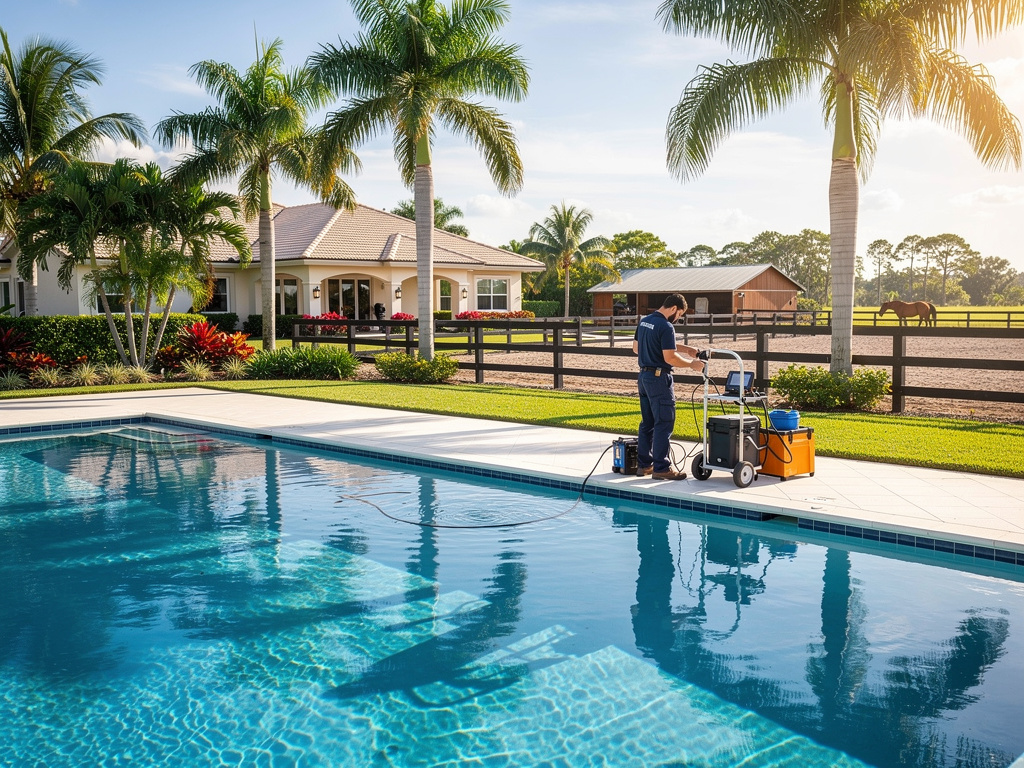
Davie’s identity as the Equestrian Capital of Broward County is built around a unique lifestyle — horses, large lots, working ranch properties alongside suburban neighborhoods, and an outdoor culture that sets it apart from every other Broward community. For the many Davie homeowners who keep horses on their property, the pool is often visible from the barn and pasture — and the ranch environment directly affects the pool chemistry and maintenance requirements in ways that a service provider calibrated for suburban pool service may not recognize.
At Pool Service Fort Lauderdale, we service pools on Davie’s equestrian properties and understand the specific chemistry challenges the ranch environment creates. This guide covers what those challenges are and how to address them.
The Phosphate Problem on Equestrian Properties
Phosphate is the primary enabler of algae growth in pool water. In a suburban pool, phosphate enters the water primarily through landscape fertilizer runoff and the occasional organic debris event. On a Davie equestrian property, phosphate inputs are dramatically higher and more continuous:
- Manure particulate: Horse manure is extremely high in phosphorus — it’s why horse manure is a prized garden fertilizer. In a ranch environment, manure particulate dries and becomes airborne, traveling significant distances from paddocks and pastures. This particulate settles on pool surfaces and enters pool water continuously. A pool within 200 feet of a horse paddock can receive significant phosphate loading from manure dust alone.
- Hay and feed debris: Hay dust and feed grain debris from feeding areas is carried by Davie’s afternoon sea breezes. Hay is approximately 0.2-0.3% phosphorus by weight — the fine dusty particles that drift from feeding operations are another continuous phosphate input to nearby pools.
- Pasture fertilizer: Many Davie horse properties fertilize pastures to maintain healthy grass for grazing. Rain events wash phosphate-rich fertilizer across the property — routing toward lower ground, which often includes the pool deck and pool itself.
The cumulative phosphate load on a Davie equestrian property pool can reach 800-1,500 ppb within weeks without proactive management. At these levels, algae blooms are not just possible — they’re nearly inevitable regardless of chlorine levels. The solution is not more chlorine; it is regular phosphate removal.
Organic Load and Chlorine Demand
Beyond phosphate, the general organic load of a ranch environment — fly bodies and insect debris, dust containing organic matter, pollen from pasture grasses, and the trace biological contamination from a working animal environment — creates elevated BOD (Biological Oxygen Demand) in the pool water. BOD consumes chlorine: every unit of organic matter in the pool water requires chlorine to oxidize it, depleting the free chlorine available for sanitization. A Davie equestrian property pool in summer can consume chlorine at 2-3 times the rate of a suburban pool in the same neighborhood. Service providers who add the standard chlorine dose for a 15,000 gallon pool will consistently under-dose equestrian property pools.
Fly and Insect Management
Flies are an unavoidable reality of equestrian properties. Fly bodies in pool water contribute organic load and can clog skimmer baskets faster than on suburban properties. More significantly, the chemical compounds used in fly control on horse properties — organophosphate and pyrethroid fly sprays — can enter pool water through spray drift and rain runoff. Most pool-relevant fly control compounds break down in chlorinated water without leaving harmful residue, but their initial entry creates a chlorine demand spike that can temporarily drop free chlorine to zero if not anticipated. Service timing in relation to fly spray application matters on equestrian properties.
The Equestrian Property Service Protocol
For Davie equestrian property pools, the appropriate service protocol differs from standard suburban service:
- Phosphate testing every visit — not monthly. Equestrian property phosphate accumulation rates require visit-by-visit monitoring and treatment to prevent algae-enabling levels from being reached between services.
- Lanthanum-based phosphate remover monthly — maintenance dose at every service visit, treatment dose when phosphate exceeds 500 ppb.
- Enzyme treatment (Natural Chemistry Pool Perfect or equivalent) — breaks down organic load (oils, body waste, ranch environmental organics) that chlorine alone oxidizes inefficiently. Monthly enzyme treatment reduces the chlorine demand from organic accumulation.
- Higher chlorine dosing calibrated to actual volume and load — not the standard suburban dose.
- Basket cleaning every visit — fly debris and ranch dust fill skimmer baskets faster than suburban service norms.
Pool Service Fort Lauderdale provides equestrian-property-aware pool service throughout Davie. Call (954) 501-2754 or visit our Davie pool service page. Full coverage at poolservicefortlauderdale.us.
Frequently Asked Questions
{“@context”:”https://schema.org”,”@type”:”FAQPage”,”mainEntity”:[{“@type”:”Question”,”name”:”Why does my Davie horse property pool keep getting algae even with regular service?”,”acceptedAnswer”:{“@type”:”Answer”,”text”:”On Davie equestrian properties, recurring algae despite regular service almost always indicates unmanaged phosphate loading from the ranch environment. Manure particulate, hay dust, pasture fertilizer runoff, and general organic material from a horse property contribute phosphate continuously — at rates that can push pool phosphate above 800-1,500 ppb without proactive removal. At these levels, algae growth outpaces standard chlorine treatment regardless of how much chlorine is added. Solution: test phosphate at every service visit and apply a lanthanum-based phosphate remover when levels exceed 500 ppb. The chlorine dose is not the problem; the phosphate load is.”}},{“@type”:”Question”,”name”:”How far from horse stalls or pastures should a pool be to avoid chemistry problems?”,”acceptedAnswer”:{“@type”:”Answer”,”text”:”There is no true safe distance on a working Davie equestrian property — wind carries manure particulate and hay dust hundreds of feet from their source, and rain runoff routes phosphate and organic material across the property in patterns that depend on terrain. Properties with pools within 500 feet of stalls, paddocks, or actively fertilized pastures consistently show elevated phosphate loading. Distance reduces the problem but doesn’t eliminate it — the practical solution is a proactive management protocol rather than relying on distance.”}},{“@type”:”Question”,”name”:”Do fly sprays used on horses affect pool chemistry in Davie?”,”acceptedAnswer”:{“@type”:”Answer”,”text”:”Most horse fly sprays (pyrethroid and organophosphate formulations) create a temporary chlorine demand spike when they enter pool water via spray drift or rain runoff — briefly dropping free chlorine before breaking down in the chlorinated water. Timing service visits the day after fly spray application (rather than the same day) allows the initial demand spike to pass. Apply fly spray in areas away from the pool direction-of-wind when possible. The compounds themselves break down in properly chlorinated pool water without leaving harmful residue.”}},{“@type”:”Question”,”name”:”How often should a Davie equestrian property pool be serviced?”,”acceptedAnswer”:{“@type”:”Answer”,”text”:”Twice-weekly service is appropriate for Davie equestrian property pools in peak summer (June-September) — the highest phosphate loading season due to afternoon thunderstorms routing ranch runoff, combined with maximum algae growth conditions. Weekly service with between-visit phosphate monitoring (via automation or homeowner test kit) is the minimum effective frequency. Standard bi-weekly service from a suburban-calibrated provider is insufficient for equestrian property conditions.”}},{“@type”:”Question”,”name”:”What is the best way to reduce phosphate in a Davie horse property pool?”,”acceptedAnswer”:{“@type”:”Answer”,”text”:”Lanthanum-based phosphate removers (PHOSfree, Natural Chemistry PhosFree, Orenda PR-10000) are the most effective pool phosphate treatment — lanthanum chloride binds dissolved phosphate into a precipitate that the filter captures. Apply dose according to tested phosphate level, run pump 24-48 hours, backwash or clean filter. Maintenance dose monthly. Source reduction measures: direct rain gutters away from pool deck; use phosphate-free pasture fertilizer nearest to the pool; consider wind barriers (hedges, screening) between the highest-traffic horse areas and the pool to reduce airborne particulate.”}}]}
Why does my horse property pool keep getting algae despite regular service? Unmanaged phosphate loading from the ranch environment. Manure particulate, hay dust, and pasture fertilizer runoff push phosphate above 800-1,500 ppb — algae growth outpaces chlorine treatment at these levels. Solution: phosphate testing every visit, lanthanum-based remover at 500+ ppb. The chlorine dose isn’t the problem; the phosphate load is.
Safe distance from stalls/pastures to avoid chemistry problems? No true safe distance — wind carries manure particulate and hay dust hundreds of feet. Properties within 500 feet of stalls or fertilized pasture consistently show elevated phosphate. Distance reduces but doesn’t eliminate the problem — a proactive protocol is the solution.
Do horse fly sprays affect pool chemistry? Temporarily — they create a chlorine demand spike when entering the pool via drift or runoff. Time service visits the day after fly spray application. Most compounds break down in properly chlorinated water without leaving harmful residue.
How often should a Davie equestrian property pool be serviced? Twice-weekly in peak summer (June-September). Weekly minimum with between-visit phosphate monitoring in other months. Standard bi-weekly suburban service is insufficient for equestrian property organic load conditions.
Best way to reduce phosphate? Lanthanum-based phosphate removers (PHOSfree, Orenda PR-10000) — bind dissolved phosphate into filter-captured precipitate. Monthly maintenance dose. Source reduction: divert rain gutters away from pool, use phosphate-free pasture fertilizer near pool, consider wind barrier plantings between high-traffic horse areas and pool.