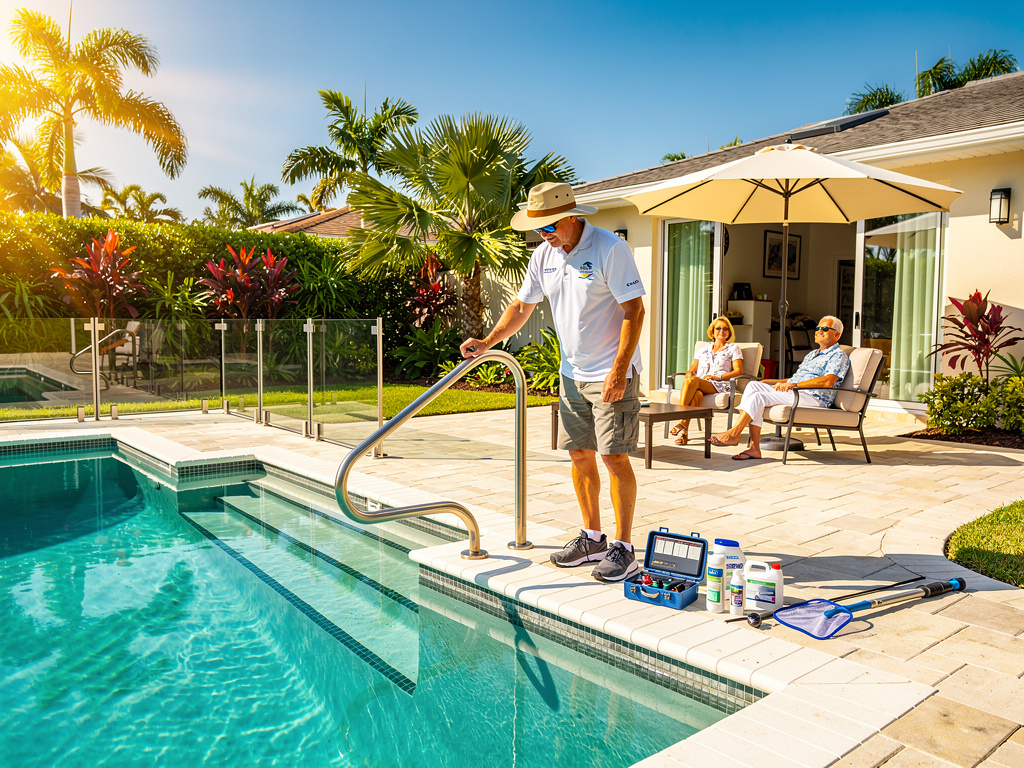
Pembroke Pines’ Retiree Community and Year-Round Pool Life
Pembroke Pines is home to a substantial retiree population — many of whom are the reason for purchasing in a planned Pembroke Pines community in the first place. The combination of well-maintained neighborhoods, strong public safety, access to healthcare, and South Florida’s climate makes Pembroke Pines a preferred retirement destination within Broward County. For active retirees, a private pool is not just a luxury; it is a practical daily-use wellness facility.
In Pembroke Pines’ retirement-age households, pool use patterns differ meaningfully from those in family-with-children households. Retiree pool users tend toward: consistent daily or near-daily use rather than intensive weekend use; lower bather load (one to three adults rather than eight to fifteen during gatherings); aquatic exercise as a primary use (water walking, water aerobics, lap swimming) rather than recreational swimming; and year-round use with minimal seasonal gaps because the users have no school calendar constraining their schedule. Understanding this use profile produces a different set of pool maintenance and design priorities than the multigenerational family pool or the party-use social pool.
Accessibility Features That Transform a Standard Pool Into a Senior-Friendly Pool
The standard residential pool design — a rectangular pool with steps in one corner, a single two-post handrail, and a poured concrete deck — was designed for able-bodied adults of working age. Modifications that improve accessibility for older Pembroke Pines pool users make a meaningful difference in both daily usability and safety, and most can be retrofitted to an existing pool without major reconstruction.
Tanning ledges and shallow entry areas are the single highest-impact accessibility upgrade for a Pembroke Pines retirement household pool. A tanning ledge — a shallow platform, typically 6–12 inches deep, spanning part of one end of the pool — allows an older adult to sit on the ledge with their legs in the water before committing to pool entry, provides a resting platform during water exercise sessions, and allows gradual acclimation to the water temperature. For pool owners with limited lower-body strength or balance challenges, the ledge provides a stable sitting surface for entry and exit that is far safer than descending pool steps while holding a handrail.
Full staircase handrails on both sides of the pool steps — not just the single two-post handrail typical in standard residential pools — provide a significantly safer pool entry for adults who cannot transfer full body weight from one hand. Both rails should be continuous from deck level to the bottom step, with a non-slip grip tape or rubber coating rather than bare metal. For Pembroke Pines retirees who use the pool daily, this feature is used twice per day, every day — the investment is small relative to the daily safety benefit.
Pool lifts are appropriate for Pembroke Pines retirees with mobility limitations that prevent standard step access. A residential pool lift — a hydraulic or battery-powered seat that transfers a user from the deck level into the water and back up — can be installed at the pool deck with a permanently mounted base. Residential pool lifts are available for $2,000–$4,500 installed and are a meaningful quality-of-life investment for a retiree who would otherwise need assistance with pool entry.
Non-slip deck surface treatment is critical for any Pembroke Pines pool where older adults are accessing the pool area on bare feet on a wet concrete or paver surface. Standard pool deck concrete develops a smooth surface over time as the aggregate wears. Non-slip coating products (silica-sand-based additive in a clear sealer) or rubber non-slip mat installations at the step approach and pool perimeter provide meaningful traction improvement that reduces fall risk at the most dangerous transition point — the wet deck immediately adjacent to the pool edge.
Aquatic Exercise: What a Senior-Use Pool Needs
Aquatic exercise — water aerobics, water walking, resistance swimming — provides cardiovascular fitness and strength building with dramatically reduced joint loading compared to equivalent land-based exercise. For Pembroke Pines retirees managing arthritis, joint replacement recovery, or orthopedic limitations, the pool may be the only exercise environment that is both effective and comfortable. The pool design and maintenance implications of primary aquatic exercise use are specific.
Water temperature: For aquatic exercise use, water at 84–86°F is the generally accepted comfort range. At this temperature, muscles warm sufficiently for exercise without the pool feeling uncomfortably warm during exertion. A pool used primarily for water aerobics that is allowed to cool to 78–80°F in Pembroke Pines’ occasional cool winter months (December and January) becomes uncomfortable for the older swimmers whose body temperature regulation is less efficient than younger adults. A heat pump or gas heater maintaining 84–86°F year-round is appropriate for a retirement-use Pembroke Pines pool.
Depth for water aerobics: Water aerobics is most effective when performed in water between waist and chest depth — approximately 3.5 to 4.5 feet. A pool that is entirely deeper than 4.5 feet throughout the main basin provides less usable space for water exercise than a pool with a shallow-to-deep gradient. If a Pembroke Pines retirement household is retrofitting for water exercise use, a bench or perimeter shelf at 3.5-foot water depth around the pool perimeter provides additional exercise positioning options without requiring pool modification.
Resistance jets: Swim jets or resistance jets installed in the pool wall produce a current for stationary resistance swimming — a particularly effective workout for senior users who want cardiovascular exercise without the lap repetition of a standard pool. A resistance jet system can be retrofitted to most existing Pembroke Pines pools through a wall penetration, and the resulting workout capability transforms a pool that’s too small for lap swimming into a full aquatic fitness facility.
Chemistry Adjustments for Senior Pool Users
Senior pool users are more sensitive to chemistry imbalances than healthy young adults. Eye and skin irritation from combined chlorine (chloramines), respiratory irritation from off-gassing of chloramines in warm water, and skin drying from high-sanitizer conditions are all more pronounced in older adults. The chemistry management priorities for a Pembroke Pines retirement-use pool reflect this heightened sensitivity.
Combined chlorine (total chlorine minus free chlorine) should be maintained below 0.2 ppm — the CDC standard — which may require weekly breakpoint chlorination in a pool that’s used daily by even a few adults. Daily use without shock treatment allows combined chlorine to accumulate in the warm Pembroke Pines water, producing the “pool smell” and respiratory irritation that seniors with any respiratory conditions (mild COPD, allergies) find particularly uncomfortable. A well-maintained retirement-use pool should smell of nothing except possibly a faint clean freshness — any chloramine odor is a maintenance signal, not an acceptable background condition.
Water temperature at 84–86°F also means chlorine stability and demand are different than in a cooler pool. Warm water consumes chlorine faster and off-gasses it more readily. A retirement-use Pembroke Pines pool at 85°F needs its free chlorine checked more frequently and may need daily topping in warm weather, particularly if the pool receives direct afternoon sun.
Pool Service Fort Lauderdale provides senior-oriented pool maintenance and accessibility consultation throughout Pembroke Pines FL. Call (954) 501-2754, visit our Pembroke Pines pool service page, or see our main website. 9900 W Sample Rd, Coral Springs, FL 33065.
{“@context”:”https://schema.org”,”@type”:”FAQPage”,”mainEntity”:[{“@type”:”Question”,”name”:”What pool temperature is best for senior water aerobics in Pembroke Pines FL?”,”acceptedAnswer”:{“@type”:”Answer”,”text”:”84–86°F is the generally accepted comfort range for aquatic exercise. This temperature warms muscles adequately for exercise without becoming uncomfortable during exertion. Pembroke Pines retirees using the pool for daily exercise should maintain this range year-round with a heat pump or gas heater, particularly during December–February cool spells.”}},{“@type”:”Question”,”name”:”What is the most important pool safety upgrade for retirees in Pembroke Pines?”,”acceptedAnswer”:{“@type”:”Answer”,”text”:”Full handrails on both sides of the pool steps (not just one post) and a non-slip deck surface at the pool approach are the highest-impact safety upgrades. Falls at pool entry and exit are the most common serious injury for older pool users — these two features directly address that specific risk.”}},{“@type”:”Question”,”name”:”What is a pool lift and do I need one for my Pembroke Pines retirement home pool?”,”acceptedAnswer”:{“@type”:”Answer”,”text”:”A pool lift is a hydraulic or battery-powered seat that transfers a user from deck level into the water and back up. They’re appropriate for retirees with mobility limitations that prevent standard step access. Residential pool lifts cost $2,000–$4,500 installed and significantly expand pool accessibility for users who would otherwise need physical assistance.”}},{“@type”:”Question”,”name”:”Why does my Pembroke Pines pool smell even though I add chlorine regularly?”,”acceptedAnswer”:{“@type”:”Answer”,”text”:”The ‘pool smell’ comes from chloramines (combined chlorine), not free chlorine. Daily use without periodic shock treatment allows combined chlorine to accumulate, particularly in warm 84–86°F water. A properly maintained pool should have no noticeable chlorine odor. Weekly breakpoint chlorination eliminates the accumulation that causes respiratory and eye irritation.”}},{“@type”:”Question”,”name”:”Can I retrofit a tanning ledge into my existing Pembroke Pines pool?”,”acceptedAnswer”:{“@type”:”Answer”,”text”:”Yes, with excavation and concrete work. A tanning ledge can be added to one end of an existing pool by partially excavating, forming a shallow platform at 6–12 inches of depth, and plastering to match. The project typically requires a permit through Pembroke Pines Building Department and costs $3,000–$8,000 depending on size and finish.”}]}}