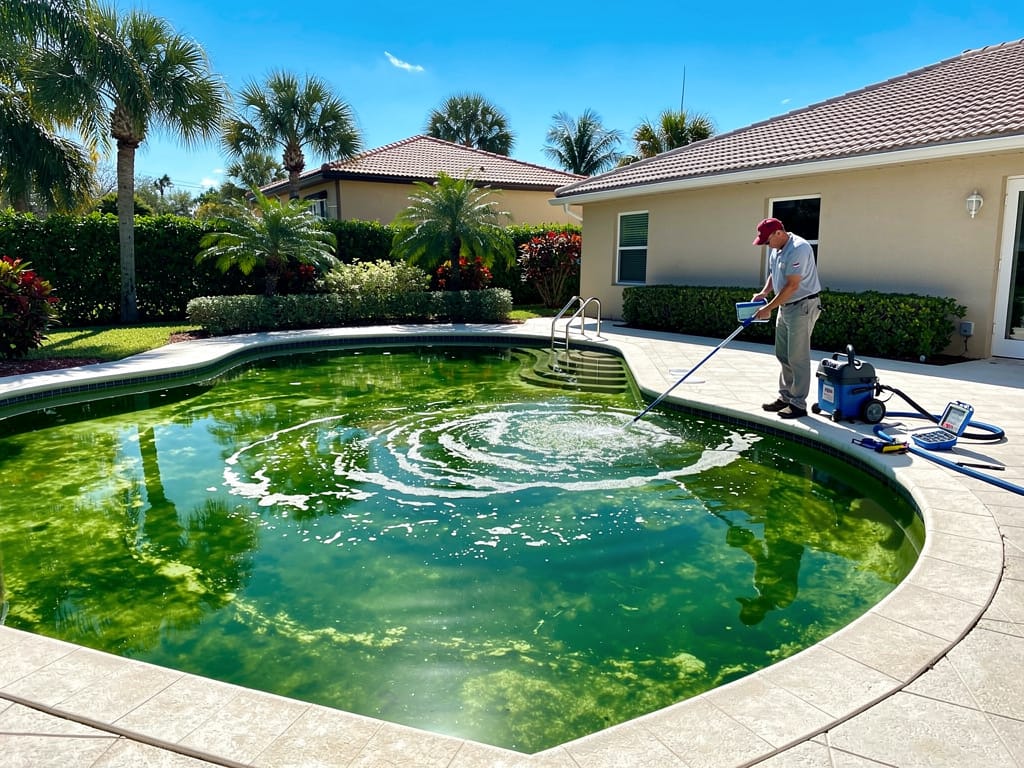
If your Deerfield Beach pool keeps developing algae despite regular shocking and correct chemistry — the chlorine is right, the pH is in range, you’re running the filter enough — phosphates are likely the underlying problem. It’s one of the most commonly misdiagnosed pool issues in South Florida and one of the most straightforward to fix once it’s identified.
This guide explains what phosphates are, why they’re elevated in Deerfield Beach pools specifically, and how to remove them effectively.
What Phosphates Are and Why They Cause Algae in Deerfield Beach Pools
Phosphates (measured as orthophosphates, reported in ppb) are inorganic compounds that serve as a primary nutrient for algae. In the presence of adequate phosphates, algae can survive conditions that would otherwise kill them — including marginally low chlorine levels — and can rebound from a shock treatment within days if the phosphate food source remains.
Think of it this way: chlorine kills algae cells, but if you don’t eliminate the food supply that allows algae to proliferate, you’re fighting a battle you’ll keep losing. Shocking a high-phosphate pool kills the current algae bloom but doesn’t prevent the next one from growing back.
The critical threshold in Deerfield Beach pools: most pool professionals consider 200–300 ppb to be the upper acceptable limit. Above 300 ppb, algae control becomes significantly more difficult. Above 1,000 ppb, phosphate levels are high enough that standard chlorine management struggles to prevent recurring algae regardless of other chemistry parameters.
Why Deerfield Beach Pools Have Elevated Phosphates
Broward County municipal water: This is the most significant and least understood phosphate source. Broward’s water supply contains phosphates deliberately added as pipe corrosion inhibitors — compounds that coat the inside of water mains to prevent lead and copper leaching from older pipes. Every gallon of make-up water added to a Deerfield Beach pool brings phosphates in. Fill a pool from near-zero phosphates to 15,000 gallons with Broward tap water, and you may start at 150–250 ppb from the fill water alone before any external source contributes.
Fertilizer runoff: Deer Creek’s golf course maintenance, standard lawn care throughout Deerfield Beach’s residential neighborhoods, and the Quiet Waters Park area’s maintained green spaces all use fertilizers that contain phosphates. Rainfall washes these into pools, particularly during Deerfield Beach’s June–September rainy season. A heavy summer rain event can spike a pool’s phosphate level by 200–400 ppb in a single event.
Organic material decomposition: Leaves, grass clippings, pollen, and other organic material decompose in pool water and release phosphates. Deerfield Beach’s mature landscaping in Deer Creek and Cypress Bend neighborhoods means significant leaf and organic debris input, particularly in fall when deciduous trees (and some Florida ornamentals) drop leaves before the snowbird season begins.
Bather waste: Sunscreen, body oils, urine, and other bather waste contain phosphates. Pools with high bather loads (family pools, community pools) accumulate phosphates faster than lightly used pools.
How to Test for Phosphates in Your Deerfield Beach Pool
Phosphate testing requires a specific test — phosphates are not measured by standard 5-in-1 test strips that cover chlorine, pH, alkalinity, hardness, and CYA. Two options:
Professional water test: Your pool service provider or a pool supply store can test phosphate levels from a water sample. Ask for a phosphate reading specifically when getting a full water panel — not all standard tests include phosphates unless requested.
Phosphate test kit: Drop-based phosphate test kits are available at pool supply stores for $15–$30. They test in a 0–2,000 ppb range and give results in minutes. Useful for homeowners who want to monitor monthly without a professional water test each time.
How to Remove Phosphates From Your Deerfield Beach Pool
Phosphate removers are lanthanum-based compounds that bind phosphates and cause them to precipitate out of the water as a white cloudiness that’s then captured by the filter. Treatment protocol:
- Test phosphate level to determine dose
- Add the appropriate dose of phosphate remover (follow product dosing chart for your pool volume and measured phosphate level)
- Run the filter 24/7 for 24–48 hours to capture the precipitated phosphates
- Clean or backwash the filter 24 hours after treatment — the phosphate precipitate loads the filter quickly
- Retest phosphates 48–72 hours after treatment to confirm reduction
Important note for Deerfield Beach pool owners: high-dose phosphate removal (treating levels above 1,000 ppb) can cause significant water cloudiness during treatment. This is normal — it means the treatment is working. Don’t add other chemicals or shock during the treatment period. Run the filter, clean it when pressure rises, and give it 48 hours before assessing whether a second treatment is needed.
Maintaining Low Phosphates in Deerfield Beach’s Environment
Because Deerfield Beach’s municipal water, landscaping, and rainfall continuously add phosphates, maintaining low levels is an ongoing process, not a one-time treatment:
- Test phosphates monthly May–September (peak runoff and evaporation season)
- Treat before levels exceed 300 ppb — smaller, more frequent treatments are easier than large single-dose treatments
- Brush debris from the pool surface regularly (organic material decomposing in the pool is a continuous phosphate source)
- Consider using a sequestrant product that also contains phosphate-binding compounds for ongoing maintenance
For phosphate testing, treatment, and comprehensive pool chemistry service in Deerfield Beach, contact Pool Service Fort Lauderdale at (954) 501-2754.
Frequently Asked Questions
Why does my Deerfield Beach pool keep turning green even though my chlorine levels are correct?
Recurring green pools despite correct chlorine are the signature symptom of elevated phosphates. High phosphate levels (above 300-500 ppb) allow algae to survive and rapidly regrow even at acceptable chlorine levels. Test phosphates specifically — they’re not included in standard strip tests — and treat before re-shocking. Treating phosphates before shocking is the correct sequence: remove the food source, then kill the algae.
How long does phosphate remover take to work in a Deerfield Beach pool?
You’ll see water clouding within 1-2 hours of adding phosphate remover as the lanthanum binds to phosphates and precipitates. The cloudiness clears within 24-48 hours as the filter captures the precipitate. Clean or backwash the filter 24 hours after treatment to prevent clogging. Test phosphates 48-72 hours after treatment to confirm they’ve dropped to acceptable levels.
Are phosphate removers safe for swimmers?
Yes. Lanthanum-based phosphate removers are safe for swimmers once the product has been diluted and circulated — typically 1-2 hours after adding the product with the pump running. The temporary cloudiness during treatment is not a safety concern, but waiting for the water to clear before swimming is recommended for visibility reasons. There are no residual health effects from phosphate remover treatment.
Can I prevent phosphates from building up in my Deerfield Beach pool?
You can slow the rate of accumulation but not prevent it entirely in Deerfield Beach’s environment. Broward municipal water continually adds phosphates with every make-up water addition; fertilizer runoff during rainy season is unavoidable. Preventive strategies: keep debris out of the pool, rinse off before swimming, add a monthly dose of a phosphate preventive product, and test monthly to catch rising levels before they become algae problems.
My pool service company hasn’t mentioned phosphates. Should I bring it up?
Yes, if you’re experiencing recurring algae. Ask your service provider to include phosphate testing in your next full water panel. Many standard service visits test the 5-6 most common parameters (chlorine, pH, alkalinity, hardness, CYA) without specifically measuring phosphates unless the customer requests it or the service protocol includes it. Knowing your baseline phosphate level is useful diagnostic information in Deerfield Beach’s high-phosphate environment.
{
“@context”: “https://schema.org”,
“@type”: “FAQPage”,
“mainEntity”: [
{
“@type”: “Question”,
“name”: “Why does my Deerfield Beach pool keep turning green even though my chlorine levels are correct?”,
“acceptedAnswer”: {
“@type”: “Answer”,
“text”: “Recurring green pools despite correct chlorine is the signature symptom of elevated phosphates. High phosphate levels (above 300-500 ppb) allow algae to survive even at acceptable chlorine levels. Test phosphates specifically — they’re not included in standard strip tests — and treat before re-shocking.”
}
},
{
“@type”: “Question”,
“name”: “How long does phosphate remover take to work in a Deerfield Beach pool?”,
“acceptedAnswer”: {
“@type”: “Answer”,
“text”: “Water clouding appears within 1-2 hours as lanthanum binds to phosphates and precipitates. Cloudiness clears within 24-48 hours as the filter captures the precipitate. Clean or backwash the filter 24 hours after treatment. Test phosphates 48-72 hours later to confirm reduction.”
}
},
{
“@type”: “Question”,
“name”: “Are phosphate removers safe for swimmers?”,
“acceptedAnswer”: {
“@type”: “Answer”,
“text”: “Yes. Lanthanum-based phosphate removers are safe for swimmers once diluted and circulated — typically 1-2 hours after adding with the pump running. Waiting for the water to clear before swimming is recommended for visibility reasons. There are no residual health effects.”
}
},
{
“@type”: “Question”,
“name”: “Can I prevent phosphates from building up in my Deerfield Beach pool?”,
“acceptedAnswer”: {
“@type”: “Answer”,
“text”: “You can slow accumulation but not prevent it entirely. Broward municipal water continuously adds phosphates with every make-up water addition; fertilizer runoff during rainy season is unavoidable. Test monthly, keep debris out of the pool, and add a monthly phosphate preventive product.”
}
},
{
“@type”: “Question”,
“name”: “My pool service company hasn’t mentioned phosphates. Should I bring it up?”,
“acceptedAnswer”: {
“@type”: “Answer”,
“text”: “Yes, if you’re experiencing recurring algae. Ask your provider to include phosphate testing in your next full water panel. Many standard service visits don’t test phosphates unless specifically requested. Knowing your baseline phosphate level is useful in Deerfield Beach’s high-phosphate environment.”
}
}
]
}