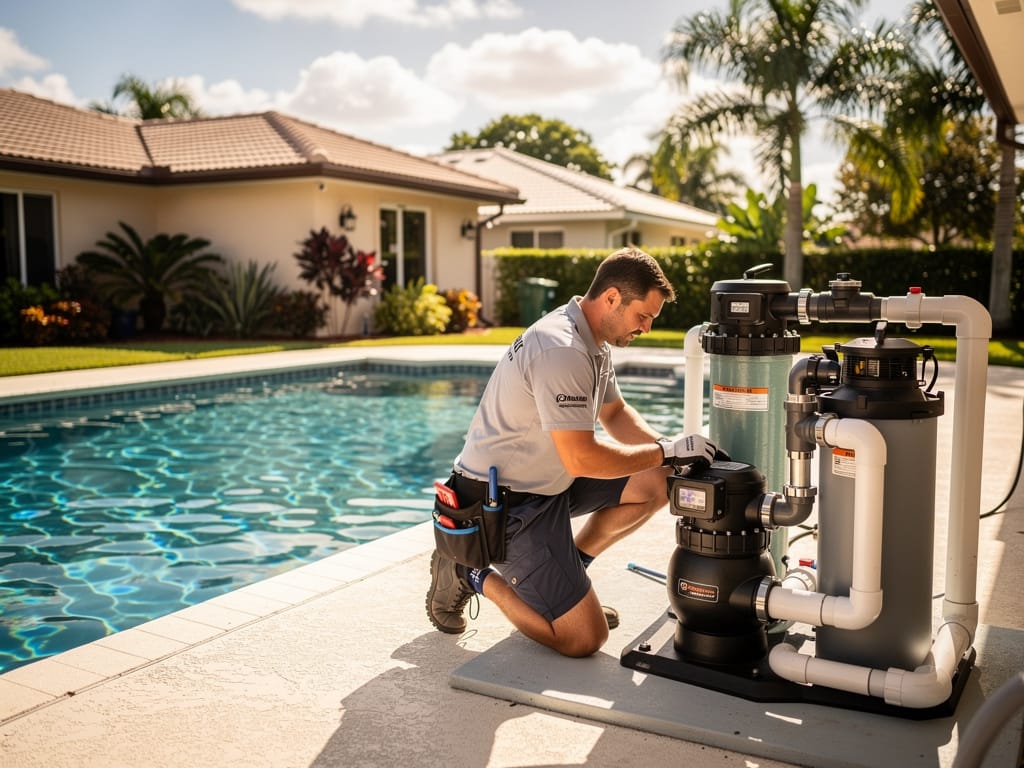
Your pool pump is making a grinding noise. Or it’s stopped moving water. Or it’s been running fine for years but a technician just told you it’s time to consider replacement. Pool pump decisions in Coral Springs involve real money on both sides — repair can be wasted expense on a pump about to fail, while replacement on a fixable pump is an unnecessary $1,000+ outlay.
Here’s how to think through the repair vs. replacement decision for Coral Springs pools, including the specific economics of variable-speed pumps in Florida’s electricity rate environment.
Common Pool Pump Problems: What They Mean
Before deciding between repair and replacement, understand what’s actually wrong. Common pump problems break into three categories:
Electrical/motor problems: Capacitor failure (the most common single repair — the capacitor starts the motor), motor bearing failure (produces a grinding or screeching noise), thermal overload trips (pump runs then shuts off, often because the motor is overheating), and motor winding failure (no start, sometimes with a burning smell). Capacitor replacement is $75–$150. Motor replacement is $300–$500 but can be worth it on a younger pump with a good housing.
Mechanical/seal problems: Mechanical seal failure causes water to leak from around the motor shaft — you’ll see dripping from the area between the wet end and the motor. Seal replacement costs $100–$200 in parts and labor. If ignored, water ingress destroys the motor bearings within weeks.
Housing/impeller problems: Cracked pump housing (usually from freeze damage — unlikely in Coral Springs but possible during rare cold snaps), broken impeller (causes poor flow with motor running fine), and clogged impeller (debris packed in the impeller — common in pools surrounded by trees). Housing cracks render the pump unrepairable. Impeller cleaning or replacement is $75–$200.
The 50% Rule: The Decision Framework
The industry-standard guideline for pool pump repair vs. replacement: if the repair cost exceeds 50% of the cost of a new equivalent pump, replace instead of repair. Here’s how that plays out:
A basic single-speed pump replacement installed in Coral Springs costs $500–$800. Under the 50% rule, repairs over $250–$400 on a single-speed pump don’t make financial sense — especially if the pump is older than 6–8 years and may need another repair within a year or two.
A variable-speed pump replacement costs $800–$1,500 installed. Under the 50% rule, repairs up to $400–$750 make sense — but only if the pump is relatively young (under 7 years). Older pumps are approaching end-of-life regardless of the repair.
Age is the most important modifier of the 50% rule. Even a cheap repair on a 12-year-old pump is often money ill-spent when the motor windings, bearings, and seals are all near end-of-life simultaneously.
Why Single-Speed Pumps in Coral Springs Are Obsolete
If you have an older single-speed pump and it needs replacement, this is your moment to upgrade. Single-speed pumps run at maximum RPM 100% of the time — typically 3,450 RPM. A variable-speed pump can run at 1,500–2,000 RPM for normal filtration and only ramp up when higher flow is needed (cleaning cycles, spa, water features).
The energy savings are significant. In Florida, where pools run year-round and electricity rates average $0.12–$0.15 per kWh, a typical single-speed 1.5 HP pump costs $600–$900 per year to operate. A variable-speed pump performing the same function at lower RPMs costs $100–$200 per year. The difference — $500–$700 annually — means a $1,200 variable-speed installation pays for itself in 18–24 months.
Florida Power & Light and other Florida utilities have offered rebates of $100–$200 for variable-speed pump installation. Ask your service provider if current rebates are available at the time of your replacement.
Note: Florida law (Florida Building Code, Section 424) has required variable-speed pumps on new pool installations since 2017. When you replace a single-speed pump, you’re upgrading to the current standard while also capturing significant energy savings.
What Pool Pump Replacement Costs in Coral Springs
Installed costs for pool pump replacement in Coral Springs (2026 pricing):
- Single-speed replacement (1.0–1.5 HP): $450–$700 installed
- Variable-speed replacement (entry level — Hayward MaxFlo VS, Pentair SuperFlo VS): $750–$1,100 installed
- Variable-speed replacement (premium — Hayward TriStar VS, Pentair IntelliFlo3): $1,000–$1,500 installed
Labor for pump replacement typically runs $150–$250 for a straightforward swap on compatible plumbing. Costs rise if plumbing modifications are needed to accommodate a different pump footprint or if the union fittings are corroded and need replacement.
DIY Pool Pump Repair vs. Hiring a Professional
Some pump repairs are genuinely DIY-friendly: cleaning a clogged impeller, replacing a worn lid O-ring, or clearing a blocked strainer basket are all straightforward. Capacitor replacement is intermediate — manageable for someone comfortable with basic electrical work and aware of the risks of stored charge in capacitors.
Motor replacement and seal replacement cross into professional territory for most homeowners. Installing a mechanical seal incorrectly leads to immediate re-failure and water damage to the new motor. Miswired motor connections are a fire and shock hazard.
For anything beyond basic cleaning and O-ring replacement, professional pump service in Coral Springs is the safer and often faster path to resolution.
For pool pump service and replacement in Coral Springs, contact Pool Service Fort Lauderdale at (954) 501-2754 or visit our Coral Springs service page.
Frequently Asked Questions
How do I know if my pool pump motor is failing vs. the wet end?
If the motor runs (you hear it operating) but you have poor or no water flow, the problem is likely in the wet end — clogged or broken impeller, airlocked housing, or blocked suction line. If the motor doesn’t start, makes a grinding/humming noise without turning, or trips the breaker, the problem is in the motor itself (capacitor, bearings, or windings).
Can I run my pool without a pump for a few days while waiting for a repair?
In Coral Springs summer conditions, running a pool without circulation for more than 24–48 hours risks algae growth and chemistry drift. If your pump fails mid-summer, prioritize rapid repair or replacement. If you must wait, add extra chlorine and algaecide and manually stir or mix the water daily to prevent dead spots.
How long do pool pumps last in Coral Springs?
Standard single-speed pumps typically last 8–12 years with proper maintenance. Variable-speed pumps, which run at lower RPMs and generate less heat, often last 10–15 years. Pumps in South Florida’s outdoor environment — UV exposure, humidity, salt air in coastal areas — may reach the lower end of these ranges. Annual equipment inspections catch failing components before catastrophic failure.
My pump is noisy but still moves water — should I replace it now or wait?
Noise diagnoses the specific problem. A grinding/growling sound = bearing failure — replace promptly, as a failing bearing can lock up and burn the motor. A squealing sound = impeller or seal issue — inspect and repair. A general increase in operating noise without other symptoms — have a technician listen and assess. Operating a pump with failing bearings increases the risk of a sudden failure at an inconvenient time.
Is it worth repairing a pool pump if I’m planning to sell my house?
In Coral Springs’s active real estate market, pool equipment condition matters to buyers and inspectors. A non-functional or visibly failing pump will come up in a pool inspection and may affect sale price or require a repair credit. Installing a newer variable-speed pump before listing can be positioned as an upgrade and may net more than its cost in sale price. At minimum, ensure the pump is functional before listing.