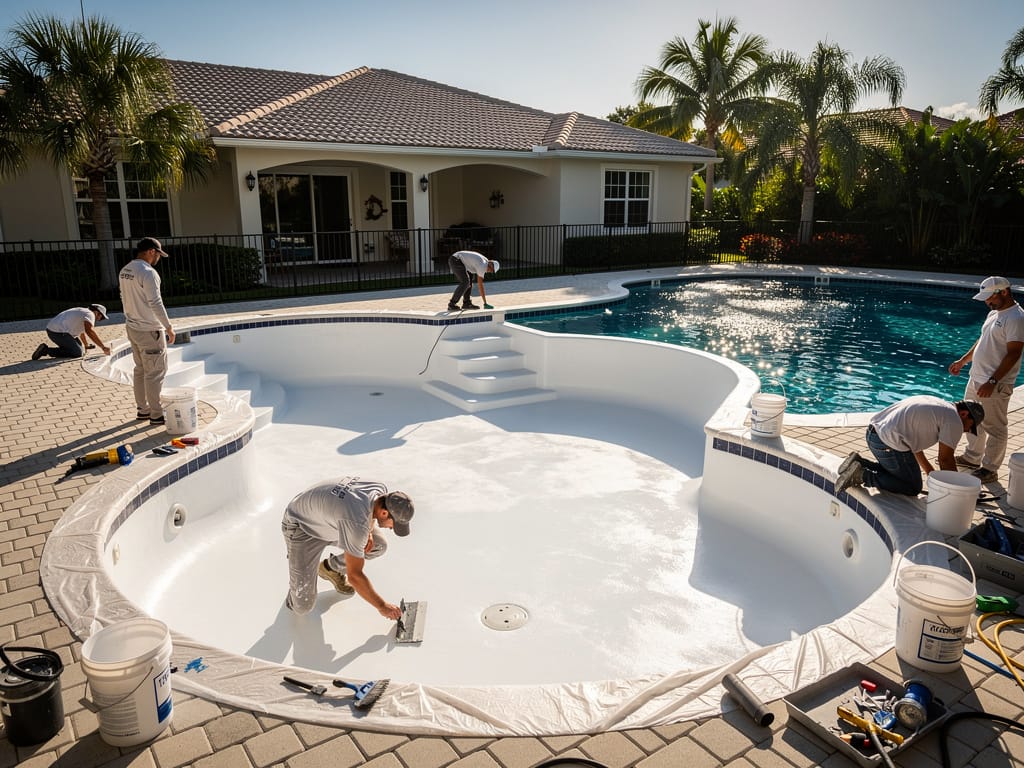
Choosing a resurfacing material for a Hallandale Beach pool involves different trade-offs than the same decision for a pool in Plantation or Coral Springs. The coastal environment — salt air, beachfront water table, year-round subtropical heat — creates surface chemistry demands that accelerate wear on softer surface materials and reward the investment in more durable options.
At Pool Service Fort Lauderdale, we provide post-resurfacing startup chemistry services and ongoing maintenance for newly resurfaced pools throughout Hallandale Beach. We see the real-world performance of different surface materials in this specific environment and have formed clear views on what holds up and what doesn’t.
Why Hallandale Beach’s Environment Is Harder on Pool Surfaces
Year-Round Chemical Demand
Pool surfaces accumulate wear from two primary chemical mechanisms: etching (caused by acidic, low-pH water drawing minerals from the surface) and scaling (caused by oversaturated, high-pH water depositing minerals onto the surface). Both cause surface roughening and degradation over time.
Because Hallandale Beach pools operate year-round without the dormant winter period that gives northern pools a rest, surfaces accumulate the same chemical stress exposure in 10 years of Florida operation that a northern pool would experience in 20+ calendar years of ownership. Year-round operation compresses the surface lifespan.
Broward County Hard Water
As described in our calcium scaling guide, Broward municipal water delivers 200-350 ppm calcium hardness to Hallandale Beach pools. South Florida’s high evaporation rate concentrates these minerals rapidly, creating chronic scaling pressure on pool surfaces when pH drifts above 7.6 — which it does naturally without regular acid additions. Pool plaster is more vulnerable to this calcium carbonate scaling than harder aggregate surfaces.
Saltwater Pools at Coastal Properties
Many Hallandale Beach pools are saltwater systems — and the 3,200 ppm salt concentration in a saltwater pool is more corrosive to plaster surfaces than the equivalent chlorine pool. The electrolytic environment at the salt-water/surface interface attacks calcium carbonate in the plaster matrix more aggressively than fresh chlorine water, accelerating surface roughening and leaching.
Surface Material Performance in Hallandale Beach
White Plaster (Marcite)
Standard white plaster is the original and least expensive pool surface material, but it’s the softest and most vulnerable to Hallandale Beach’s chemical environment. Expected lifespan in Hallandale Beach: 6-10 years for saltwater pools or beachfront properties; 8-12 years for inland Hallandale Beach chlorine pools with good chemistry management.
Typical cost: $4,500-$7,500 for a standard residential pool. For Hallandale Beach homeowners who are highly diligent about water chemistry management and plan to resell within 10 years, plaster is a reasonable cost-minimizing choice. For long-term owners who want to minimize the frequency of resurfacing cycles, the alternatives below offer better value over a 20-year ownership horizon.
Quartz Aggregate (Diamond Brite, Sunstone, and Similar)
Quartz aggregate finishes embed crushed quartz crystals in a Portland cement matrix, producing a surface significantly harder than basic plaster. The quartz is chemically inert and resists both etching from low pH and calcium bonding from high pH better than pure plaster. In Hallandale Beach’s hard water environment, quartz aggregate outperforms plaster measurably.
Expected lifespan in Hallandale Beach: 12-15 years for most properties; 10-13 years at saltwater or beachfront properties. Typical cost: $6,500-$10,000. For most Hallandale Beach homeowners, quartz aggregate is the recommended value choice — meaningful durability upgrade over plaster at a manageable cost premium.
Pebble Aggregate (Pebble Tec, Pebble Sheen, and Similar)
Pebble aggregate surfaces embed natural river pebbles or glass beads in a cement matrix. The natural stone aggregate is significantly harder than either cement or quartz, making it the most resistant to both etching and scaling chemistry. The surface texture is naturally irregular — creating a visually distinctive appearance and excellent non-slip texture — and the aggregate’s UV stability means color holds better over time than plaster finishes.
Expected lifespan in Hallandale Beach: 18-22 years for most properties, including saltwater and near-beachfront installations. This is a meaningful lifespan advantage over both plaster and quartz — potentially avoiding one full resurfacing cycle in a 20-year ownership period. Typical cost: $9,000-$15,000+.
For Hallandale Beach homeowners with saltwater pools, beachfront properties, or those planning long-term ownership, pebble aggregate is the recommended choice based on real-world performance in coastal Broward County conditions.
What to Expect During and After Resurfacing
A Hallandale Beach pool resurfacing project follows the same general sequence regardless of surface material: drain (6-8 hours), prepare the shell (pressure wash, repair cracks, replace fittings), apply new surface material, refill immediately after application, and complete a startup chemistry process over 5-7 days.
The startup chemistry is critical for any new surface — particularly important for Hallandale Beach pools where Broward’s hard water provides immediate scaling pressure. The first 30 days after resurfacing require more frequent chemistry checks (typically 3x weekly) and careful pH control to prevent calcium deposits from forming on the new surface before it has fully cured.
Pool Service Fort Lauderdale provides post-resurfacing startup chemistry management for newly resurfaced pools throughout Hallandale Beach — ensuring the new surface gets the chemical environment it needs during the critical first month. Call (954) 501-2754 or visit our Hallandale Beach service page. All coverage at poolservicefortlauderdale.us.
Frequently Asked Questions
{
“@context”: “https://schema.org”,
“@type”: “FAQPage”,
“mainEntity”: [
{
“@type”: “Question”,
“name”: “How long does pool plaster last in Hallandale Beach, FL?”,
“acceptedAnswer”: {
“@type”: “Answer”,
“text”: “In Hallandale Beach’s hard water, coastal environment, and year-round operation, pool plaster typically lasts 8-12 years for chlorine pools with good chemistry management, or 6-10 years for saltwater pools or beachfront properties with intense salt air exposure. Both are shorter than the 10-15 year estimates in softer-water, non-coastal markets.”
}
},
{
“@type”: “Question”,
“name”: “Which pool surface material is best for a saltwater pool in Hallandale Beach?”,
“acceptedAnswer”: {
“@type”: “Answer”,
“text”: “Pebble aggregate (Pebble Tec and similar) is the recommended choice for saltwater pools in Hallandale Beach. The natural stone aggregate is significantly harder than plaster or quartz, resisting the electrolytic etching that saltwater chemistry accelerates on softer surfaces. Expected lifespan: 18-22 years vs. 6-10 years for plaster in the same application.”
}
},
{
“@type”: “Question”,
“name”: “What does pool resurfacing cost in Hallandale Beach?”,
“acceptedAnswer”: {
“@type”: “Answer”,
“text”: “White plaster: $4,500-$7,500. Quartz aggregate (Diamond Brite, Sunstone): $6,500-$10,000. Pebble aggregate (Pebble Tec and similar): $9,000-$15,000+. Prices depend on pool size, current shell condition, and any structural repairs needed before resurfacing.”
}
},
{
“@type”: “Question”,
“name”: “Why does pool resurfacing need special chemistry management in Hallandale Beach?”,
“acceptedAnswer”: {
“@type”: “Answer”,
“text”: “New pool surfaces are chemically active during curing and vulnerable to both etching (from low pH) and calcium deposits (from Broward’s hard water at elevated pH). In Hallandale Beach’s hard water environment, the first 30 days after resurfacing require 3x weekly chemistry checks and careful pH control to prevent calcium from permanently bonding to the new surface before it has cured.”
}
},
{
“@type”: “Question”,
“name”: “Is quartz aggregate worth the extra cost over plaster for a Hallandale Beach pool?”,
“acceptedAnswer”: {
“@type”: “Answer”,
“text”: “Yes, for most Hallandale Beach homeowners. Quartz aggregate adds $2,000-$3,000 to resurfacing cost but extends surface lifespan by 4-6 years in Hallandale Beach’s coastal conditions. Over a 20-year ownership period, the additional durability may prevent one full resurfacing cycle — saving $4,500-$7,500 in avoided future resurfacing cost.”
}
}
]
}
How long does plaster last here? 8-12 years for chlorine pools; 6-10 years for saltwater or beachfront properties. Both shorter than inland estimates.
Best surface for a saltwater pool? Pebble aggregate — hardest material, most resistant to saltwater’s electrolytic etching. 18-22 year expected lifespan.
What does resurfacing cost? Plaster: $4,500-$7,500. Quartz: $6,500-$10,000. Pebble: $9,000-$15,000+.
Why does new surface need special chemistry? Broward’s hard water creates immediate calcium scaling pressure on new surfaces. 30-day careful chemistry management during curing prevents permanent early deposits.
Is quartz worth it over plaster? Yes — adds $2,000-$3,000 upfront, but may prevent one full resurfacing cycle over 20 years of Hallandale Beach ownership.