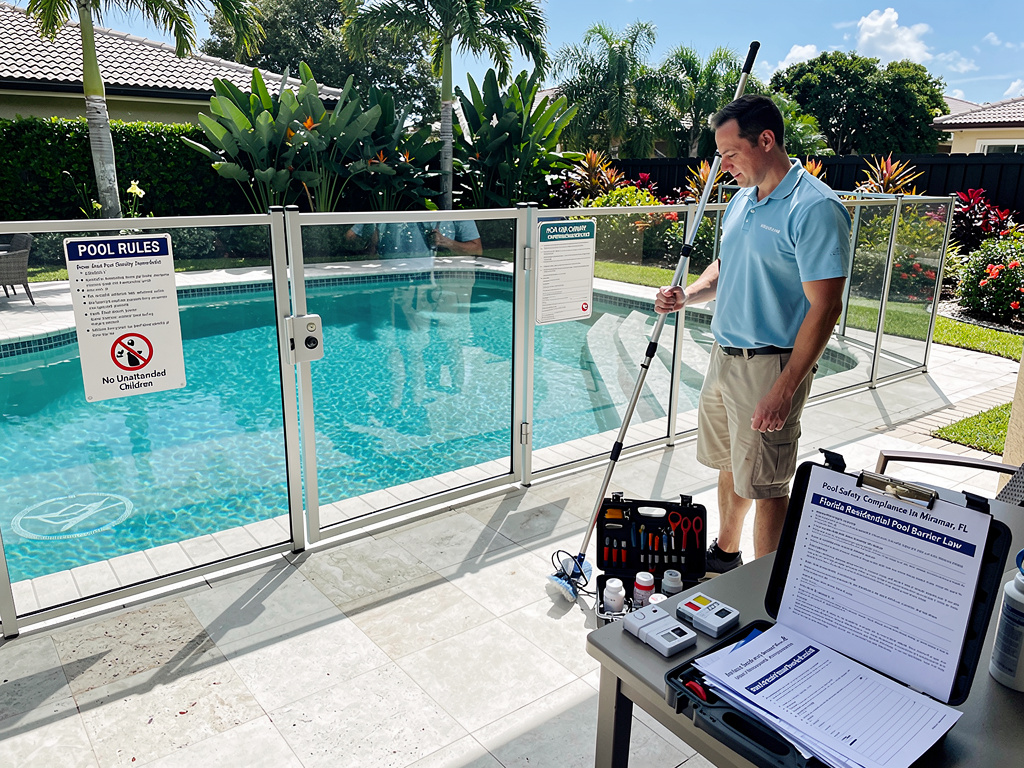
Why Pool Safety Compliance Matters More in a Fast-Growing City
Miramar’s rapid growth — the city has been one of Florida’s fastest-growing municipalities for more than a decade — means a large and continuing flow of new pool installations across its expanding residential developments. This pace of growth creates specific safety compliance considerations: newly installed pools are subject to the most current version of Florida’s building code, Broward County’s local amendments, and the city of Miramar’s own zoning and construction requirements. What was compliant for a pool installed in Miramar in 2005 may not meet 2024 standards, and buyers purchasing older Miramar homes should verify that their existing pool meets current requirements rather than assuming older installations were inspected to current standards.
Florida’s drowning statistics are among the most serious in the United States, and Broward County — including Miramar — has been a focus of state and county public health campaigns around residential pool safety. The enforcement of pool barrier requirements, once primarily complaint-driven, has become more active in Miramar’s code enforcement operations as the city’s population density has increased and the concentration of families with young children in Miramar’s newer developments has grown. Understanding current requirements and ensuring compliance is both a legal obligation and a genuine safety imperative in Miramar’s family-oriented community.
Florida’s Residential Pool Safety Act: What It Requires
The Florida Residential Swimming Pool Safety Act (FHAB, Chapter 515) applies to all residential swimming pools built after October 1, 2000. For pools built before that date, compliance is strongly recommended even if not legally mandated. The Act requires that any residential pool have at least one of the following safety features:
Option 1 — Pool barrier fence: A fence or wall at least 48 inches high, surrounding the pool on all four sides (not using the home as one side, unless the door alarm option below is also in place), with no openings large enough for a 4-inch sphere to pass through (preventing child foot-holds and head-through risks), non-climbable on the pool side, and equipped with a self-closing, self-latching gate where the latch is on the pool side and above child reach (at least 54 inches from the bottom of the gate).
Option 2 — Safety cover: An ASTM F1346-certified power safety cover or safety barrier that meets specific load-bearing and entrapment-prevention standards. Note that standard solar blankets do NOT qualify — an ASTM-certified safety cover is a rigid or motor-driven cover designed to support child and adult weight and prevent access to the water.
Option 3 — Door/window alarms: All doors and windows in the home that provide direct access to the pool area must have an audible alarm that sounds when opened. The alarm must meet ASTM F2208 standards and sound within 7 seconds of activation at a minimum 85 dB measured at 10 feet.
Most Miramar residential pools use Option 1 (barrier fence) as the primary method because it provides passive protection without requiring any action by household members or guests. Options 2 and 3 require consistent use to be effective and depend on human compliance that may not be reliable in a household with multiple family members or guests.
Broward County and Miramar Local Amendments
Broward County has adopted the Florida Building Code with local amendments that apply to Miramar pool installations. The permit process for a new Miramar pool installation runs through the City of Miramar Building Department, which reviews applications for conformance with Florida Building Code, Broward County local amendments, and Miramar’s own zoning code (particularly setback requirements from property lines, structures, and easements).
Typical Miramar pool setbacks require: minimum 5 feet from property lines; minimum 7.5 feet from the primary structure; and minimum 3 feet from any easement. Pools on HOA lots in Miramar may have additional setback requirements established in the community’s plat or deed restrictions. The city’s zoning department review as part of the permit process checks for compliance with all applicable setbacks before construction begins.
Miramar’s growth has increased permit processing times at the city’s Building Department compared to historical norms. Homeowners planning a new pool installation should budget realistic permit processing time — typically 4–8 weeks for plan review in Miramar’s current construction volume environment — into their project timeline before signing contractor agreements with specific start dates.
The Virginia Graeme Baker Act: Drain Safety
Federal law requires that all residential pools and spas installed or renovated after December 2008 comply with the Virginia Graeme Baker Pool and Spa Safety Act, which mandates specific drain cover designs intended to prevent suction entrapment. Entrapment — where a swimmer’s body, hair, or limb becomes trapped against a pool drain by the suction force — is a rare but serious and sometimes fatal pool accident type. VGB-compliant drain covers are designed to spread the suction force over a larger area and to prevent hair entrapment through cover geometry.
For Miramar homeowners with older pools — particularly those built before 2008 — verifying that current drain covers are VGB-compliant is a safety action that should not be deferred. Non-compliant covers are still present in older Miramar pools and represent both a safety risk and, for any pool used commercially or as a rental property, a regulatory liability. A pool technician can visually identify whether drain covers are VGB-compliant; replacement covers are typically $30–$80 per drain and require only simple installation.
Safety Features That Exceed Code Minimums
Beyond the legal minimums, several additional safety measures are worth implementing for Miramar pool households with young children, given the concentration of families in the city’s newer developments. Pool alarms — which trigger when something breaks the pool water surface — provide a secondary layer of detection even when a barrier fence is in place. Surface wave sensors and subsurface motion detectors are available at various price points; no single technology is foolproof, but layered protection (barrier + alarm + supervision) is the standard recommended by drowning prevention organizations.
Miramar’s concentration of families from Caribbean and Latin American backgrounds, where extended family visits and large household gatherings are common, makes the “water watcher” supervision protocol particularly worth establishing as a household norm. Designating a specific adult as the water watcher (with the phone away, facing the water) during any pool use by children is the most effective single drowning prevention measure — more effective than any physical barrier alone, and important to maintain even when physical barriers are present.
Pool Service Fort Lauderdale provides pool safety assessments and VGB drain cover inspections throughout Miramar FL. Call (954) 501-2754, visit our Miramar pool service page, or see our main website. 9900 W Sample Rd, Coral Springs, FL 33065.
{“@context”:”https://schema.org”,”@type”:”FAQPage”,”mainEntity”:[{“@type”:”Question”,”name”:”What pool safety barrier is required in Miramar FL?”,”acceptedAnswer”:{“@type”:”Answer”,”text”:”Florida law requires at least one of: a 48-inch barrier fence with self-closing/self-latching gate; an ASTM F1346-certified safety cover (not a standard solar blanket); or audible alarms on all home access points to the pool area. Most Miramar homes use the barrier fence as the primary method since it provides passive protection regardless of household member behavior.”}},{“@type”:”Question”,”name”:”What are the pool setback requirements in Miramar FL?”,”acceptedAnswer”:{“@type”:”Answer”,”text”:”Typical Miramar setbacks require minimum 5 feet from property lines, 7.5 feet from primary structures, and 3 feet from easements. HOA communities may have additional restrictions in their plat or deed documents. The city’s Building Department verifies all setbacks during plan review as part of the permit process.”}},{“@type”:”Question”,”name”:”What is the Virginia Graeme Baker Act and does it apply to my Miramar pool?”,”acceptedAnswer”:{“@type”:”Answer”,”text”:”The VGB Act (2008) requires all residential pools to have drain covers specifically designed to prevent suction entrapment. Pools installed or renovated after December 2008 must comply. Older Miramar pools with pre-VGB drain covers should have them inspected and replaced — VGB-compliant covers cost $30–$80 per drain and reduce a serious safety and liability risk.”}},{“@type”:”Question”,”name”:”How long does a pool building permit take in Miramar FL?”,”acceptedAnswer”:{“@type”:”Answer”,”text”:”Currently 4–8 weeks for plan review in Miramar’s high-volume construction environment. The permit process includes zoning review (setbacks), plan check (structural and code), and multiple inspections during construction. Factor permit timing into project timelines before signing contractor agreements with specific start dates.”}},{“@type”:”Question”,”name”:”Does a solar pool cover qualify as a safety barrier in Miramar FL?”,”acceptedAnswer”:{“@type”:”Answer”,”text”:”No. Standard solar blankets do not qualify under Florida law as safety barriers. Only ASTM F1346-certified safety covers — rigid, power-driven, or mesh covers designed to support adult weight and prevent access to water — meet the code definition. A solar blanket can be easily displaced by a child and provides no meaningful entrapment protection.”}]}}