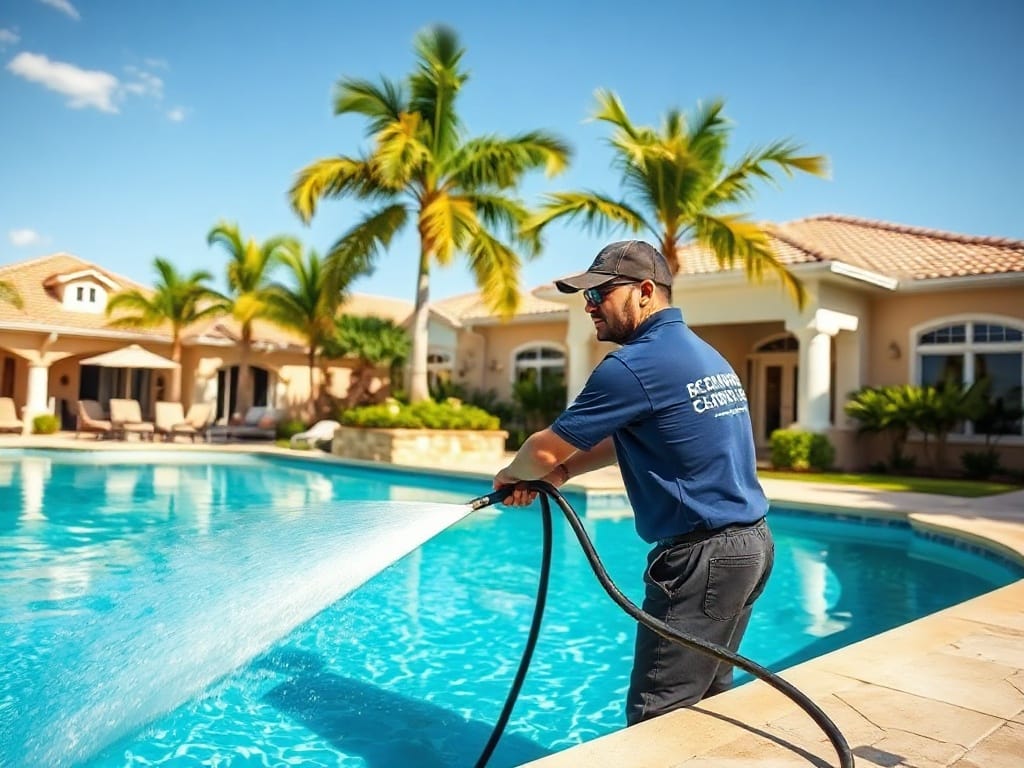
If you own a pool in Boca Raton, FL, you already know that keeping it clean, safe, and properly balanced is a year-round responsibility. Boca Raton’s subtropical climate means pool season never really ends, and the combination of intense sun, frequent afternoon rain, high humidity, and the strict maintenance standards enforced by the city’s many HOA-governed communities creates a pool care environment unlike almost anywhere else in the country. Whether you live in Boca West, Broken Sound, the Polo Club, St. Andrews Country Club, or a waterfront estate near the Intracoastal Waterway, your pool demands consistent, skilled attention to stay in peak condition.
This complete guide covers everything Boca Raton homeowners need to know about professional pool service: service frequency in South Florida’s climate, what a proper weekly visit includes, how HOA requirements affect your maintenance obligations, realistic cost expectations, warning signs your pool needs immediate care, and how to evaluate service companies in a market full of options. If you’re already looking for a local provider, visit our pool service Boca Raton page to learn about our specific coverage and schedule a consultation.
Why Boca Raton Homeowners Treat Pool Maintenance as Non-Negotiable
Boca Raton sits at the northern edge of the South Florida coastal corridor, straddling the Palm Beach–Broward County line. The city’s geography and demographics create a pool maintenance market with some of the highest standards and most demanding conditions in the state. Here is why pool service in Boca Raton is genuinely different from most other markets.
Year-Round Use. Boca Raton’s average annual high temperature sits above 83°F, and lows rarely dip below the mid-50s even in January. The practical result is that most Boca homeowners use their pools in every month of the year. There is no off-season maintenance pause, no period where the pool can coast on a reduced schedule. A pool that is used continuously requires continuous, consistent chemical management and mechanical upkeep.
Intense Algae Pressure. Water temperatures in an unshaded Boca Raton pool regularly exceed 85°F from April through October. Algae of all types — green, black, and mustard — thrive in warm, nutrient-rich water. A single missed service visit during the rainy season can allow green algae to establish a visible bloom within 72 hours of a heavy rain event washing organic material into the pool. Weekly service is not a luxury in this climate; it is the minimum required to prevent recurring algae problems that become increasingly expensive to correct.
High-Value Properties. The median home value in Boca Raton significantly exceeds the national average, and pools are standard features in most single-family communities. A neglected pool doesn’t just create a maintenance problem — it depresses property value, creates a liability, and in HOA communities, triggers formal notices of violation. The cost of a year of professional weekly service is typically a fraction of a single serious chemical remediation or equipment repair caused by deferred maintenance.
HOA Accountability. Boca Raton has one of the highest concentrations of HOA-governed communities in South Florida. Many of those communities — including Boca West, Broken Sound, Woodfield Country Club, the Polo Club, and St. Andrews Country Club — maintain active architectural and landscape review committees that inspect pool conditions and issue violations for green water, visible algae, improper equipment, or unmaintained surrounds. We will address HOA requirements in detail later in this guide.
How Often Should You Service Your Boca Raton Pool?
The answer for nearly every Boca Raton homeowner is: weekly, every week, without exception during the warm months. During the cooler months of December through February, some pools with light use and efficient sanitation systems can tolerate bi-weekly service visits — but this requires monitoring and an honest assessment of the pool’s actual conditions, not a default scheduling decision made for cost reasons.
What drives the weekly standard in Boca Raton specifically:
- Rain frequency: Boca Raton averages over 60 inches of annual rainfall, heavily concentrated in the June through September rainy season. Each rain event dilutes pool chemicals, changes water chemistry, and introduces organic contaminants — leaves, pollen, bird waste, and soil runoff. After a significant rain, water balance can shift enough to stress equipment and create algae conditions within days.
- UV degradation: South Florida’s UV index is among the highest in the continental United States. Chlorine degrades rapidly in direct sunlight, and pools in Boca Raton that are not stabilized with the correct cyanuric acid levels can lose their entire chlorine residual within 24 to 48 hours of a sunny day. Stabilizer levels, chlorine dosing, and shock frequency must be calibrated specifically for this UV environment.
- Bather load and landscaping: Pools surrounded by lush tropical landscaping — common in Boca — receive constant organic material input from dropping flowers, seeds, and leaves. Pools with high bather load from family use introduce additional nitrogen and phosphate, both of which feed algae growth.
- Equipment longevity: Pumps, filters, salt cells, and heaters that receive weekly professional inspection and cleaning last significantly longer than equipment on deferred service schedules. A $400 annual service difference rarely justifies the risk of a $1,500 pump replacement or a $900 filter cleaning that would have been a simple preventive backwash.
What a Professional Pool Service Visit Includes in Boca Raton
A thorough weekly pool service visit covers the water, the physical structure of the pool, and the mechanical systems that keep everything running. Here is what each component involves and why it matters for pools in Boca Raton’s specific environment.
Water Chemistry Testing and Balancing
Every visit begins with testing the water. A complete chemical test covers free chlorine, combined chlorine (chloramines), pH, total alkalinity, calcium hardness, cyanuric acid (stabilizer), and salt level for saltwater pools. Each parameter affects the others, and all of them interact with Boca Raton’s specific source water characteristics — Palm Beach County municipal water tends toward higher pH and calcium hardness levels than water in some other Florida regions, which affects how chemicals are dosed and balanced.
Adjustments are made on the visit based on actual test results, not on a fixed-addition schedule. pH is the most frequently adjusted parameter — it naturally rises in pools from CO2 outgassing and sanitizer additions, and needs regular correction to keep it in the 7.4 to 7.6 range where chlorine is most effective. Alkalinity functions as a pH buffer and is adjusted less frequently but has a major effect on water stability. Calcium hardness is particularly important in South Florida’s environment because low calcium levels cause water to become aggressive and etch plaster surfaces, while high calcium leads to scaling on equipment and tile.
Physical Cleaning
Skimming removes floating debris from the water surface before it sinks and decomposes. Brushing the walls, steps, and floor of the pool removes biofilm — the thin biological layer that forms on all submerged surfaces and serves as the foundation for algae growth if not regularly disrupted. Vacuuming removes settled debris and dead algae from the floor. Tile line cleaning is performed as needed to remove calcium scale buildup, which is a persistent issue in pools with Palm Beach County’s harder source water. Cleaning the skimmer baskets and pump strainer basket ensures adequate flow through the circulation system.
Equipment Inspection and Maintenance
Every service visit includes a visual inspection of the pump, filter, heater, automation system, and any additional equipment. The filter — whether sand, cartridge, or diatomaceous earth — is checked for pressure differential and backwashed or cleaned according to need rather than on a fixed schedule. Salt chlorine generators require cell inspection and periodic cleaning with a mild acid wash to remove calcium buildup on the cell plates, a task that is often neglected on self-service pools and leads to premature cell failure. The technician checks that the pump is priming correctly, that return lines are flowing evenly, and that all valves and fittings are intact.
For the full scope of services available to Boca Raton properties, our pool service Fort Lauderdale team serves the entire Broward and southern Palm Beach County region with the same standard of care.
Boca Raton Communities and Neighborhoods We Serve
Boca Raton is one of South Florida’s most geographically and demographically diverse cities, with residential communities ranging from dense east-side condominiums to vast gated country club estates in the west. Pool service needs and HOA requirements vary significantly across these communities, and effective service requires familiarity with the specific conditions in each area.
Boca West. The largest private country club community in the United States, Boca West encompasses over 1,400 acres west of Military Trail with four golf courses and thousands of residential units. Pool owners in Boca West deal with a combination of heavy shade from mature trees (which reduces direct UV but increases organic debris input) and very active HOA oversight. The Boca West Country Club community association maintains standards for pool appearance and condition that are enforced visually from the street and by neighbor reports.
Broken Sound Club. Located along Clint Moore Road and Yamato Road, Broken Sound is a high-density gated community with condominiums, villas, and single-family homes surrounding two golf courses. Pool owners in this community deal with proximity to the golf course — cart path runoff and irrigation overspray can introduce chemicals and organic material into pools, requiring more frequent water testing during active irrigation periods.
Polo Club of Boca Raton. One of the more upscale gated communities in northwest Boca, the Polo Club’s HOA maintains strict visual standards for all residential properties including pools. Pool water must remain visibly clear at all times, and equipment must be properly screened or housed per community guidelines.
Woodfield Country Club. Located along Woodfield Boulevard in the Glades Road corridor, Woodfield is a gated single-family community where pool maintenance standards are a point of community pride. Technicians servicing pools in this area are expected to leave the pool deck clean and reset furniture after cleaning visits.
St. Andrews Country Club. One of Boca Raton’s premier addresses, St. Andrews occupies a large parcel in northwest Boca with a community association that manages some of the most demanding property standards in Broward and Palm Beach County. Pools here are typically large, custom-designed features with complex equipment systems including automation, water features, and spa equipment that require technical competence beyond basic chemical service.
Mission Bay. A large family-oriented community in northwest Boca Raton off Lyons Road, Mission Bay features hundreds of single-family homes with pools and an active HOA. It is one of the most pool-dense communities in the western part of the city.
East Boca Raton. Communities along the Intracoastal Waterway and A1A — including Royal Palm Yacht and Country Club, Boca Harbor, and Camino Real estates — feature large waterfront properties with pools that are often subjected to higher salinity in the air, increased moisture exposure, and premium-level homeowner expectations. Equipment in these areas is frequently high-end automation systems from Pentair, Jandy, or Hayward requiring technicians with genuine systems knowledge.
Other Boca Raton communities served: Boca Del Mar, Boca Pointe, Boca Falls, Boca Winds, Camino Lakes, Bocaire Country Club, The Bridges, Stonebridge Country Club, Whisper Walk (55+ community), Boca Lyons, and unincorporated Palm Beach County areas adjacent to the Boca Raton city limits.
Boca Raton HOA Pool Requirements: What Every Homeowner Should Know
Boca Raton has one of the highest concentrations of HOA-governed single-family home communities in South Florida, and the rules governing pool maintenance in those communities are significantly more detailed than state or municipal requirements. Understanding your HOA’s specific pool standards before you hire a service provider can save you significant time, money, and aggravation.
Proof of Licensed Service. Many Boca Raton HOAs require that pools be serviced only by licensed and insured pool service contractors. Florida requires pool service contractors to hold a Certified Pool-Spa Contractor license (CPC) from the Department of Business and Professional Regulation (DBPR). Some communities will ask for the contractor’s license number and certificate of insurance as part of a new resident orientation or upon request. Before hiring any service company in a gated community, confirm that they hold a current Florida CPC license.
Service Log Requirements. Communities like Boca West and several Polo Club sub-associations require pool service companies to maintain a service log on-property that documents each visit: date, technician name, chemical readings before and after treatment, chemicals added, and any observations about equipment. This log can be requested by HOA inspectors during a violation investigation and serves as your defense if a neighbor files a complaint about pool appearance or odor.
Visual Standards and Violations. The typical HOA standard for pool water condition is simple: the pool must appear clear and blue at all times from the pool deck. Green, cloudy, or discolored water is an immediate violation in most communities and can result in a fine of $25 to $100 per day until corrected. More significant is the HOA’s authority to contract emergency remediation at the homeowner’s expense if the condition is not corrected within the notice period — a cost that can easily run $500 to $1,500 for a full remediation.
Service Hours. Many gated communities in Boca Raton enforce service vehicle access restrictions and service hour windows. Most allow contractor access only between 8:00 AM and 5:00 PM, Monday through Friday, with some communities excluding specific days for noise-sensitive events like tournament weekends. Confirm your community’s access and hour rules with your service company before scheduling.
Pool Service Costs in Boca Raton FL: What to Expect
Pool service pricing in Boca Raton generally reflects the city’s premium market position, the technical complexity of many of its pools, and the travel logistics of serving a geographically spread-out market. Here is a realistic breakdown of what you should expect to pay.
Weekly Full-Service Maintenance. For a standard residential pool (15,000 to 20,000 gallons) with typical equipment, weekly full-service maintenance — including chemical testing and balancing, skimming, brushing, vacuuming, basket cleaning, and equipment inspection — typically runs between $150 and $250 per month in the Boca Raton market. Pools with complex equipment (automation, spas, water features, UV systems) or in communities with demanding access requirements may fall toward the upper end of this range or above it.
Chemical Costs. In the standard service model, chemicals are either included in the monthly rate (all-inclusive) or billed separately. All-inclusive pricing tends to be simpler to budget but can penalize customers with efficient pools. Chemical-only billing tends to run $30 to $75 per month for well-maintained pools and more for pools with problems or heavy bather load. Clarify which model your service company uses before signing an agreement.
One-Time Services. Pool openings and closings are not standard in South Florida since pools do not close seasonally, but green pool remediation (algae clearing and chemical shock treatment) typically costs $150 to $300 depending on severity. Pressure washing pool decks costs $100 to $250. Acid washing a plaster pool to remove calcium scale and staining runs $400 to $800 for a typical residential pool.
Equipment Repairs and Replacement. Pump replacement costs $400 to $900 installed depending on the unit. Variable-speed pump upgrades, now required for new installations and increasingly popular for energy efficiency in existing pools, run $800 to $1,400 installed. Salt cell replacement for chlorine generator systems runs $200 to $500 depending on the brand. Filter cartridge replacement is typically $80 to $180 per set. Heater replacement for a residential gas or heat pump heater runs $1,200 to $2,500 installed.
Warning Signs Your Boca Raton Pool Needs Immediate Attention
Between service visits, homeowners should do a quick visual check of their pool every day or two. These are the signs that require a service call rather than waiting for the next scheduled visit.
- Green or teal water: Active algae bloom. Requires immediate shock treatment and brush-down. Do not swim in green water — algae can harbor harmful bacteria, and the high chlorine levels used to treat blooms are unsafe for swimming.
- Cloudy or hazy water: Can indicate chlorine demand (not enough active sanitizer), high combined chlorine from heavy use, high calcium or pH, or a filtration issue. Clear water that clouds within hours of treatment suggests a filtration problem.
- Foam on the water surface: Usually indicates elevated TDS (total dissolved solids), body oils from heavy bather load, or a chemistry imbalance. Persistent foam that doesn’t clear after 24 hours warrants a service visit.
- Strong chlorine odor: Counterintuitively, a strong chlorine smell indicates not enough chlorine — the odor comes from combined chlorines (chloramines) formed when chlorine reacts with nitrogen compounds. A properly balanced pool should have very little odor.
- Pump running loudly or failing to prime: Air in the system, a clogged strainer basket, a failing impeller, or a suction-side leak. Don’t let a noisy pump run unchecked — cavitation destroys pump components quickly.
- Pool losing more than 1/4 inch of water per day: Normal evaporation in Boca Raton is approximately 1/4 inch per day in hot weather. Faster water loss suggests a leak in the shell, plumbing, or equipment.
How to Choose a Pool Service Company in Boca Raton
The Boca Raton market has dozens of pool service providers, ranging from large regional operations to one-person owner-operator businesses. Here is how to evaluate your options before committing to a service agreement.
Verify the Florida CPC License. The Florida DBPR license search at myfloridalicense.com is publicly accessible and takes 60 seconds to use. Enter the company name or the owner’s name and confirm that their Certified Pool-Spa Contractor license is current and in good standing. This is not optional due diligence — it is the minimum standard for any company working on your pool or equipment.
Confirm Insurance. A legitimate pool service company carries general liability insurance (minimum $1 million per occurrence is standard in the industry) and workers’ compensation coverage if they have employees. If a technician is injured on your property or damages your equipment, you need to know their insurance carrier before they start work, not after a claim arises. Ask for a certificate of insurance naming you as the certificate holder.
Ask About Chemical Documentation. A professional service company should be able to provide you with a service log or digital report after each visit showing the chemical readings taken and the adjustments made. Any company that cannot or will not provide this documentation is not doing full testing on each visit — a common shortcut in the industry that eventually results in uncorrected imbalances and equipment damage.
Understand the Agreement Terms. Review the cancellation policy carefully. Many pool service companies in South Florida offer month-to-month agreements, but some lock customers into annual contracts with penalties for early termination. Understand exactly what is included in the monthly fee and what is billed separately before signing anything.
Evaluate Responsiveness. Before you hire, test the company’s responsiveness by calling or emailing with a question. How quickly they respond, how clearly they communicate, and how knowledgeable the person you speak with seems are all accurate predictors of how they will handle service issues once you are a customer.
Frequently Asked Questions: Pool Service in Boca Raton FL
How often do pools in Boca Raton need professional service?
Most Boca Raton pools require weekly professional service year-round due to the subtropical climate, year-round pool use, and HOA standards in most communities. Pools with low bather load and efficient sanitation systems may tolerate bi-weekly service during the cooler months (December through February), but the default standard for South Florida pools is weekly.
Does my Boca Raton HOA require a licensed pool service company?
Many Boca Raton HOA communities do require that pool service be performed by licensed and insured contractors. Check your HOA’s community rules and restrictions document (CC&Rs) for specific requirements. Florida requires a Certified Pool-Spa Contractor (CPC) license from the DBPR for companies performing pool maintenance and repair services.
What causes algae in my Boca Raton pool and how can I prevent it?
Algae grows when chlorine levels fall below the minimum effective range, particularly when combined with the warm water temperatures common in South Florida. The most common causes are: chlorine depletion after heavy rain, insufficient stabilizer (cyanuric acid) allowing UV to destroy chlorine rapidly, and missed or inadequate service visits. Prevention requires consistent weekly chemical balancing, adequate chlorine levels appropriate for water temperature, and physical brushing to disrupt biofilm on pool surfaces.
What is the average cost of weekly pool service in Boca Raton?
Weekly full-service pool maintenance in Boca Raton typically ranges from $150 to $250 per month for a standard residential pool, depending on pool size, equipment complexity, chemical inclusion in the fee, and community access requirements. Pools with spas, water features, or automation systems may be priced higher. Always confirm exactly what is included in the monthly rate — whether chemicals are included or billed separately makes a meaningful difference in your true monthly cost.
Can I maintain my Boca Raton pool myself to save money?
DIY pool maintenance is possible but requires significant time investment and a willingness to learn water chemistry. In Boca Raton specifically, the challenges of managing chemistry in a warm, high-UV environment mean that errors — wrong stabilizer levels, missed shock treatments after heavy rain, incorrect pH adjustments — result in algae problems or equipment damage faster than in cooler climates. For pools in HOA communities with visual appearance standards, the risk of a violation notice for improperly maintained water adds another layer of complication. Many homeowners who attempt DIY maintenance ultimately hire a professional service after an algae bloom or equipment problem that costs more to remediate than a year of professional service would have cost.
How do I know if my pool has a leak?
The standard evaporation test is the bucket test: place a bucket of pool water on a step, mark the water level inside the bucket and the pool water level on the outside, and check after 24 hours. If the pool water has dropped more than the bucket water (accounting for evaporation), you likely have a leak. Normal evaporation in Boca Raton is roughly 1/4 inch per day in summer. A pool losing more than 1/2 inch per day during dry, moderate-temperature periods should be checked by a leak detection professional.
What should I do with my pool before a hurricane or tropical storm?
Before a storm, lower the pool water level by 6 to 12 inches to accommodate anticipated rainfall and reduce splash-out risk, but do not drain it completely (an empty pool can float out of the ground in saturated soil). Add a double dose of shock and algaecide, since the storm will dramatically dilute your chemistry. Remove or secure all loose pool equipment and furniture. Turn off the pool’s electrical systems at the breaker if flooding is possible. After the storm, retest and rebalance the chemistry before allowing anyone to swim, remove debris, and inspect all equipment for damage before running the system.
For professional pool service throughout Boca Raton and the surrounding Broward and Palm Beach County area, contact our team to discuss a maintenance plan that fits your property’s specific needs and your community’s requirements.