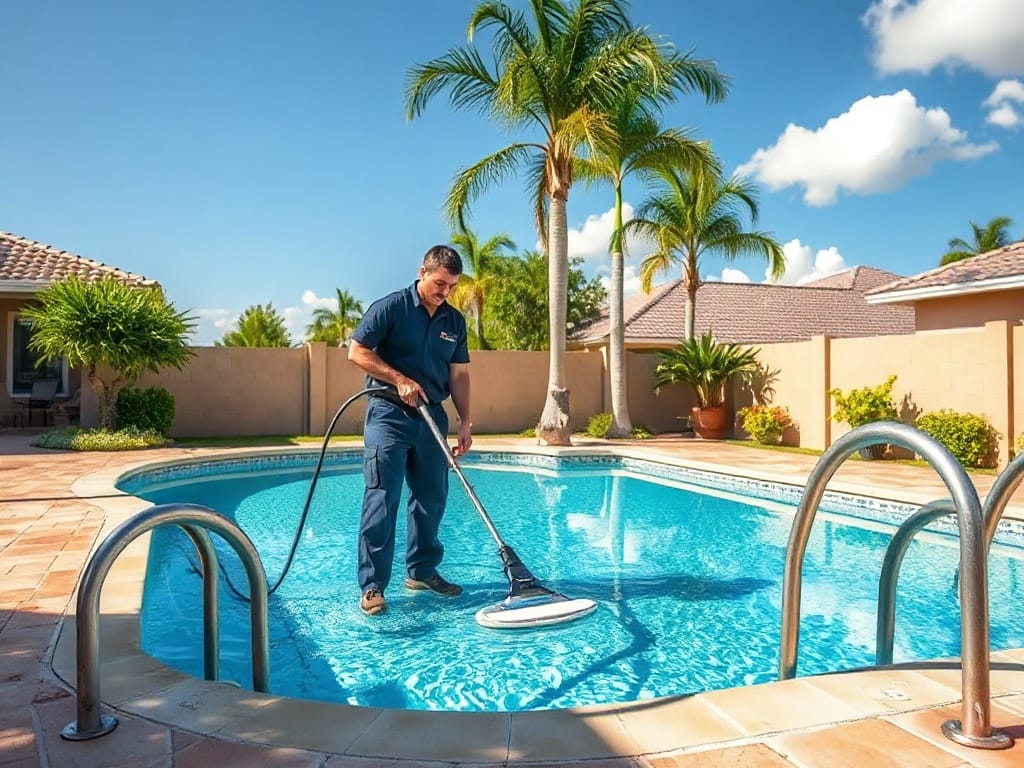
Coconut Creek homeowners know that a pool is one of the most enjoyable features a South Florida property can offer — and one of the most demanding to maintain. Sitting in the heart of northwest Broward County, Coconut Creek’s subtropical climate keeps pool water warm enough to use in every month of the year, but that same warmth accelerates algae growth, degrades pool chemicals rapidly, and puts continuous stress on equipment. Whether you live in Wynmoor Village, Regency Lakes, Banyan Trail, Winston Park, or one of Coconut Creek’s many gated communities, your pool needs a consistent, professional maintenance routine to stay clean, balanced, and safe.
This guide covers everything Coconut Creek pool owners need to know: service frequency in Broward County’s climate, what a proper maintenance visit includes, how the city’s HOA-governed communities affect your maintenance obligations, what pool service costs in this market, and how to identify a problem before it becomes an expensive repair. If you are ready to schedule service, visit our pool service Coconut Creek page for coverage details and scheduling.
Coconut Creek’s Pool Environment: Why Maintenance Is a Year-Round Job
Coconut Creek is located at a latitude of approximately 26.3°N — well within South Florida’s tropical zone — with average annual temperatures that rarely drop below 60°F even in the coldest months. In practical terms for pool owners, this means there is no off-season. Pools in Coconut Creek are used from January through December, and the warm water that makes them enjoyable year-round is the same condition that makes chemical management an ongoing, active process rather than a seasonal task.
Temperature and algae pressure. Broward County pool water temperatures routinely exceed 85°F from April through October and stay above 75°F for most of the remaining months. This temperature range is ideal for every common pool algae species — green, yellow (mustard), and black algae — and these organisms can establish a visible bloom in an insufficiently chlorinated pool within 48 to 72 hours of a chemistry lapse. In Coconut Creek’s summer months, that window can be even shorter after a heavy rain dilutes pool chemicals.
Rainfall and chemistry disruption. Coconut Creek averages over 63 inches of annual rainfall, with the heaviest concentration between June and September. Each rain event introduces organic contaminants — pollen, bird waste, atmospheric deposits, lawn chemicals from irrigation runoff — and dilutes the water balance that was established at the last service visit. After a summer storm, chlorine levels, pH, and alkalinity can all shift enough to require re-treatment within 24 to 48 hours. Pools without consistent service often develop their worst algae problems in the days following rain events, not during extended dry periods.
UV intensity. South Florida’s UV index is among the highest recorded in the continental United States during the summer months. Chlorine that is not protected by an adequate level of cyanuric acid (stabilizer) can be completely destroyed by solar UV within six to eight hours on a clear summer day. Coconut Creek pool owners who rely on unstabilized chlorine, or whose stabilizer levels have drifted too high or too low, often find that they cannot maintain adequate sanitizer levels regardless of how much product they add.
Service Frequency: What Coconut Creek Pools Actually Need
The standard for residential pool service in Coconut Creek — and throughout Broward County — is weekly professional maintenance, performed every seven days throughout the year. This standard exists not because pool service companies prefer it, but because the climate, bather loads, and community standards of South Florida do not support longer service intervals without meaningful risk of algae, chemistry imbalance, or equipment problems.
Weekly service accomplishes several things that cannot be replicated on a bi-weekly schedule in this environment:
- Chlorine continuity: Chlorine demand in a Coconut Creek pool — from UV degradation, bather load, and organic contamination — is high enough that a seven-day interval is already near the outer edge of what maintains an effective residual. A 14-day interval creates a window of days where the pool has no effective sanitizer, allowing bacteria and algae to establish.
- Physical cleaning cadence: Biofilm — the thin biological layer that forms on pool surfaces and serves as the foundation for algae — grows continuously. Weekly brushing disrupts it before it can develop into a visible growth. Two weeks without brushing in warm water is often long enough for early algae growth to gain a foothold on walls, steps, and the floor.
- Equipment monitoring: Pumps, filters, salt cells, and heaters can develop problems quickly in continuous operation. A technician who visits weekly catches a clogged filter, a slipping o-ring, or an underperforming salt cell while it is still a minor issue. Equipment problems discovered after two weeks of unmonitored operation are often more costly to correct.
- HOA compliance: For Coconut Creek homeowners in HOA communities, the appearance of pool water is a community standards issue. Green or cloudy water that develops between bi-weekly visits can result in a violation notice before the next scheduled service — a situation that requires an emergency visit and remediation on top of the regular service cost.
What Every Coconut Creek Pool Service Visit Should Include
A thorough professional pool service visit covers the water chemistry, the physical condition of the pool, and the mechanical systems. Each component is essential, and a company that skips any of them is delivering incomplete service — something that tends to show up in pool conditions over time even if it is not immediately obvious.
Complete Water Chemistry Testing and Adjustment
Every visit should begin with a full chemistry test: free chlorine, combined chlorine, pH, total alkalinity, calcium hardness, cyanuric acid, and salt level for saltwater systems. These parameters interact with each other — pH affects chlorine efficacy, alkalinity affects pH stability, calcium hardness affects the aggressive or scaling tendency of the water — and all of them must be measured and adjusted as a system, not individually.
Broward County municipal water, which most Coconut Creek properties use, typically comes in with a pH above 7.8 and elevated calcium compared to pools using well water. This affects how chemicals drift over time and requires technicians to account for local water chemistry characteristics when dosing adjustments. A service company that uses a one-size-fits-all chemical addition schedule rather than testing actual water conditions is not providing accurate care for your specific pool.
Physical Cleaning
Skimming removes floating debris — leaves, insects, flower petals, pollen — before it sinks and begins decomposing. Decomposing organic material adds nitrogen and phosphate to the water, both of which promote algae growth. Brushing the pool walls, steps, benches, and floor disrupts biofilm and loosens calcium deposits before they can harden into visible scale. Vacuuming removes settled material from the pool floor. Skimmer basket and pump strainer basket cleaning ensures adequate water flow through the circulation system — clogged baskets are one of the most common and easily preventable causes of pump strain and reduced filtration efficiency.
Filter Service
The filter is the pool’s primary mechanism for removing particulate contamination from the water. Sand filters require backwashing when the pressure differential indicates loading; cartridge filters require removal and hosing down; D.E. filters require backwashing and periodic disassembly and element cleaning. A properly functioning filter runs at an optimal pressure differential and maintains water clarity between chemical treatments. A neglected filter — running at excessive pressure, with broken or bypassed elements, or with exhausted filter media — will produce cloudy water no matter how well the chemistry is managed.
Equipment Inspection
Every service visit should include a brief inspection of the pump, motor, filter, heater (if present), automation system, and salt chlorine generator (if applicable). The technician should note any unusual sounds from the pump or motor, check that return jets are flowing evenly, verify that the timer or automation schedule is operating correctly, and inspect visible plumbing fittings for seepage. For saltwater pools, the salt cell should be inspected for calcium buildup on the cell plates — scaling reduces cell output and, if left uncorrected, shortens cell life significantly.
For a complete overview of our service offerings throughout Broward County, our pool service Fort Lauderdale team serves the full range of residential and commercial pool needs from Coconut Creek to the coast.
Coconut Creek Neighborhoods and Communities We Serve
Coconut Creek is a compact but densely residential city with a diverse mix of housing types — from large-lot single-family homes to dense condominium and villa communities. Pool service needs and expectations vary across these communities, and local knowledge of each area makes a meaningful difference in service quality.
Wynmoor Village. One of the largest active adult communities in Broward County, Wynmoor Village occupies a significant portion of Coconut Creek’s residential footprint. With thousands of units across multiple neighborhood clusters, Wynmoor has dozens of community pool facilities maintained by the association and hundreds of private patios with spas and plunge pools. Service in Wynmoor requires contractor registration with the community association, adherence to access hour requirements, and familiarity with the specific rules governing work in an active adult environment.
Regency Lakes. A gated single-family community in northwest Coconut Creek with lake views, Regency Lakes features well-maintained homes with private pools. The community’s HOA actively enforces visual property standards, and pool condition is specifically monitored. Homeowners in Regency Lakes frequently need to provide proof of licensed service during annual compliance reviews.
Banyan Trail. A larger single-family neighborhood with established landscaping and a strong community identity, Banyan Trail features many homes with private in-ground pools ranging from small plunge pools to full-size swimming pools with spas and water features. The tree canopy in this area increases the organic debris load on pools — fallen leaves, seed pods, and flower material are constant during South Florida’s non-winter seasons.
Winston Park. An established Coconut Creek community with a mix of single-family homes and townhomes, Winston Park is one of the city’s more affordable and family-oriented neighborhoods. Pool owners in this area tend to prioritize cost efficiency and reliability, and the pool density is high enough that effective route scheduling can deliver consistent service at competitive prices.
Centura Parc and Lyons Creek. These adjacent communities in the southern part of Coconut Creek feature newer construction homes with modern pool designs, often including salt chlorine generators, variable-speed pumps, and LED lighting systems. Equipment in these communities is generally newer and better maintained but requires technicians familiar with current automation systems and variable-speed pump programming.
Other Coconut Creek communities served: Wyndham at Coconut Creek, Coconut Creek Golf and Country Club area, Coquina Lakes, Coconut Key, Coconut Creek Pines, and unincorporated Broward County areas bordering the city limits.
HOA Pool Standards in Coconut Creek: What You Are Responsible For
Coconut Creek has a high proportion of HOA-governed residential communities relative to its city size, and the pool maintenance standards embedded in HOA governing documents range from basic visual cleanliness requirements to detailed specifications for contractor licensing, chemical documentation, and service hour restrictions.
Water appearance standards. The baseline requirement in most Coconut Creek HOA documents is that pool water must be visually clear and blue at all times when viewed from the property boundaries. Green, cloudy, or dark water is a violation in virtually every community and typically triggers a written notice within days of the condition being observed. The notice period for correction is commonly five to ten business days, and continued non-compliance can result in daily fines or HOA-contracted emergency service billed back to the homeowner.
Contractor licensing. Florida requires that companies performing pool maintenance and repair hold a Certified Pool-Spa Contractor (CPC) license from the state Department of Business and Professional Regulation. Many Coconut Creek HOAs specifically require that the pool service company on your property hold a current CPC license and carry general liability and workers’ compensation insurance. Verify your HOA’s requirements before hiring any service provider, and ask any candidate company for their license number and certificate of insurance before they begin work.
Service documentation. A number of Coconut Creek communities, particularly in larger gated developments, require that pool service be documented in a logbook maintained on the property. This log typically records the service date, technician name, chemical readings before and after adjustment, chemicals added, and any equipment observations. This documentation protects homeowners during compliance reviews and provides a verifiable maintenance history if a dispute about pool condition arises.
Pool Service Pricing in Coconut Creek FL
Pool service pricing in Coconut Creek reflects Broward County market rates, which have risen modestly over the past several years due to increased chemical costs, labor market conditions, and higher equipment prices. Here is a realistic breakdown of what you should expect to pay.
Weekly full-service maintenance. For a standard residential in-ground pool in the 15,000 to 20,000 gallon range with typical equipment, weekly full-service maintenance — chemical testing and balancing, skimming, brushing, vacuuming, basket cleaning, and equipment inspection — typically runs $140 to $220 per month in the Coconut Creek market. Pools with spas, water features, salt chlorine generators, or automation systems may price at the upper end of this range or above it. Chemical inclusion in the monthly fee versus separate billing is a significant variable — always clarify before signing an agreement.
Remediation and one-time services. Green pool treatment — chemical shock, algaecide application, and extended filtration to clear an algae bloom — typically costs $150 to $300 depending on severity. A mild green pool that responds to a single heavy shock treatment is at the lower end; a persistent bloom requiring multiple treatment visits and significant chemical input can reach the upper end. Acid washing a pool to remove deep staining and calcium scale runs $350 to $700 for a typical residential pool. Pressure washing the pool deck is usually $100 to $200.
Equipment repairs. Pump replacement costs $350 to $850 installed depending on the unit type. Variable-speed pump upgrades (increasingly standard and in many cases code-required for new installations) run $700 to $1,300 installed. Salt cell replacement for chlorine generator systems is $200 to $500. Cartridge filter replacement is $75 to $175. Minor plumbing repairs — o-ring replacement, valve repair, small leaks — are typically $75 to $200 depending on labor and parts. Heater replacement for gas or heat pump units is $1,100 to $2,500 installed.
Recognizing Pool Problems Early in Coconut Creek
Catching pool problems between service visits can save significant remediation costs and prevent the embarrassment of a violation notice from your HOA. Here are the conditions that indicate immediate attention is needed.
- Green water: Active algae bloom requiring shock treatment, extended brushing, and filtration. Do not use the pool until the water has cleared and chemistry has been re-tested and confirmed safe.
- Cloudy or hazy water: May indicate low chlorine, high combined chlorine, poor filtration, or chemistry imbalance. Persistent cloudiness after chemical treatment usually points to a filtration issue.
- Dark staining on walls or floor: Often black algae (Cyanobacteria), which embeds in plaster and is significantly harder to eradicate than green algae. Black algae requires aggressive brushing and repeated treatment and may require acid washing to fully resolve.
- Equipment running continuously: If your pump or timer is running outside its normal schedule, the automation system may have a fault or the timer may have lost its programming after a power outage — common in South Florida’s storm season.
- Pool water level dropping faster than normal: Normal evaporation in Coconut Creek is roughly 1/4 inch per day in summer. Faster loss suggests a leak in the shell, plumbing, or equipment pad.
- Strong chemical odor near the pool: Usually indicates high combined chlorine from insufficient shocking rather than excess free chlorine. A properly balanced pool has very little detectable odor.
Frequently Asked Questions: Pool Service in Coconut Creek FL
How often should I schedule pool service in Coconut Creek FL?
Weekly professional service is the standard for Coconut Creek pools year-round. The combination of warm water temperatures, high UV intensity, Broward County’s rainy season, and the HOA visual standards in most Coconut Creek communities makes bi-weekly service too risky for most homeowners. Pools with very low bather load and efficient saltwater sanitation systems may tolerate bi-weekly visits during December through February, but weekly remains the correct baseline for South Florida conditions.
Why does my Coconut Creek pool turn green so quickly?
Rapid algae growth in Coconut Creek is almost always caused by one or more of the following: insufficient stabilizer (cyanuric acid) allowing UV to destroy chlorine within hours, chlorine demand exceeding your current dosing after a rain event, pH climbing above 7.8 (which significantly reduces chlorine’s effectiveness), or a long gap between service visits during the summer. The solution requires a comprehensive chemistry review, not just adding more chlorine. A thorough shock treatment followed by stabilizer adjustment and corrected weekly dosing typically solves recurrent algae issues.
What pool services are available in Coconut Creek?
Full-service residential pool maintenance in Coconut Creek includes weekly chemical testing and balancing, skimming, brushing, vacuuming, basket and filter service, and equipment inspection. Additional services available include green pool remediation, acid washing, pool deck pressure washing, equipment repair and replacement (pumps, filters, heaters, salt cells, automation systems), leak detection, resurfacing coordination, and specialty services like tile cleaning and calcium removal.
Does Wynmoor Village allow outside pool service contractors?
Wynmoor Village allows licensed outside contractors to service private pools and spas on individual units, subject to contractor registration with the community association and compliance with access hours and rules of conduct. The community association maintains a list of registered contractors and may require proof of current Florida CPC license and insurance before granting access. If you live in Wynmoor, confirm contractor access requirements with the association office before scheduling service with any provider.
How do I choose the best pool service company in Coconut Creek?
Verify that any company you consider holds a current Florida Certified Pool-Spa Contractor (CPC) license — searchable at myfloridalicense.com — and carries general liability insurance of at least $1 million per occurrence. Ask whether chemicals are included in the monthly rate or billed separately, whether they provide a written service report after each visit, and what the cancellation terms are. Responsiveness before you hire is a reliable indicator of responsiveness after. A company that takes three days to answer an inquiry will likely take three days to respond to a service problem.
What is included in a standard pool service visit in Coconut Creek?
A comprehensive weekly service visit covers: complete water chemistry testing (chlorine, pH, alkalinity, calcium, cyanuric acid, salt for saltwater pools) and chemical adjustment; skimming, brushing, and vacuuming; skimmer basket and pump strainer basket cleaning; filter backwash or pressure check; and equipment inspection. Some companies include minor equipment adjustments and chemical top-offs in their standard visit; others bill separately for anything beyond the basic service scope. Clarify exactly what is included before signing a service agreement.
Ready to schedule professional pool service in Coconut Creek? Contact our team to discuss a maintenance plan designed for your pool, your community, and your budget.