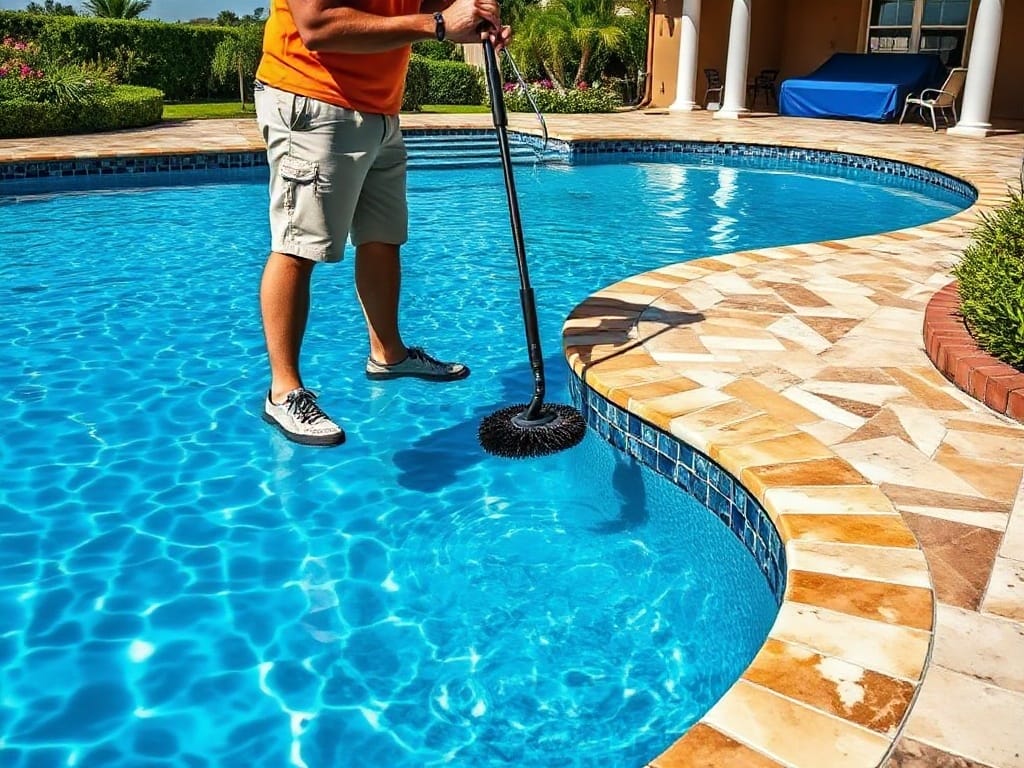
Miramar is one of South Florida’s fastest-growing cities — a large, planned suburban community in southwestern Broward County built primarily through the 1990s and 2000s. Its residential neighborhoods, including Silver Lakes, Monarch Lakes, Riviera Isles, and the corridors along Miramar Parkway, are characterized by well-appointed single-family homes with private pools and the modern construction standards of their era. For Miramar pool owners, pool service Miramar FL involves the hard-water chemistry management common throughout Broward County alongside the specific demands of newer, more complex pool systems — saltwater chlorination, variable-speed pumps, automated chemical dosing, and large spas that most Miramar pools were designed to include from the start. This guide covers what Miramar homeowners need to know to maintain their pool properly year-round.
What Professional Pool Service Covers in Miramar
A complete weekly service visit in Miramar covers the full maintenance scope that South Florida’s year-round climate demands. Water chemistry is tested at every visit — free chlorine, combined chlorine, pH, total alkalinity, calcium hardness, cyanuric acid, and salt for saltwater systems — and all parameters are adjusted to target before leaving the property. Physical service includes surface skimming, wall and step brushing, floor vacuuming or automatic cleaner inspection, skimmer and pump basket emptying, filter pressure check, and a visual equipment inspection that takes note of anything requiring follow-up attention.
Miramar pools frequently include spas, water features, and automation systems that add scope to a thorough service visit. Spa chemistry is tested and adjusted separately from pool chemistry — a spa’s smaller water volume and higher temperatures create chemistry dynamics that diverge from the main pool if not independently managed. Water feature operation is checked during the visit, and automation controller settings are verified to confirm proper daily run times and dosing schedules if applicable. Items billed separately include equipment repairs, filter media replacement, algae remediation, and post-storm recovery visits.
Water Chemistry in Miramar: Hard Water and Modern Systems
Miramar pool water comes from Broward County’s Biscayne Aquifer — naturally hard, with elevated calcium and magnesium. Calcium hardness should be maintained between 200 and 400 ppm. In Miramar’s southern Broward location, summer evaporation drives calcium concentration upward in pools not receiving periodic dilution. Scale formation on tile lines, spa surfaces, and salt cell plates is the cumulative result of unmanaged hardness. Miramar pools with travertine or pavers around the deck area also show calcium efflorescence on the deck surface when pool water chemistry is chronically out of balance — an aesthetic issue that goes beyond the pool shell itself.
pH management is the weekly chemistry backbone. Miramar pools should be maintained between 7.4 and 7.6. Pools with large spillover spas, sheer descent waterfalls, or bubblers experience consistent upward pH pressure from aeration and CO2 off-gassing — these features are standard in many Miramar homes and require weekly acid additions to hold pH in range. High pH reduces chlorine effectiveness, accelerates scale formation on tile and equipment, and irritates swimmers even when free chlorine reads adequate on the test kit.
Cyanuric acid management is straightforward in Miramar’s predominantly saltwater pool population — saltwater systems do not add CYA with every chlorine generation cycle the way stabilized tablets do, so CYA tends to build more slowly in Miramar saltwater pools. However, CYA levels should still be tested quarterly; pools that have converted from tablets to salt but still maintain a tablet feeder as a backup, or that receive stabilized shock products, can accumulate CYA faster than expected. The corrective action when CYA climbs above 80 ppm remains a partial drain-and-refill regardless of the chlorination system type.
Saltwater and Variable-Speed Pool Systems in Miramar
Miramar’s newer construction era means that saltwater chlorination and variable-speed pumps are the baseline equipment configuration in most of the city’s private pools, rather than the upgrade option they represent in older Broward communities. This is generally good news for pool owners — both technologies deliver advantages over the traditional alternatives — but they create specific maintenance requirements that weekly service must address to deliver their intended benefits.
Salt cells in Miramar’s hard Biscayne Aquifer water accumulate calcium scale on the electrolytic plates over time. A salt cell that is visually active on the controller display may be generating significantly less chlorine than its rated output if the plates are partially fouled with scale. Because the automation controller measures flow and conductivity rather than actual chlorine output, a scaled cell can operate for weeks or months without triggering an alarm while the pool is systematically under-sanitized. Quarterly salt cell inspection — removing the cell, checking the plates, cleaning with dilute acid when needed — is the most important preventive maintenance step for Miramar saltwater pool owners and should be a standard part of every service company’s annual protocol for these accounts.
Variable-speed pumps deliver energy savings by running at lower RPMs during off-peak filtration periods. In Miramar’s warm climate, pump run times should be calibrated to ensure adequate daily water turnover — typically a full pool volume turnover per 24-hour period is the baseline target, which may require longer daily run times at lower speeds than the original programming was set to achieve. A service company that sets up or reviews VSP programming should verify that the total daily run time and speed schedule actually achieves the necessary turnover for the pool’s volume, not simply that the pump is operational.
Canal Communities in Miramar
Many of Miramar’s residential neighborhoods were developed with canal-backed lots — properties whose rear yards border the drainage canals that run throughout the city’s western and central zones. Canal-adjacent pools in Miramar carry the same phosphate loading and debris accumulation profile as canal-backed properties throughout Broward: windblown organic material from the waterway raises the phosphate baseline in the pool water, and skimmer debris loads are heavier than on interior-lot pools in the same neighborhoods.
Quarterly phosphate testing and removal treatment is the standard preventive protocol for canal-adjacent Miramar pool accounts, keeping the nutrient baseline below the threshold that enables persistent algae growth even with adequate chlorine management. Pre-storm water level reduction is also more important for canal-backed properties, where sustained heavy rainfall can raise canal levels enough to overflow onto adjacent pool decking in severe events.
Miramar Neighborhoods We Serve
Silver Lakes is one of Miramar’s largest planned communities, with single-family homes throughout the Silver Lakes Boulevard and Red Road corridors. Pools in Silver Lakes are typically late 1990s to early 2000s installations — modern equipment by Broward standards, with saltwater systems and variable-speed pumps common in renovated or updated accounts.
Monarch Lakes in western Miramar near Flamingo Road features larger, more recently built homes with the larger pools and more complex equipment configurations that southwestern Broward’s premium residential market supports. Spas, automation, water features, and full enclosure screening are standard in this area.
Riviera Isles and the Miramar Parkway corridor include a range of residential construction vintages and price points. Central and eastern Miramar neighborhoods in this corridor tend toward the mid-2000s construction era with standard residential pool configurations.
We serve pool owners throughout Miramar, including Silver Lakes, Monarch Lakes, Riviera Isles, and all residential neighborhoods in zip codes 33025, 33027, and 33029.
Hurricane Season Pool Preparation in Miramar
Miramar’s southwestern Broward location places it directly in the path of hurricanes approaching from the Gulf side as well as those tracking up the eastern Florida coast. Standard pre-storm protocol: lower pool water 12 to 18 inches, add shock and triple-dose algaecide, remove all loose deck furniture and accessories, shut off equipment circuit breakers. For canal-adjacent properties, a larger water level reduction is prudent. Post-storm: test chemistry before adding chemicals, inspect equipment before restarting, schedule a service visit within 24 to 48 hours to reset chemistry before algae establishes in the warm water.
Choosing a Pool Service Company in Miramar
Florida DBPR license verification is the baseline. Miramar homeowners with saltwater pools and automation systems should ask prospective service companies specifically about their salt cell inspection schedule and VSP programming review practices — these are the two technical disciplines most likely to be handled inadequately by a company without strong experience on modern Broward pool systems. A company that cannot describe its quarterly salt cell inspection procedure clearly should not be servicing a Miramar saltwater pool.
Chemistry logging is also a meaningful differentiator. A service company that records test results after every visit and makes them accessible to you provides a factual record of your pool’s chemistry history — valuable for saltwater pool management, where understanding the seasonal patterns in chlorine output and calcium dynamics helps the service company stay ahead of scale and algae problems rather than reacting to them. Pricing for weekly full-service in Miramar runs $120 to $175 per month for standard residential pools; larger installations with spas and full automation run higher.
Pool Service Fort Lauderdale: Serving Miramar Year-Round
At Pool Service Fort Lauderdale, we serve Miramar pool owners throughout the year — saltwater systems, variable-speed pumps, spa chemistry, canal-adjacent accounts, and all configurations of the modern residential pool that southwestern Broward has built over the past three decades. Chemistry is documented after every visit. Equipment concerns are communicated before repair work is authorized. Contact us to discuss a weekly service program built around your Miramar pool.
Frequently Asked Questions About Pool Service in Miramar
How often does a Miramar pool need professional service? Weekly service is the standard for Miramar residential pools. Year-round warm water temperatures and active household use create consistent chemistry demand that bi-weekly service cannot reliably manage in South Florida’s climate. Saltwater pools in Miramar require the same weekly chemistry attention as traditional pools — the salt cell generates chlorine, but pH, alkalinity, calcium, and salt levels all require weekly monitoring and adjustment.
How often should we have our salt cell inspected? Quarterly is the standard recommendation for Miramar saltwater pools in Broward County’s hard water. Calcium scale builds on the titanium plates inside the cell over time, reducing chlorine output without triggering obvious controller alerts. A quarterly inspection that checks plate condition and cleans when needed ensures the cell is producing its rated chlorine output and that the pool is actually receiving the sanitizer level the controller reports.
Our Miramar pool has a large spa — does that change the service scope? Yes. Spa water chemistry diverges from pool chemistry due to the spa’s smaller volume and significantly higher temperatures — heat drives pH upward faster, consumes sanitizer more quickly, and concentrates dissolved solids faster than the main pool. Spa chemistry should be tested and adjusted independently at every service visit, not assumed to track with the pool readings. A service company that tests the pool without separately testing the spa is leaving a significant chemistry gap in an account with a heated spa.
What does pool service cost in Miramar? Weekly full-service with chemicals runs $120 to $175 per month for standard residential pools. Larger pools with spas, automation, and water features run toward the upper end of the range or above it. Chemistry-separate pricing starts at $75 to $95 per month before chemical costs. Salt cell inspection and cleaning is typically billed separately from the weekly service rate when performed.
Does our canal-backed location in Miramar affect pool maintenance? Yes. Canal-adjacent pools accumulate higher phosphate levels from windblown organic material off the waterway, and skimmer debris loads are heavier than on interior-lot pools. Quarterly phosphate removal treatment is the standard preventive addition to the weekly service program for canal-backed Miramar accounts. Pre-storm water level reduction is also more important given the risk of canal overflow during major rainfall events.
How do we know if our variable-speed pump is programmed correctly? Correct VSP programming achieves at least one full pool volume turnover per 24-hour period while using lower speed settings during off-peak hours for energy efficiency. If the pump’s daily run schedule at its various speed settings does not achieve full turnover for your pool’s volume, the pool is being under-filtered — a common setup error in VSP installations where the energy-saving speed settings are set without calculating the required daily flow volume. Your service company should be able to verify turnover adequacy from the pump’s GPM rating and your pool’s volume.
Get Started with Pool Service in Miramar
Miramar’s newer, well-equipped residential pools deserve service that matches their quality — consistent weekly chemistry management, salt cell maintenance, spa attention, and the year-round discipline that South Florida’s climate requires. Contact Pool Service Fort Lauderdale today to discuss a weekly maintenance program built around your Miramar pool.