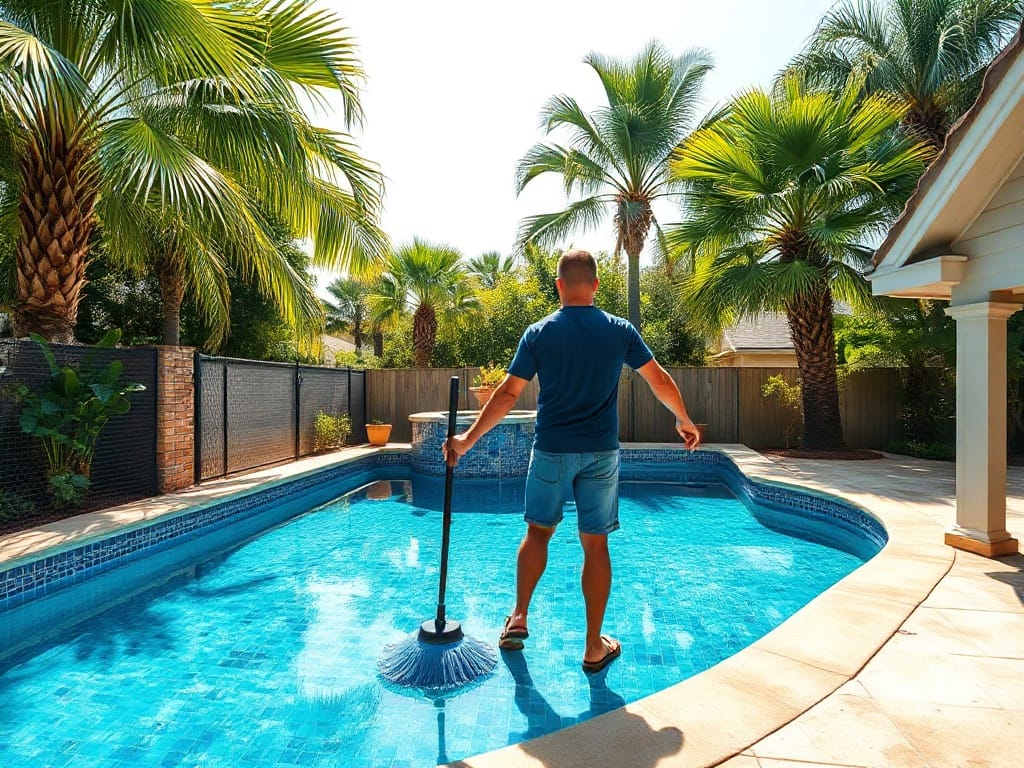
Plantation is one of Broward County’s most established cities — a community whose residential development began in the 1950s and continued through the 1980s, creating a mature urban fabric of tree-lined streets, ranch-style homes, and well-established neighborhoods adjacent to Fort Lauderdale’s western border. The city’s age gives its residential stock a character distinct from the newer suburban communities further west: larger lots in many areas, established tree canopies that shade pool decks and contribute debris to pool water, and a private pool population whose age spans a wider range than in cities developed primarily after 1990. For Plantation pool owners, pool service Plantation FL involves consistent chemistry management in Broward’s hard water, attention to the debris loading created by mature landscaping, and the equipment awareness that an older pool stock demands. This guide covers what Plantation homeowners need to know to keep their pool properly maintained year-round.
What Professional Pool Service Covers in Plantation
A complete weekly service visit in Plantation includes full water chemistry testing — free chlorine, combined chlorine, pH, total alkalinity, calcium hardness, cyanuric acid, and salt for saltwater systems — with all parameters adjusted to target before leaving the property. Physical service covers surface skimming, thorough wall and step brushing, floor vacuuming or automatic cleaner inspection, skimmer and pump basket emptying, filter pressure check, and equipment visual inspection.
Plantation’s established tree canopy is a defining characteristic of weekly service in the city. Skimmer baskets on pools with mature oak, ficus, or palm trees overhead fill more rapidly with organic debris than those in newer, less-vegetated neighborhoods — weekly basket emptying matters more when a large tree is dropping material into the pool continuously. The organic loading from leaf matter, seed pods, berries, and bark also elevates phosphate levels in pools with heavy tree coverage, creating higher algae nutrient baselines than in more exposed pools in the same zip code. Items billed separately include equipment repairs, filter media replacement, algae remediation, and post-storm recovery visits.
Water Chemistry in Plantation: Hard Water and Organic Loading
Plantation pool water comes from Broward County’s Biscayne Aquifer — hard, calcium-rich municipal supply that creates scale formation risk on tile lines, plaster surfaces, and salt cell plates throughout the city. Calcium hardness should be maintained between 200 and 400 ppm. Plantation’s established residential environment, with significant mature tree canopy providing partial shading of many pool decks, reduces peak evaporation rates compared to fully sun-exposed pools — a modest benefit for calcium concentration management, but not a substitute for periodic dilution through partial drain-and-refill cycles when calcium climbs.
The organic loading that Plantation’s mature landscaping introduces to pool water is the chemistry factor that most distinguishes service in this city from newer suburban Broward communities. Leaves, seed matter, bark, and decomposing organic material introduce phosphates and nitrogen compounds into the pool water at rates that fully exposed pools in the same climate do not experience. Combined chlorine (chloramines) can build faster in Plantation pools with significant overhead tree coverage due to the nitrogen loading from organic debris — pools that smell strongly of chlorine despite adequate free chlorine readings are often experiencing chloramine buildup from organic nitrogen rather than a simple chlorine deficit.
Phosphate management is accordingly more active in Plantation than in many neighboring cities. Quarterly phosphate testing and removal treatment is standard preventive practice for Plantation pools with significant organic tree debris loading — keeping the nutrient baseline below the threshold that enables persistent algae growth even when chlorine is occasionally stressed by debris events or summer thunderstorms.
pH and cyanuric acid management follow the same Broward-wide protocols: maintain pH between 7.4 and 7.6 with weekly correction, track CYA quarterly and recommend partial drain-and-refill before it climbs above 80 ppm. Plantation pools using stabilized tablets as their primary chlorination method should expect CYA to reach the 80 ppm threshold within one to two years of continuous use without dilution.
Plantation’s Mature Pool Stock: Equipment Age and Assessment
Plantation’s residential development history means the city contains some of Broward County’s oldest private pools. The earliest installations from the 1950s and 1960s are rare surviving originals or have been completely rebuilt — but pools from the 1970s and 1980s are common throughout Plantation’s residential neighborhoods, and these represent the most significant equipment age considerations in the city’s pool service landscape.
Single-speed pumps from the 1980s that are still operational have exceeded their designed service life. These pumps run at constant high RPM, draw more electricity than modern variable-speed alternatives, and fail without the warning signs that earlier-generation equipment sometimes provided — a motor that is hot to the touch, a bearing noise that appeared weeks before failure, or a capacitor issue that could be caught with a basic electrical check. A first-visit equipment assessment on a Plantation home with its original or early-replacement pump should document pump age and condition clearly and prompt an honest conversation about replacement planning.
Plaster finishes in Plantation pools from the 1970s and 1980s that have not been resurfaced represent the full spectrum of plaster degradation: from pools that are showing early surface roughness and beginning to develop persistent algae staining, to pools where the plaster is severely deteriorated with exposed aggregate and structural cracking that weekly chemistry management cannot meaningfully address. A service company doing an initial assessment should communicate plaster condition honestly — documenting where the pool falls on this spectrum and what that means for the maintenance effort required to keep it looking acceptable in the near term.
Plantation also contains a significant number of pools that have been renovated or updated over the years — plaster resurfaced, equipment replaced with modern variable-speed pumps and saltwater systems, or the pool shell itself expanded or reconfigured. These updated installations in Plantation’s established homes represent a mixed-vintage profile: a 1970s concrete shell with 2015 equipment and 2019 plaster, for example. Service companies need to assess each account individually rather than assuming that a Plantation address means older or newer equipment.
Plantation Neighborhoods We Serve
Plantation Acres is one of the city’s most distinctive residential areas — a low-density zone of large lots with agricultural roots, where properties often include substantial mature landscaping and pools that are large by standard residential measures. The combination of large pool volume, heavy organic debris from mature landscaping, and equipment vintages that span several decades makes Plantation Acres one of the more variable service environments in Broward County.
Central Plantation neighborhoods along Broward Boulevard, Peters Road, and the Sunrise Boulevard corridor represent the core of the city’s classic 1960s and 1970s residential development. Ranch-style homes with pools on modest lots, established landscaping, and the full range of pool vintages common in mid-century South Florida construction. Year-round family use is the dominant pattern throughout this zone.
East Plantation neighborhoods adjacent to Fort Lauderdale’s western boundary include some of Plantation’s most densely developed residential stock. Equipment age in this zone trends toward the older end of Plantation’s pool spectrum, and first-visit equipment assessments are particularly important for accounts in this area that have not recently updated their pool systems.
West Plantation neighborhoods extending toward Weston and Davie include more recently developed subdivisions with younger construction and correspondingly newer pool equipment. These areas transition between Plantation’s classic character and the newer suburban residential product of Broward’s western expansion.
We serve pool owners throughout Plantation, including Plantation Acres, the Broward Boulevard corridor, and all residential neighborhoods in zip codes 33317 and 33324.
Hurricane Season Pool Preparation in Plantation
Plantation’s central Broward location provides reasonable buffer from direct coastal storm surge, but tropical weather affecting the Broward coast delivers wind, rain, and debris throughout the county’s interior. For Plantation pools with significant overhead tree canopy, the pre-storm preparation should include not just the standard pool lowering and chemical treatment but also assessment of tree branches overhanging the pool or equipment area — large branches that could fall during a storm are a concern for pool shells, equipment, and screen enclosures alike, and a pre-storm trim is far less expensive than post-storm structural damage. Standard pool protocol: lower water level 12 to 18 inches, add shock and triple-dose algaecide, remove deck furniture, shut off equipment circuits.
Choosing a Pool Service Company in Plantation
Florida DBPR license verification is the baseline. Plantation homeowners with older pools should ask prospective service companies specifically about their equipment condition assessment practice on new accounts, their approach to phosphate management in tree-heavy environments, and their communication protocol for aging equipment that is approaching replacement. Chemistry logging that makes visit records accessible to the homeowner is a meaningful service differentiator — particularly for Plantation accounts where the organic loading from mature landscaping creates chemistry patterns that benefit from a longitudinal record.
Pricing for weekly full-service with chemicals in Plantation runs $120 to $175 per month for standard residential pools. Plantation Acres and larger installations run toward the upper end. Chemistry-separate pricing starts at $75 to $95 per month.
Pool Service Fort Lauderdale: Serving Plantation Year-Round
At Pool Service Fort Lauderdale, we serve Plantation pool owners throughout the year — established landscaping, older equipment, newer renovations, and everything in between. We understand the hard-water chemistry of Broward’s Biscayne Aquifer, the phosphate and debris loading that mature Plantation tree canopy creates, and the year-round service discipline that South Florida’s climate demands. Chemistry is documented every visit. Equipment concerns are communicated before repair work is authorized. Contact us to discuss a service program built around your Plantation pool.
Frequently Asked Questions About Pool Service in Plantation
How often should a Plantation pool be serviced? Weekly service is the correct frequency for Plantation residential pools. South Florida’s year-round warm water temperatures mean algae pressure never stops, and Plantation’s mature tree canopy introduces organic debris and phosphate loading that makes chemistry management more demanding than in pools located in less-vegetated environments. Bi-weekly service in this organic loading environment leaves chemistry gaps that are longer than safe in Plantation’s climate.
Why does our Plantation pool smell like chlorine even though it just received service? The chlorine odor in pool water is almost always caused by combined chlorine (chloramines) rather than excess free chlorine. In Plantation pools with significant organic tree debris loading, nitrogen compounds from decomposing organic matter enter the water continuously and combine with chlorine to form chloramines — the source of the odor and eye irritation. The fix is superchlorination (shocking), which oxidizes combined chlorine back to free chlorine. Pools with heavy overhead canopy often need shock treatment more frequently than the standard occasional schedule to prevent chloramine buildup.
Does Plantation’s tree canopy affect pool chemistry differently than an open-air pool? Yes, in two ways. First, elevated organic debris loading from leaf matter, seed pods, and bark increases phosphate levels and nitrogen loading, raising algae pressure and combined chlorine accumulation rates. Second, partial shading from tree canopy somewhat reduces UV-driven chlorine degradation — a modest benefit for chlorine retention between service visits. The first effect is more significant than the second; tree-covered Plantation pools generally require more active phosphate management and more frequent shock treatment than fully exposed pools in similar climates.
What does pool service cost in Plantation? Weekly full-service with chemicals runs $120 to $175 per month for standard residential pools. Plantation Acres and larger installations run toward the upper end or above it. Chemistry-separate pricing starts at $75 to $95 per month. Equipment repairs, filter media replacement, and algae remediation are billed separately.
Our Plantation pool is shaded most of the day — does that reduce maintenance needs? Shading reduces UV chlorine degradation slightly, which is a modest benefit. But it does not reduce the bather load chemistry demand, the pH drift from hard municipal water, the CYA accumulation from stabilized tablets, or the organic debris and phosphate loading from the trees providing the shade. Weekly service frequency and the full chemistry management protocol remain unchanged for shaded Plantation pools — the shade changes one input variable in the chemistry equation without meaningfully reducing the overall maintenance requirement.
How do older Plantation pools compare to newer suburban pools for maintenance difficulty? Older pools in Plantation require more assessment-based maintenance — the service company needs to understand what the pool’s specific equipment age, plaster condition, and configuration mean for the chemistry effort required and the equipment reliability risk. Newer pools are more predictable: modern equipment, known service life, standard configurations. The maintenance frequency is the same; the maintenance intelligence required is higher for older accounts. A service company that performs honest condition assessment on older Plantation pools and communicates its findings clearly provides more value than one that offers a standard weekly service package without looking closely at what the pool actually needs.
Get Started with Pool Service in Plantation
Plantation pool owners — whether in an original 1970s ranch home or a more recently renovated property — deserve consistent, knowledgeable service that accounts for the specific character of Broward County’s most established residential city. Contact Pool Service Fort Lauderdale today to discuss a weekly maintenance program built around your Plantation pool.