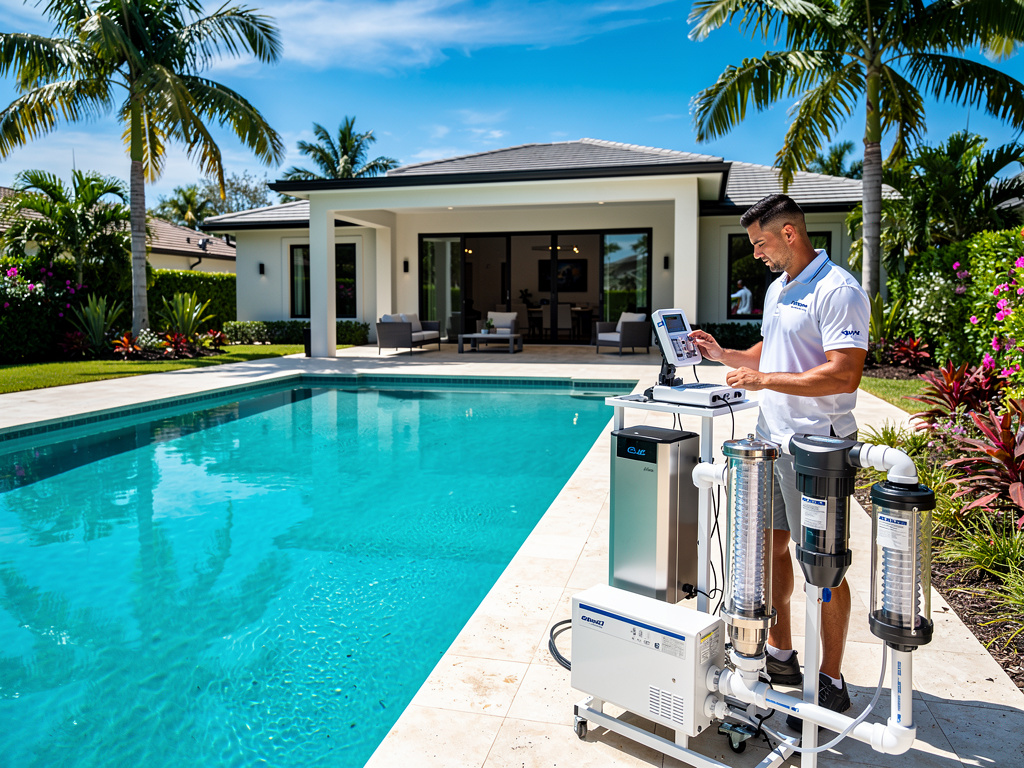
Why Standard Tablet Chlorination Is a Starting Point, Not an Endpoint
Standard tablet chlorination — trichlor tablets in a floating dispenser or inline feeder — is the baseline residential pool sanitization method, adequate for maintaining a safe pool but not optimized for the water quality experience that Weston’s luxury market expects. Trichlor tablets contain cyanuric acid (CYA) as part of their chemistry, which stabilizes chlorine against UV degradation. This is beneficial for UV stability, but CYA also bonds to free chlorine and reduces its effective sanitization power (the “CYA penalty”). As CYA builds in a tablet-maintained pool, an increasing percentage of the total chlorine is bound to CYA and not available for active sanitation — requiring higher total chlorine levels to maintain the same effective sanitation capacity.
More significantly, tablet chlorination alone does not address combined chlorine (chloramines) — the reaction products of chlorine with nitrogen compounds from bather sweat and organic input. Chloramines are responsible for the “chlorine smell” that many pool users associate with heavily treated water, the eye irritation that makes goggles necessary in many pools, and the water feel that leaves skin and hair feeling dried out and chemical-residue-laden. In a Weston luxury pool used for high-quality entertaining and daily family swimming, the chloramine problem is the primary water quality limitation that standard chlorination cannot resolve on its own.
Saltwater Generation: The Foundation of Premium Sanitization
A saltwater chlorine generator (SCG) is the appropriate primary chlorine source for a Weston luxury pool and has become essentially universal in Weston’s premium pool market. The SCG produces free chlorine continuously from dissolved salt through electrolysis — maintaining stable chlorine levels without the CYA loading from tablets, without the salt-of-chemical-addition that builds TDS in tablet-managed pools, and without the handling and storage of chlorine products. Saltwater pools feel softer and less irritating than tablet-chlorinated pools at equivalent sanitization because the chlorine is produced continuously in small quantities rather than in the pulsed doses from tablet dissolution.
For a Weston pool, the saltwater generator is baseline — the starting point of a premium sanitization system, not the premium element itself. The premium elements that elevate a Weston saltwater pool to the finest water quality available are UV sanitation, ozone supplementation, or both.
UV Sanitation: Eliminating Chloramines at the Source
UV sanitation systems — medium-pressure or low-pressure UV lamps installed in the circulation line — destroy chloramines (combined chlorine) and pathogens through photodegradation as water passes through the UV chamber. Where chloramines in a tablet-maintained pool can reach 0.5–1.5 ppm and produce the characteristic odor and irritation, a UV-supplemented pool maintains combined chlorine below 0.1 ppm — below the threshold for any detectable odor or skin irritation. This is the water quality transformation that Weston pool owners who have installed UV systems most consistently describe: not just “better chemistry” but a fundamentally different water experience — soft, clear, completely odor-free, and comfortable for extended swimming without goggles.
UV systems also reduce the required free chlorine level for effective sanitation (because UV provides direct pathogen inactivation in parallel with chlorine), which further reduces chloramine formation and chemical additions. A Weston pool with UV supplementation typically maintains effective sanitation at 1.5–2.5 ppm free chlorine rather than the 3.0–4.0 ppm required without UV — a chemistry benefit that reduces chemical consumption and operating cost while improving water feel.
Medium-pressure UV systems ($1,500–$2,500 installed) provide broader-spectrum UV coverage than low-pressure systems and are the appropriate choice for Weston’s premium pool market. They provide both pathogen inactivation and chloramine destruction in a single system, operate reliably with annual UV lamp replacement, and are compatible with saltwater and all standard pool chemistry approaches.
Ozone: The Alternative Premium Supplemental Sanitizer
Ozone generation systems produce ozone (O₃) — a powerful oxidizer — and inject it into pool water through a contact chamber in the circulation line. Ozone oxidizes chloramines, destroys organic compounds, and inactivates pathogens at a rate significantly faster than chlorine. The ozone itself is consumed (reverts to oxygen) in the contact chamber and never reaches the pool at detectable concentrations — it supplements the chlorine system without introducing any additional chemical into the pool water.
The water quality result of saltwater + ozone combination is comparable to saltwater + UV: very low combined chlorine, excellent clarity, reduced required free chlorine, and water that feels notably softer and less chemically aggressive than standard chlorination. Ozone systems are slightly less common than UV in South Florida residential applications (because UV is simpler to operate and maintain) but are technically equivalent in water quality outcome. Some Weston luxury pool installations include both UV and ozone — a belt-and-suspenders approach that maximizes combined chlorine destruction and organic oxidation capacity, achieving water quality indistinguishable from the finest commercial pool installations.
Mineral Sanitization: Enhancement, Not Replacement
Mineral sanitization systems — which use copper and silver ionization cartridges in the circulation line — are marketed as alternatives or reductions to chlorine rather than supplements. In Weston’s pool market, mineral systems are best understood as enhancements that provide some algaecidal and bactericidal benefit, not as primary sanitizers. Florida’s pool chemistry regulations require maintained free chlorine in all residential pools regardless of supplemental sanitization systems — mineral systems cannot legally or effectively replace chlorine as the primary sanitizer. They can, however, reduce the chlorine demand (allowing lower free chlorine levels to achieve the same sanitation outcome) and provide residual protection against algae that supplements the chlorine system.
The complete Weston premium sanitization system for a household that wants the best available water quality: saltwater generator (primary chlorine, softer water) + UV (chloramine elimination) + monthly enzyme treatment (organic compound degradation) + sequestrant (scale prevention in hard-water environment). This combination addresses every element of water quality — sanitation, clarity, feel, odor, and surface protection — and produces water quality equivalent to the world’s finest hotel pools in a residential Weston backyard.
Pool Service Fort Lauderdale installs and maintains premium sanitization systems throughout Weston FL. Call (954) 501-2754, visit our Weston pool service page, or see our full website. 9900 W Sample Rd, Coral Springs, FL 33065.
{“@context”:”https://schema.org”,”@type”:”FAQPage”,”mainEntity”:[{“@type”:”Question”,”name”:”What is the best pool sanitization system for a Weston FL luxury pool?”,”acceptedAnswer”:{“@type”:”Answer”,”text”:”Saltwater generation (primary chlorine) + UV sanitation (chloramine elimination) is the premium residential standard. This combination produces water quality comparable to the world’s finest hotel pools: soft feel, crystal clarity, no eye irritation, no chemical odor, combined chlorine below 0.1 ppm. Installed cost: $2,500–$5,000. Saltwater + ozone is an equivalent alternative. Either combination dramatically outperforms tablet-only chlorination.”}},{“@type”:”Question”,”name”:”Why does my Weston FL pool smell like chlorine even when the chemistry tests correct?”,”acceptedAnswer”:{“@type”:”Answer”,”text”:”Chlorine smell is caused by chloramines (combined chlorine) — reaction products of chlorine with nitrogen from sweat and organic input. Free chlorine itself is odorless; the smell indicates combined chlorine, not excess free chlorine. A UV sanitation system photodegrades chloramines continuously, eliminating the odor at the source. Test combined chlorine specifically — if above 0.3 ppm, that’s the source of the odor.”}},{“@type”:”Question”,”name”:”Is a saltwater pool better than a regular chlorine pool in Weston FL?”,”acceptedAnswer”:{“@type”:”Answer”,”text”:”Yes — for water quality experience and maintenance convenience. Saltwater generators produce free chlorine continuously without CYA loading from tablets, without pulsed chemical additions, and without the handling of chlorine products. Saltwater pools feel softer and less irritating at equivalent sanitation. The generator is the foundation of a premium Weston pool sanitization system, typically paired with UV for complete water quality optimization.”}},{“@type”:”Question”,”name”:”What does a UV pool sanitation system cost in Weston FL?”,”acceptedAnswer”:{“@type”:”Answer”,”text”:”Medium-pressure UV systems (the appropriate choice for Weston luxury pools) cost $1,500–$2,500 installed. Annual operating cost is one UV lamp replacement ($200–$400). The system requires no chemicals, no consumables beyond the annual lamp, and integrates with existing pool plumbing in a circulation line installation. Return on investment: improved water quality experience and reduced chlorine chemical consumption.”}},{“@type”:”Question”,”name”:”Can a mineral system replace chlorine in my Weston FL pool?”,”acceptedAnswer”:{“@type”:”Answer”,”text”:”No — Florida pool chemistry regulations require maintained free chlorine in all residential pools regardless of supplemental systems. Mineral ionization systems (copper/silver) reduce chlorine demand and provide supplemental algaecidal benefit but cannot replace chlorine as the primary sanitizer. They are enhancements, not replacements. A Weston pool cannot legally operate without maintained free chlorine regardless of other systems installed.”}]}}