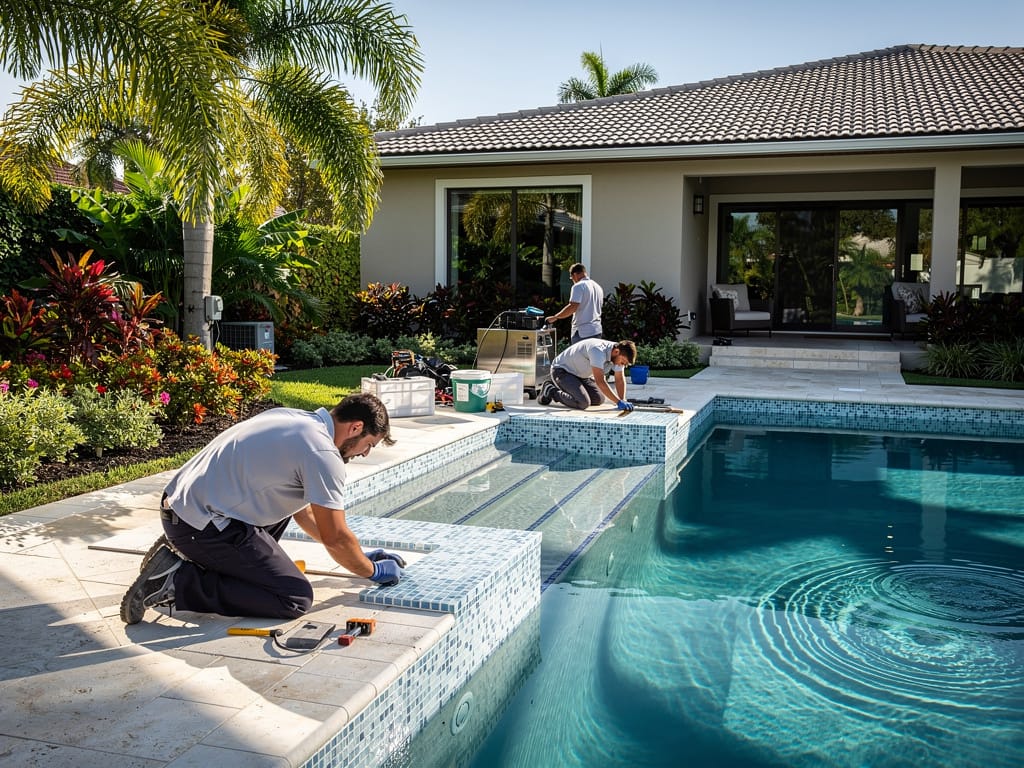
Coconut Creek’s active home renovation market — kitchen remodels, bathroom upgrades, screen enclosure replacements, and outdoor living area additions — regularly puts construction activity adjacent to backyard pools. For Coconut Creek homeowners who don’t want to shut down pool enjoyment during renovation or who return to find their pool has suffered chemistry damage from nearby work, understanding the specific hazards and protection strategies matters.
At Pool Service Fort Lauderdale, we serve Coconut Creek homeowners through renovation periods and are called regularly to remediate chemistry damage from construction contamination. This guide covers prevention and response.
Concrete Dust and Mortar — the Most Damaging Construction Contaminant
Concrete dust and mortar are strongly alkaline (calcium hydroxide, pH 12-13). When concrete dust enters pool water in significant quantity, it drives pool pH upward — past the 7.6 maximum of the target range, potentially to 8.0-8.5. At this pH range, chlorine’s sanitization effectiveness drops significantly and calcium carbonate begins precipitating from the pool water, depositing as white scale on pool surfaces, equipment, and filter media.
Renovation work involving concrete cutting, grinding, or mixing near the pool — patio work, pool deck renovation, new construction on adjacent areas — produces concrete dust that travel as airborne particles into the pool. Even a single afternoon of concrete work without pool cover protection can introduce enough alkaline material to require chemistry correction.
Response to concrete contamination:
- Test pH immediately — if above 7.8, add pH decreaser (muriatic acid or sodium bisulfate) to bring back to 7.4-7.6
- Test total alkalinity — high alkalinity from concrete requires incremental acid addition over multiple days to correct without overshooting
- Clean filter — concrete dust loads the filter rapidly; backwash or clean after a significant dust event
- Brush pool surfaces — concrete particles that settled on the floor or steps before pH was corrected can begin etching plaster at high pH; brush to suspension and let the filter capture them
Pool Cover During Active Construction Phases
The most effective single protection: a solid pool cover (solar cover, safety cover, or tarp secured at the pool perimeter) installed during active construction phases. A cover eliminates virtually all airborne debris entry into the pool water. For Coconut Creek renovation projects expected to generate significant dust or debris, install the cover before work begins each day and remove it after work concludes and the area has been cleaned.
Practical considerations: a cover that fills with debris needs to be removed carefully to avoid depositing the collected material into the pool when rolling back. Roll the cover from one end, shaking debris off before it falls into the water.
Protecting Pool Equipment During Construction
Pool equipment — pump, filter, heater — on the equipment pad adjacent to construction areas should also be protected:
- Cover equipment with a tarp or plywood sheet during active dust-generating work
- Confirm the pump intake and exhaust vents (heat pump) are not blocked by the temporary cover
- Inspect skimmer baskets and pump basket daily during construction periods — debris loading is significantly higher than normal
- Check filter pressure daily and backwash or clean when pressure rises 3-5 psi above clean baseline (during high-dust periods this may occur daily)
Post-Renovation Pool Reset Protocol
After construction is complete and the work area is cleaned up, a full pool reset is recommended before resuming normal swimming schedule:
- Full 7-parameter water test — test everything, not just chlorine and pH
- Brush all pool surfaces to dislodge any settled construction particles
- Vacuum to waste if significant debris is on the floor (vacuuming to the filter during high-debris conditions can overwhelm the filter)
- Clean or backwash filter
- Correct all chemistry to target range
- Run pump for 24 hours before confirming swim-ready status
Pool Service Fort Lauderdale provides construction-period pool monitoring and post-renovation pool reset services for Coconut Creek homeowners. Call (954) 501-2754 or visit our Coconut Creek pool service page. Full coverage at poolservicefortlauderdale.us.
Frequently Asked Questions
{“@context”:”https://schema.org”,”@type”:”FAQPage”,”mainEntity”:[{“@type”:”Question”,”name”:”How does concrete dust from nearby construction damage a Coconut Creek pool?”,”acceptedAnswer”:{“@type”:”Answer”,”text”:”Concrete dust is strongly alkaline (pH 12-13). When it enters pool water in sufficient quantity, it drives pool pH upward past the 7.6 maximum target, reducing chlorine effectiveness and triggering calcium carbonate precipitation — white scale on pool surfaces, equipment, and filter media. A single afternoon of concrete cutting or grinding near an uncovered Coconut Creek pool can introduce enough alkaline material to require chemistry correction.”}},{“@type”:”Question”,”name”:”How do I protect my Coconut Creek pool during a home renovation?”,”acceptedAnswer”:{“@type”:”Answer”,”text”:”Install a solid pool cover (solar cover, safety cover, or secured tarp) before active construction work begins each day, and remove after the work area is cleaned up. Cover pool equipment on the pad with a tarp during heavy dust work (ensuring heat pump vents aren’t blocked). Inspect skimmer and pump baskets daily. Check filter pressure daily and backwash or clean when it rises 5 psi above clean baseline. Test pH after any significant dust event.”}},{“@type”:”Question”,”name”:”Can I still use my Coconut Creek pool during nearby construction work?”,”acceptedAnswer”:{“@type”:”Answer”,”text”:”Yes, as long as the pool hasn’t been chemically contaminated and the water tests swim-safe. Cover the pool during active construction work to prevent contamination, remove the cover after work concludes and the area is cleaned, test chemistry before swimming, and cover again before the next day’s work begins. If a chemistry event occurs (pH spike from concrete contamination), correct it and retest before swimming.”}},{“@type”:”Question”,”name”:”What should I do if concrete mix or mortar entered my Coconut Creek pool?”,”acceptedAnswer”:{“@type”:”Answer”,”text”:”Test pH immediately — if above 7.8, begin acid addition (pH decreaser) to bring back to 7.4-7.6 range. Test total alkalinity. Brush settled material off pool surfaces into suspension. Backwash or clean the filter. Correct all chemistry to target ranges. Do not swim until pH is in range (7.2-7.6) and chlorine is at 1-3 ppm. For significant contamination (large amount of concrete entered the water), have a professional do a full chemistry reset before swimming.”}},{“@type”:”Question”,”name”:”Do I need more frequent pool service during a home renovation in Coconut Creek?”,”acceptedAnswer”:{“@type”:”Answer”,”text”:”Yes. Construction periods require more frequent monitoring — daily skimmer basket checks, more frequent filter pressure checks, and chemistry testing after dust events rather than only at the scheduled weekly visit. Most Coconut Creek renovation projects benefit from temporary bi-weekly professional service during the construction period, or from homeowner agreement to perform daily basket checks and report any significant contamination events to the service provider for a response visit.”}}]}
How does concrete dust damage a pool? Drives pH above 7.6 (highly alkaline at pH 12-13), reducing chlorine effectiveness and triggering calcium scale precipitation. Single afternoon of uncovered concrete work can require full chemistry correction.
How to protect the pool during renovation? Solid pool cover every day before work starts. Cover equipment pad with tarp. Daily basket and filter pressure checks. Test pH after every dust event.
Can I still use the pool during construction? Yes — cover during work, test before swimming each evening, cover before next morning’s work. Pause swimming if chemistry event occurs until corrected.
Concrete mix entered the pool — what to do? Test pH immediately, add pH decreaser if above 7.8, brush surfaces, backwash filter, correct all chemistry. Don’t swim until pH 7.2-7.6 and chlorine 1-3 ppm.
More frequent service needed during renovation? Yes — daily basket checks, more frequent filter monitoring, chemistry test after dust events. Temporary bi-weekly service during the construction period is recommended.