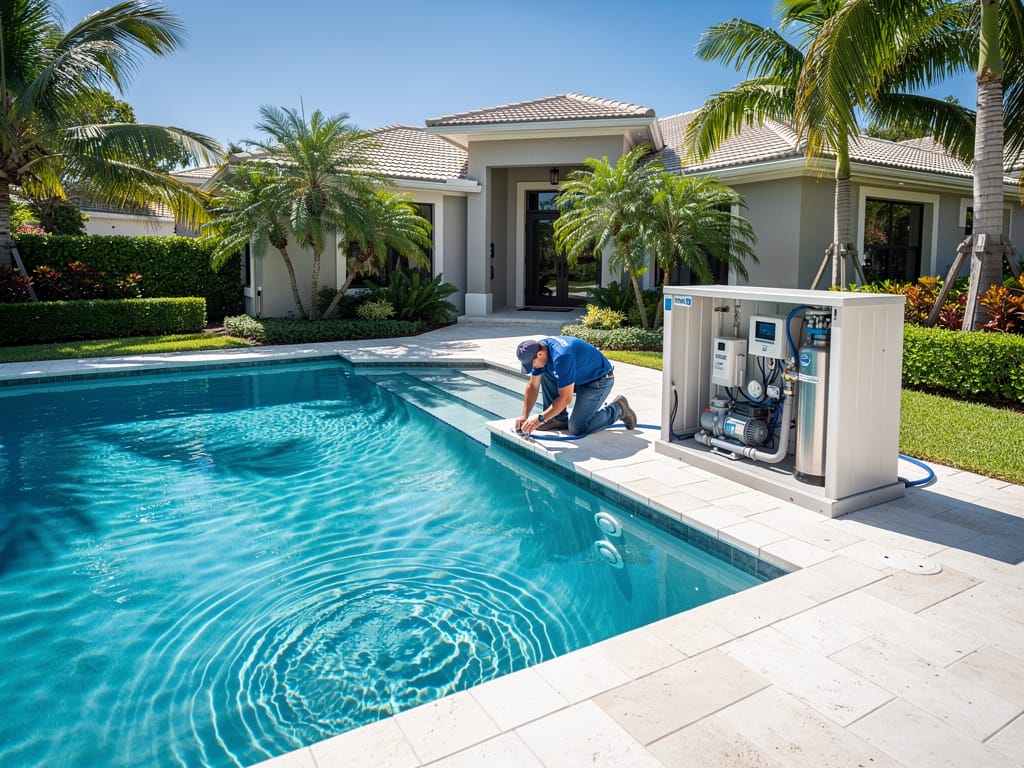
Salt water pools have become the expected standard in Coconut Creek’s upscale market, and for good reason — the benefits for active families with children are real. But some of what gets attributed to salt water in marketing conversations is either overstated or misunderstood. This guide covers the genuine benefits, the genuine limitations, and what the conversion decision looks like for a Coconut Creek family that swims regularly.
At Pool Service Fort Lauderdale, we install, maintain, and service salt water systems throughout Coconut Creek and have candid conversations with families about whether conversion makes sense for their specific situation. Here is what we tell them.
What Salt Water Genuinely Delivers for Coconut Creek Families
Softer-Feeling Water
This is real, and it matters for families with children who swim for extended periods. A saltwater chlorine generator produces chlorine continuously at a low, steady rate — maintaining free chlorine at approximately 1-2 ppm most of the time. Manually dosed chlorine pools spike to 3-5 ppm immediately after addition, then drift down. The lower steady-state free chlorine concentration is genuinely gentler on eyes, skin, and hair at equivalent sanitization. Children who swim for hours will notice the difference.
No Chlorine Purchasing or Handling
For busy Coconut Creek families, eliminating the weekly chlorine tablet top-up or the monthly liquid chlorine purchase run is a real quality-of-life benefit. The SCG handles chlorine production automatically — you add salt once at startup and top up annually (50-100 lbs to replace what’s lost to backwash and splash). The only chlorine-related task that remains: verify the SCG is producing at the right percentage via the control panel or app, and test free chlorine at the weekly service visit to confirm.
No “Chlorine Smell”
The chemical odor associated with pools is caused by chloramines — combined chlorine formed when free chlorine reacts with ammonia and nitrogen compounds (from sweat, urine, and other bather contamination). A well-managed salt water pool maintains lower total bather load on chlorine reserves and produces fewer chloramines. This is partially genuine (lower peak chlorine means fewer spike-period chloramine formations) and partially management quality (any pool with excellent chemistry and regular shocking has minimal chloramine odor).
What Salt Water Does Not Do
It Still Requires Professional Chemistry Management
The #1 misconception about salt water pools: that they are “self-maintaining.” The SCG handles only chlorine production. pH, total alkalinity, calcium hardness, cyanuric acid, and phosphate all still require exactly the same periodic testing and adjustment as a standard chlorine pool. Salt water pools that fall behind on chemistry management develop the same algae problems and chemistry damage as any other pool. Professional service remains essential.
Salt Corrodes Certain Materials
Salt at pool concentration (3,200 ppm) is corrosive to natural stone coping (travertine, limestone), older heater heat exchangers not rated for salt use, galvanized or low-grade steel components, and some decorative elements. Before converting a Coconut Creek pool to salt water, verify: heat exchanger salt compatibility rating, coping material type, and any galvanized fittings in the plumbing. Modern pools with polymer or synthetic stone coping and titanium heat exchangers are fully compatible.
Salt Water Conversion for Existing Coconut Creek Pools
Converting a standard chlorine Coconut Creek pool to salt water:
- Install a salt chlorine generator (SCG) inline on the return plumbing after the filter and heater. Cost: $600-$1,500 for the SCG unit. Popular models: Hayward AquaRite, Pentair IntelliChlor, Jandy TruClear.
- Add pool-grade sodium chloride to reach 3,200 ppm. A 15,000-gallon Coconut Creek pool needs approximately 400-600 lbs of salt. Cost: $40-$80.
- Set SCG output percentage (typically 50-70% for a residential pool in South Florida summer, lower in winter).
- Install the control box on the equipment pad and wire to the electrical system.
Total conversion cost: $800-$2,000 depending on the SCG model and existing electrical infrastructure. Professional installation ensures proper wiring, plumbing integration, and initial salt level setup.
Pool Service Fort Lauderdale installs and services salt water systems for Coconut Creek families. Call (954) 501-2754 or visit our Coconut Creek pool service page. Full coverage at poolservicefortlauderdale.us.
Frequently Asked Questions
{“@context”:”https://schema.org”,”@type”:”FAQPage”,”mainEntity”:[{“@type”:”Question”,”name”:”Is salt water really better for children’s skin and eyes in Coconut Creek pools?”,”acceptedAnswer”:{“@type”:”Answer”,”text”:”Yes, for most families. The steady low free chlorine concentration (1-2 ppm) of a properly maintained salt water pool causes less eye and skin irritation than the 3-5 ppm spikes that occur immediately after manual chlorine addition in standard pools. Children who swim for extended periods notice the softer feel and less eye irritation. For children with chlorine sensitivity, the difference is significant.”}},{“@type”:”Question”,”name”:”Do salt water pools still need a professional service provider in Coconut Creek?”,”acceptedAnswer”:{“@type”:”Answer”,”text”:”Yes. The salt chlorine generator handles only chlorine production. pH, total alkalinity, calcium hardness, CYA, and phosphate still require the same periodic testing and adjustment as any pool. Many Coconut Creek families discover after converting to salt water that chemistry management remains unchanged — the SCG doesn’t manage pH drift, calcium scale, or phosphate accumulation. Professional weekly service remains the right approach.”}},{“@type”:”Question”,”name”:”How long does the salt cell last in a Coconut Creek pool?”,”acceptedAnswer”:{“@type”:”Answer”,”text”:”Salt chlorine generator electrolytic cells typically last 3-7 years depending on water chemistry management. Cells operated in water with proper calcium hardness and salt levels (within manufacturer specifications) reach the upper end of this range. Cells operated in low-pH or high-calcium water degrade faster. Replacement cell cost: $200-$600. Factor this into the long-term cost of salt water ownership.”}},{“@type”:”Question”,”name”:”Will salt water damage my Coconut Creek pool’s coping or equipment?”,”acceptedAnswer”:{“@type”:”Answer”,”text”:”Salt at pool concentration (3,200 ppm) can accelerate corrosion or deterioration in: natural stone coping (travertine, limestone), non-titanium heat exchangers in older heaters, and galvanized or low-grade steel components. Check your heater’s salt compatibility rating and coping material before converting. Coconut Creek’s newer homes with polymer or brushed concrete coping and modern equipment are generally salt-compatible.”}},{“@type”:”Question”,”name”:”Can I smell a salt water pool differently from a regular pool in Coconut Creek?”,”acceptedAnswer”:{“@type”:”Answer”,”text”:”A properly maintained salt water pool has significantly less chemical odor than a standard chlorine pool experiencing high chloramine levels. The ‘chlorine smell’ is caused by chloramines (combined chlorine), not free chlorine itself. Salt water systems that maintain steady low free chlorine levels produce fewer chloramines during normal operation. Any pool — salt or standard — that is properly shocked and managed has minimal chloramine odor.”}}]}
Is salt water better for kids’ skin and eyes? Yes — steady 1-2 ppm free chlorine is gentler than the 3-5 ppm spikes after manual additions. Significant for families where children swim for extended periods.
Still need professional service? Yes — SCG handles only chlorine. pH, alkalinity, calcium, CYA, phosphate all require the same management as any pool.
How long does the salt cell last? 3-7 years depending on chemistry management. Replacement: $200-$600. Factor into long-term cost of ownership.
Will it damage coping or equipment? Check heater salt compatibility and coping material. Natural stone and non-titanium heat exchangers are vulnerable. Newer Coconut Creek homes with modern equipment are generally compatible.
Does it smell different? Less chemical odor from fewer chloramines at lower steady-state chlorine levels. Any well-managed pool has minimal odor — salt water reduces the risk of buildup.