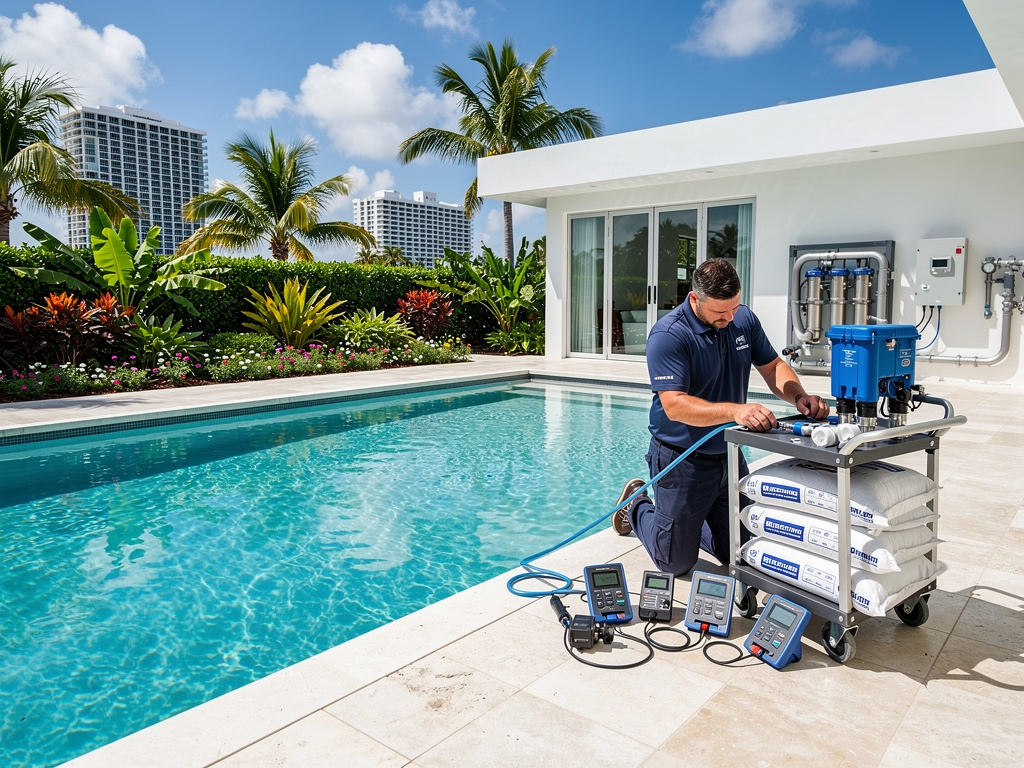
Why Hollywood Homeowners Are Converting to Saltwater
Hollywood’s proximity to the Atlantic Ocean makes salt water a familiar and comfortable idea. Families who spend weekends at Hollywood Beach or the Broadwalk are already accustomed to salt water and appreciate its softer feel compared to the sharp, sometimes harsh sensation of heavily tablet-chlorinated pool water. When salt chlorine generators became more affordable in the mid-2000s and their maintenance advantages became better understood, conversion rates in Hollywood and the surrounding coastal Broward communities increased substantially. Today, saltwater pools represent a significant and growing fraction of Hollywood’s residential pool stock.
The appeal beyond the sensory experience is real. Traditional chlorine tablet programs introduce CYA (cyanuric acid, the stabilizer bonded to trichlor tablets) at every tablet dose. Over a season without dilution from rain or water changes, CYA accumulates past the effective threshold — typically above 80–100 ppm — and binds available chlorine in a way that makes it inactive against pathogens. Saltwater systems avoid this accumulation because they generate unstabilized chlorine continuously. The result is consistently effective sanitization with more stable chemistry month after month, once the system is properly dialed in.
What a Saltwater Pool Is — and What It Isn’t
The most persistent misconception about saltwater pools is that they contain “natural” salt water similar to the ocean. They do not. A properly maintained saltwater pool contains 2,700–3,400 ppm of dissolved sodium chloride (table salt). Ocean water is approximately 35,000 ppm of salinity — roughly ten times the concentration in a saltwater pool. The saltwater pool’s salt level is barely perceptible as taste and creates a noticeably softer feeling than unsalted pool water, but it is not comparable to swimming in the ocean.
The salt doesn’t sanitize the pool by itself. The salt chlorine generator — a cell of titanium plates installed in the plumbing return line — passes a low-voltage current through the salt water, causing electrolysis that produces chlorine gas (Cl₂) which immediately dissolves in the water as hypochlorous acid (HOCl), the same active sanitizer as traditional chlorine. The difference is that the chlorine is produced continuously and at low concentration, rather than being added in large doses weekly or dissolving from tablets slowly. The result is a more consistent sanitizer level and the absence of the chloramines that form when tablet-derived chlorine reacts with bather load.
Conversion Process and Cost in Hollywood FL
Converting an existing Hollywood pool from traditional chlorine to a saltwater system is a straightforward electrical and plumbing project. The main components are: the salt chlorine generator cell (installed in the return plumbing after the heater), the control board (mounted near the equipment pad), and the electrical connection to the control board.
Equipment costs for a quality salt chlorine generator appropriate for a Hollywood residential pool (15,000–35,000 gallons) run $800–$1,600 for the unit itself. Installation labor adds $500–$800 depending on the complexity of the existing equipment pad and whether any electrical panel work is needed for the dedicated circuit. Including initial salt addition (approximately 250–400 pounds for a standard-size pool at roughly $7–$10 per 40-pound bag), total conversion cost typically runs $1,500–$2,800 all-in for a Hollywood residential pool.
After conversion, ongoing salt costs are minimal — only salt lost to splash-out, backwashing, and dilution from rain needs to be replaced, typically 50–100 pounds per year for an active Hollywood pool. The generator cell itself is the primary ongoing expense, lasting 5–7 years before the titanium coating degrades and chlorine production drops below adequate levels. Replacement cells run $250–$500 depending on the brand and model.
pH Management: The Main Challenge of Saltwater Systems
Saltwater pools have one significant chemistry management challenge that traditional chlorine systems don’t share: the electrolytic process that generates chlorine also produces sodium hydroxide as a byproduct, which causes pH to rise continuously. In a Hollywood climate where pools run year-round and the generator is producing chlorine essentially every day, pH can rise from 7.4 to 8.0 in a week without intervention.
At pH above 7.8, chlorine effectiveness drops sharply — the ratio of effective hypochlorous acid to ineffective hypochlorite ion shifts significantly in the wrong direction. A saltwater pool running at pH 8.0 is losing 60–70% of its chlorine’s effectiveness even if the concentration measures correctly. This is why saltwater pools require more frequent acid (muriatic acid) additions to keep pH in the 7.4–7.6 range than comparable tablet-chlorinated pools.
Automated pH dosing systems — liquid acid feeders that inject muriatic acid based on continuous pH monitoring — are a particularly good match for saltwater pools because they address this continuous pH rise without requiring manual intervention. The combination of a saltwater generator and an automated acid feeder creates a nearly self-managing chemistry system, with monthly salt level checks and quarterly generator cell cleaning being the primary remaining maintenance tasks.
Saltwater and Pool Surfaces: What’s Compatible
Concerns about saltwater damaging pool surfaces are sometimes overstated. Standard white plaster, pebble finishes (PebbleTec and similar), and fiberglass shells are all compatible with 2,700–3,400 ppm salt levels. The more accurate concern is that calcium scaling becomes more visible on plaster surfaces in saltwater pools because the consistent pH cycling (rise, then acid addition) slightly accelerates the calcium carbonate equilibrium that leads to scaling. Regular calcium hardness management and a periodic acid wash keep this under control.
What saltwater systems do affect more quickly in Hollywood’s coastal environment is incompatible metals and decorative features. Cheap zinc or aluminum pool fittings, some composite decking materials, natural stone (especially limestone coping), and LED fixtures without marine-grade sealing can be affected by the salt environment over time. This is more a function of Hollywood’s ambient coastal salt air than the pool salt level per se — the pool salt at 3,000 ppm is a minor additional factor on top of the ambient coastal environment that Hollywood properties already experience.
Pool Service Fort Lauderdale handles saltwater pool conversions and ongoing salt system maintenance throughout Hollywood FL. Call (954) 501-2754, visit our Hollywood service area page, or see our full website. 9900 W Sample Rd, Coral Springs, FL 33065.
{“@context”:”https://schema.org”,”@type”:”FAQPage”,”mainEntity”:[{“@type”:”Question”,”name”:”Is a saltwater pool the same as swimming in the ocean?”,”acceptedAnswer”:{“@type”:”Answer”,”text”:”No. Saltwater pools are maintained at 2,700–3,400 ppm of dissolved salt. Ocean water is approximately 35,000 ppm — about ten times more concentrated. The pool’s salt level creates softer-feeling water than unsalted pools but is barely perceptible as taste and is nothing like swimming in the ocean.”}},{“@type”:”Question”,”name”:”How much does a saltwater pool conversion cost in Hollywood FL?”,”acceptedAnswer”:{“@type”:”Answer”,”text”:”Equipment for a residential Hollywood pool typically runs $800–$1,600. Installation adds $500–$800. Including the initial salt purchase (250–400 lbs at roughly $8–$10 per 40-lb bag), total conversion cost runs $1,500–$2,800 all-in for most Hollywood residential pools.”}},{“@type”:”Question”,”name”:”Do saltwater pools require less maintenance than traditional chlorine pools?”,”acceptedAnswer”:{“@type”:”Answer”,”text”:”They require different maintenance, not necessarily less. pH rises steadily in saltwater pools and requires more frequent acid additions. The generator cell needs cleaning every 3 months with a mild acid solution. Salt levels need quarterly checking. But the daily chemical balancing act of tablet systems is reduced.”}},{“@type”:”Question”,”name”:”How long does a salt chlorine generator cell last?”,”acceptedAnswer”:{“@type”:”Answer”,”text”:”Most cells last 5–7 years at proper salt levels (2,700–3,400 ppm). Running at consistently low or high salt levels, or neglecting quarterly cell cleaning, can reduce cell life to 3–4 years. Replacement cells run $250–$500 depending on brand and model.”}},{“@type”:”Question”,”name”:”Does saltwater damage pool equipment in Hollywood FL’s coastal environment?”,”acceptedAnswer”:{“@type”:”Answer”,”text”:”Pool salt at 3,000 ppm is a minor additional factor on top of Hollywood’s ambient coastal salt air environment. Standard plaster, pebble finishes, and fiberglass are fully compatible. Incompatible elements include cheap zinc or aluminum fittings, some natural stone coping, and unsealed decorative LED fixtures — the same elements affected by coastal salt air generally.”}]}}