How Shade Changes Pool Chemistry Dynamics
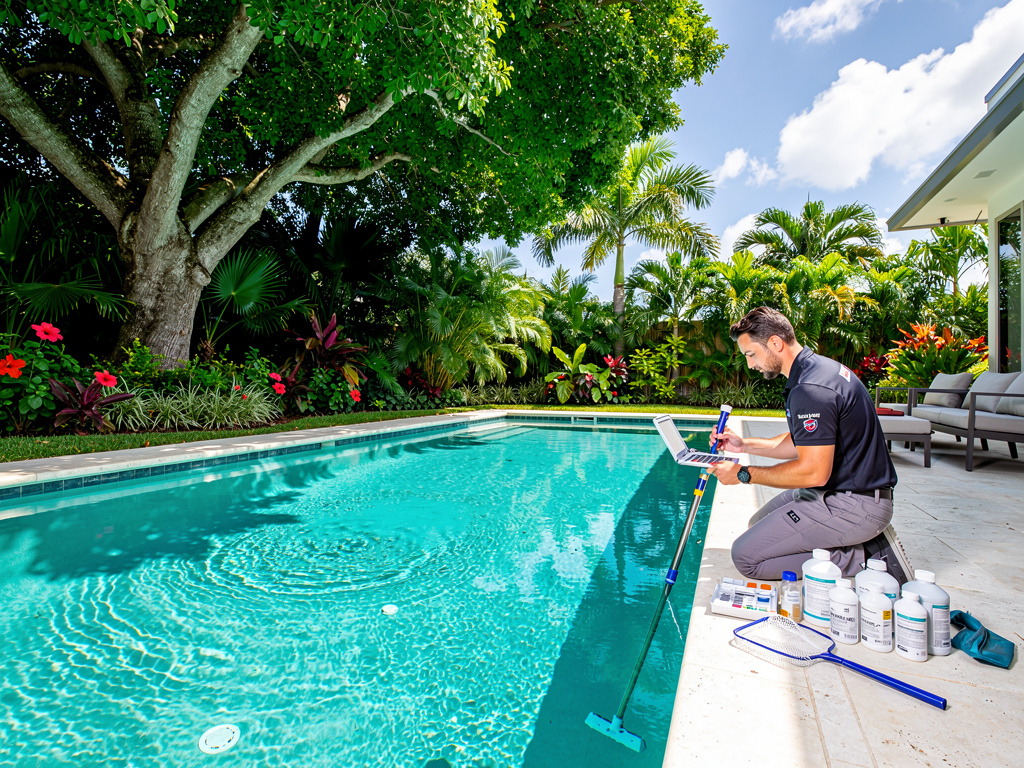
Most pool chemistry guidance is written for sun-exposed pools — which is the majority of South Florida pools in open suburban yards with typical setbacks from landscaping. In Plantation FL’s heavily canopied neighborhoods, a significant number of pools receive substantial shade from mature oaks, banyans, and tropical trees — either partial shade covering part of the pool surface during morning or afternoon hours, or in some cases heavy shade covering most of the pool for most of the day. This shading creates a fundamentally different pool chemistry environment that requires a different management approach.
UV radiation from direct sunlight has two relevant effects on pool chemistry. First, UV degrades free chlorine — unstabilized chlorine in particular breaks down rapidly in direct South Florida sunlight, which is why CYA (cyanuric acid, the chlorine stabilizer) is essential for outdoor pools. In a shaded Plantation pool, UV breakdown of chlorine is significantly reduced — which means a shaded pool needs less CYA to protect its chlorine from degradation. Operating a shaded pool at the typical sunny-pool CYA level of 50–80 ppm creates conditions where chlorine is over-stabilized relative to the reduced UV exposure — the CYA bonds are limiting chlorine effectiveness unnecessarily. Shaded Plantation pools can operate effectively at CYA of 30–50 ppm.
Second — and more importantly for Plantation’s shaded pools — UV contributes to sanitization of pool water through direct photodegradation of organic compounds and some pathogen inactivation. In a sun-exposed pool, UV is working in parallel with chlorine to sanitize the water. In a shaded pool, this UV contribution is absent, meaning chlorine alone must handle the full sanitization burden. This is why shaded pools should be maintained at slightly higher free chlorine levels than sun-exposed pools despite the slower chlorine degradation rate: the higher free chlorine compensates for the absent UV sanitization contribution.
Algae in Shaded Plantation Pools: A Different Population
Shaded pools grow different algae than sun-exposed pools, and some of these species are significantly more challenging to treat. Green algae (the most common pool algae species) thrives in warm water with adequate phosphate and insufficient chlorine — it grows prolifically in both sunny and shaded conditions. Black algae (Chroococcales species) specifically favors shaded pool surfaces and is one of the most treatment-resistant algae species in pool management. Mustard algae (a yellowish-green algae) also preferentially colonizes shaded pool walls and floors.
Black algae in particular is the signature problem of shaded Plantation pools. It colonizes rough pool surfaces (particularly older roughened marcite plaster) and establishes protective chlorine-resistant layers over its cell mass — making it nearly impossible to eliminate with chlorine alone at normal treatment concentrations. Black algae spots on Plantation pool surfaces that remain even after shock treatment and physical brushing are a common complaint that requires a specific treatment protocol: physical scrubbing to break the protective layer, followed by high-dose localized treatment (trichlor tablets applied directly to the spot), then systemic treatment of the water chemistry.
Mustard algae — appearing as a yellowish or greenish-yellow dusting on pool walls and floor that brushes off easily but reestablishes within days — is also common in Plantation’s shaded pool environment. Unlike green algae, mustard algae is chlorine-tolerant and doesn’t respond to standard shock treatment at typical concentrations. Eliminating a mustard algae infestation in a Plantation shaded pool requires a triple-shock protocol (10 ppm free chlorine maintained for 24 hours) and simultaneous washing of all pool equipment, toys, and accessories that have been in the water — because mustard algae reintroduces itself to the pool from any contaminated surface within days of treatment if not addressed comprehensively.
Direct Debris Input: The Shaded Pool’s Overhead Problem
A tree that shades a Plantation pool is positioned directly over or immediately adjacent to the pool surface — which means it’s also directly depositing debris into the pool. Leaves, seed pods, catkins, bark fragments, and bird waste from wildlife in the canopy fall directly into the pool water rather than landing on the surrounding deck where they can be blown or swept away before reaching the water. This direct-into-water debris introduction creates a higher per-unit-of-debris organic load than the same debris volume landing on a deck, because deck debris typically has hours or days on a dry surface before being swept into the pool (if at all), while canopy-deposited debris begins decomposing in the water immediately.
The result is accelerated phosphate loading, tannin release, and chlorine demand in shaded Plantation pools compared to the same tree’s debris volume falling onto a nearby deck. The enzymatic treatment and phosphate management protocols discussed for Plantation’s tree-canopy pools generally are doubly important for shaded pools where the debris is landing in the water directly.
Cleaning Shaded Pool Surfaces: More Frequent Brushing Required
Algae that colonizes shaded Plantation pool surfaces establishes itself in surface irregularities — rough plaster texture, grout line gaps, tile edges — and is difficult to remove once it has developed a protective biofilm. The preventive approach is more effective than the remedial approach: weekly brushing of all pool surfaces (walls, floor, steps, ledges) prevents algae from establishing before chlorine can kill the individual cells. A robotic pool cleaner provides daily physical cleaning of pool floors and, in some models, walls — reducing the algae establishment that occurs between manual brushing sessions.
For shaded Plantation pools with older roughened plaster, monthly algaecide treatment as a preventive measure is advisable in addition to maintaining correct chlorine levels. The algaecide maintains a chemical presence in the water that reduces algae’s ability to establish in micro-surface pores between brushing sessions. This preventive approach is significantly less expensive and less disruptive than treating an established algae bloom — which in a shaded pool with black algae may require scrubbing, high-dose treatment, and multiple follow-up visits to confirm eradication.
Pool Service Fort Lauderdale provides specialized shaded-pool service throughout Plantation FL. Call (954) 501-2754, visit our Plantation pool service page, or see our full website. 9900 W Sample Rd, Coral Springs, FL 33065.
{“@context”:”https://schema.org”,”@type”:”FAQPage”,”mainEntity”:[{“@type”:”Question”,”name”:”Does shade help or hurt pool chemistry in a Plantation FL pool?”,”acceptedAnswer”:{“@type”:”Answer”,”text”:”Both — in different ways. Shade slows UV breakdown of chlorine (so less CYA is needed; 30–50 ppm vs. 50–80 ppm for sunny pools). But shade removes UV’s sanitization contribution, making algae growth more aggressive in the absence of UV. Higher free chlorine (3.0–4.0 ppm) compensates for absent UV sanitization. Shaded pools need more algae prevention, not less.”}},{“@type”:”Question”,”name”:”Why do I have black spots in my Plantation FL pool that won’t go away?”,”acceptedAnswer”:{“@type”:”Answer”,”text”:”Black spots on pool surfaces are black algae — a chlorine-resistant species that establishes protective biofilm layers and specifically favors shaded, rough-textured surfaces. Standard shock treatment doesn’t penetrate the protective layer. Treatment: physical scrubbing to break the layer, direct application of trichlor tablets to spots, high-dose systemic treatment, followed by weekly brushing to prevent reestablishment.”}},{“@type”:”Question”,”name”:”What is mustard algae and how do I treat it in my shaded Plantation FL pool?”,”acceptedAnswer”:{“@type”:”Answer”,”text”:”Mustard algae is a yellowish-green, chlorine-tolerant algae that appears as a loose dusting on walls and floors that brushes off easily but reestablishes within days. Treatment requires triple-shock (10 ppm free chlorine for 24 hours) AND simultaneous washing of all pool equipment, toys, and accessories that have been in the water — mustard algae reintroduces from contaminated surfaces if not addressed comprehensively.”}},{“@type”:”Question”,”name”:”Should I use algaecide in my shaded Plantation FL pool?”,”acceptedAnswer”:{“@type”:”Answer”,”text”:”Yes, as a monthly preventive treatment. Shaded pools face more aggressive algae growth than sun-exposed pools, and monthly algaecide creates a chemical presence that reduces algae establishment in micro-surface pores between brushing sessions. Preventive monthly algaecide is substantially less expensive and less disruptive than treating an established black algae or mustard algae bloom.”}},{“@type”:”Question”,”name”:”Does a tree shading my Plantation FL pool increase debris in the water?”,”acceptedAnswer”:{“@type”:”Answer”,”text”:”Yes — significantly. Debris from overhanging trees falls directly into pool water, beginning decomposition immediately and releasing phosphate and tannins faster than the same debris volume landing on a deck. Direct-into-water debris creates higher per-unit organic load than deck-deposited debris. Weekly enzyme treatment and monthly phosphate remover are baseline maintenance for any Plantation pool receiving direct canopy debris.”}]}}