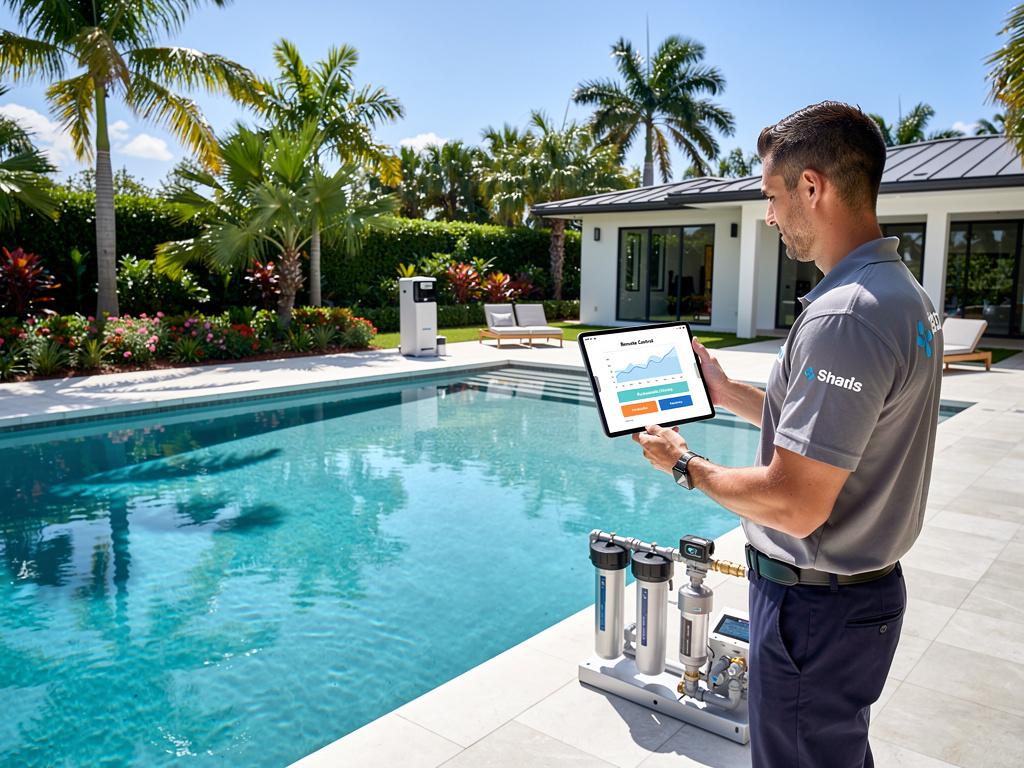
Why Automation Matters in Plantation’s Professional Households
Plantation FL’s professional and executive homeowner demographic values their pool as a lifestyle amenity — not as a DIY project. The typical Plantation professional household wants a pool that is always ready: clear water, comfortable temperature, clean surfaces, and no chemistry crisis requiring an urgent call to the service company or a last-minute run to the pool supply store before a weekend gathering. This expectation of reliable availability is fundamentally different from a homeowner who enjoys the hands-on aspect of pool chemistry management and is comfortable monitoring and adjusting daily.
The gap between the expected pool experience — always-ready, always-clean — and the reality of a manually managed pool in Plantation’s demanding tree-canopy environment creates a dissatisfaction pattern that most Plantation pool owners with time constraints eventually recognize. A pool that requires attention to stay in optimal condition, in a household where that attention isn’t reliably available, drifts gradually until something is visibly wrong — and by then the correction is more disruptive and more expensive than continuous management would have been.
Modern pool automation technology was specifically designed to close this gap — to provide the continuous, responsive management that a time-constrained household can’t deliver manually. Understanding what’s available and what it actually costs is the first step for a Plantation professional homeowner ready to move from reactive pool management to a system that genuinely runs itself.
The Saltwater Generator as the Foundation
For a Plantation FL professional household, the saltwater chlorine generator is the most impactful single automation investment because it eliminates the most time-sensitive aspect of manual pool management: chlorine replenishment. A saltwater generator continuously produces chlorine from dissolved salt through electrolysis, maintaining a stable free chlorine level in the pool water without the owner buying, handling, or adding chlorine products. The generator’s output can be set as a percentage of capacity (typically 40–80% for a Plantation residential pool) and left unchanged between service visits.
The practical effect for a Plantation professional: chlorine management becomes a monthly water test (to confirm the generator is operating correctly) rather than a weekly or biweekly manual chemical addition. The pool cannot run out of chlorine during a busy work week when pool service is delayed or the owner is traveling — the generator continues producing as long as the salt level is adequate, which it remains for several months without attention in a properly filled pool.
Saltwater pools also deliver the softer water feel that Plantation’s upscale homeowners associate with higher-quality pool experiences. The reduced skin and eye irritation compared to a tablet-chlorinated pool is consistently cited by Plantation pool owners who have made the switch as a meaningful improvement in pool enjoyment — particularly for households with children who are frequent swimmers.
Variable-Speed Pump Scheduling: Automation That Also Saves Money
A variable-speed pump with a programmable controller is the second foundational component of a Plantation automation package. Beyond the electricity savings described in energy efficiency discussions, the scheduling capability means the pump automatically manages daily filtration and feature operation without owner involvement. A typical Plantation automation schedule might run: low-speed filtration (1,500 RPM) overnight for 8 hours, high-speed cleaning cycle (2,800 RPM) for 2 hours in mid-morning after the overnight debris fall settles, water feature operation (3,200 RPM for waterfalls or jets) during the late afternoon and evening hours most convenient for the household, and automated shutoff overnight.
This schedule runs automatically every day without any homeowner input. The pool circulates and filters on schedule; the cleaner runs on schedule; the water features operate when the household is most likely to be using or viewing the pool. From the Plantation professional homeowner’s perspective, the pool is simply always in the right state — filtering when it should filter, featuring when it should feature — without requiring any daily decision-making or timer adjustment.
pH Dosing Systems: Addressing Plantation’s Biggest Chemistry Challenge
In Plantation’s high-organic-input pool environment, pH management is a continuous challenge. Organic acid input from tannins and leaf decomposition depresses pH over time; carbon dioxide outgassing from warm water raises pH. The net result in a typical Plantation pool is pH drift in both directions that, if not corrected between service visits, allows chemistry to operate outside optimal range — either scaling conditions (high pH) or corrosive conditions (low pH) — for days at a time.
An automatic pH dosing system — a metering pump connected to a pH controller that monitors water chemistry continuously and dispenses liquid acid or CO₂ injection to maintain pH in a target range — eliminates this drift. The system samples pool water continuously, detects pH drift, and doses the appropriate correction chemical within minutes of the drift occurring. The result is pH maintained in a 0.1–0.2 unit range around the target (typically 7.4–7.5) rather than the 0.5–1.0 unit drift that can occur between weekly manual visits in a demanding environment like Plantation’s.
Automatic pH dosing systems cost $600–$1,200 installed and require a liquid acid reservoir refill every 2–6 weeks depending on pool volume and pH demand. The chemistry consistency improvement is meaningful: pools with automatic pH dosing have measurably better chlorine efficiency (chlorine effectiveness is pH-dependent), lower acid consumption over time (small continuous corrections are more efficient than large periodic corrections), and reduced scaling tendency. For a Plantation professional homeowner who wants consistent water quality between weekly service visits, automatic pH dosing delivers that consistency reliably.
Smartphone Monitoring and Remote Management
Modern pool automation systems — Pentair IntelliConnect, Hayward OmniHub, Jandy iAqualink, and several others — provide smartphone apps that allow real-time pool monitoring and control from anywhere with cellular service. A Plantation pool owner traveling for business can check their pool’s current chemical readings, pump status, and temperature from their hotel room. They can remotely turn on the water feature before driving home from the office, so it’s running when they arrive. They can receive push notification alerts if a monitored parameter goes out of range — a salt cell alarm, a low water level, a filter pressure spike — and address it before it becomes a problem rather than discovering it on the weekend.
For Plantation’s traveling professional households, this remote visibility eliminates much of the anxiety associated with extended pool absence. The system monitors continuously whether the owner is present or not, and provides the data and control capability to identify and respond to issues before the weekly service visit — or to confirm that everything is operating normally and no intervention is needed.
Pool Service Fort Lauderdale provides pool automation installation and smart pool service throughout Plantation FL. Call (954) 501-2754, visit our Plantation pool service page, or see our full website. 9900 W Sample Rd, Coral Springs, FL 33065.
{“@context”:”https://schema.org”,”@type”:”FAQPage”,”mainEntity”:[{“@type”:”Question”,”name”:”What does a fully automated pool in Plantation FL cost?”,”acceptedAnswer”:{“@type”:”Answer”,”text”:”A comprehensive automation package — variable-speed pump with scheduler, saltwater generator, automatic pH dosing system, and smartphone-connected controller — typically costs $3,000–$8,000 installed depending on pool size and existing equipment condition. This hardware investment delivers better water quality consistency than manual management while requiring less than 5 minutes of owner attention per week.”}},{“@type”:”Question”,”name”:”Can I monitor my Plantation FL pool from my phone while traveling?”,”acceptedAnswer”:{“@type”:”Answer”,”text”:”Yes. Systems like Pentair IntelliConnect, Hayward OmniHub, and Jandy iAqualink provide smartphone apps with real-time monitoring of chemistry readings, pump status, and temperature. You can control equipment remotely, receive alerts for out-of-range parameters, and confirm your pool is operating normally without being home. Particularly valuable for Plantation’s professional households with frequent travel.”}},{“@type”:”Question”,”name”:”Is a saltwater pool better for a Plantation FL professional household?”,”acceptedAnswer”:{“@type”:”Answer”,”text”:”Yes, for most professional households. The saltwater generator eliminates the most time-sensitive manual chemistry task — chlorine replenishment — by continuously producing chlorine from dissolved salt. The pool cannot run out of chlorine during a busy week or when service is delayed. Softer water feel and reduced eye irritation are additional benefits. The trade-off is higher upfront cost ($800–$1,500 for the generator) and salt cell maintenance every 3 months.”}},{“@type”:”Question”,”name”:”What is an automatic pH dosing system and do I need one in Plantation FL?”,”acceptedAnswer”:{“@type”:”Answer”,”text”:”An automatic pH dosing system uses a controller and metering pump to continuously monitor pool pH and dispense liquid acid to maintain it within a 0.1–0.2 unit target range. In Plantation’s high-organic environment where tannin input and carbon dioxide outgassing cause constant pH drift, automated pH management delivers significantly more consistent chemistry than weekly manual correction. Cost: $600–$1,200 installed.”}},{“@type”:”Question”,”name”:”What pump schedule works for a Plantation FL automated pool?”,”acceptedAnswer”:{“@type”:”Answer”,”text”:”A typical effective schedule: low-speed filtration (1,500 RPM) overnight for 8 hours; high-speed cleaning cycle (2,800 RPM) for 2 hours mid-morning after overnight debris settles; water feature operation (3,200 RPM) in late afternoon and evening; automated overnight shutoff. This schedule provides full daily filtration, cleaner operation, and feature activation during peak use hours — all without daily owner input.”}]}}