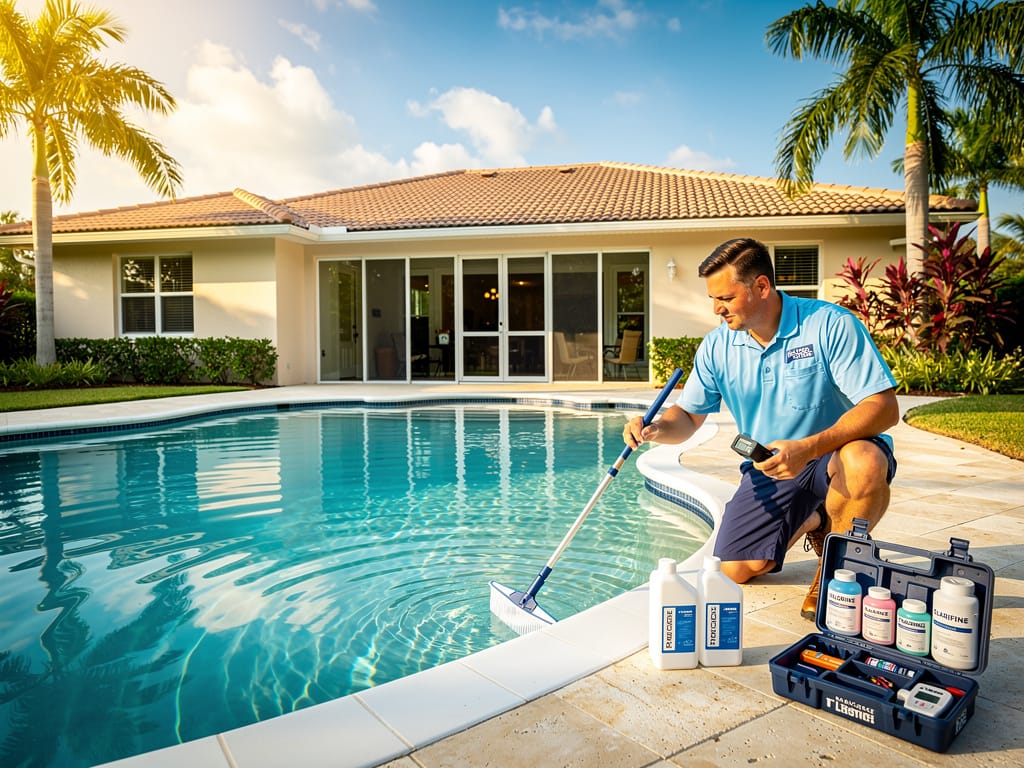
Many Tamarac homeowners in the Woodlands, Mainlands, and surrounding communities spend part of the year elsewhere — in northern states, Canada, or other Florida homes. The annual cycle of departure and return is a routine part of life in Tamarac’s 55+ community, and pool management during the absent months requires a deliberate plan rather than assumption that the pool will be fine on its own.
At Pool Service Fort Lauderdale, we provide seasonal service for Tamarac’s snowbird population and have developed the departure and return protocol below based on what actually goes wrong during extended Tamarac pool absences.
The Departure Checklist — Before You Leave Tamarac
1-2 Weeks Before Departure
- Schedule professional bi-weekly service for the entire absence period. Confirm the service provider has your emergency contact information and authority to make minor repairs without calling you for pre-approval on expenses under a defined threshold ($200-$500 is typical for absentee service authorizations).
- Test and correct all chemistry: Get full 7-parameter readings (free chlorine, pH, alkalinity, calcium hardness, CYA, TDS, phosphate) and correct any out-of-range values before departure.
- Inspect and repair any equipment issues: Sounds, leaks, pressure anomalies that seemed minor when you were home become bigger problems when unmonitored for months.
Day of Departure
- Shock to 10 ppm free chlorine: Superchlorinate the pool to 10 ppm free chlorine (typically 2-3 lbs of cal-hypo or 3-4 gallons of liquid chlorine for a 15,000-gallon pool). This provides an extended chlorine reserve as the pool transitions to unoccupied status.
- Add phosphate removal treatment: Apply lanthanum-based phosphate remover at the full recommended dose. Run the pump 24 hours after treatment and backwash or clean the filter.
- Add enzyme treatment: Pool enzyme product (Natural Chemistry Pool Perfect or similar) added at departure reduces organic load accumulation over the first weeks of absence.
- Verify pump timer settings: Timer should be set for 8-10 hours/day minimum. Do not reduce pump run time to save electricity — adequate circulation is the most important factor in pool health during unoccupied periods.
- Confirm auto-fill is functioning: Auto-fill or ball valve on the fill line should be operational to compensate for evaporation during absence. A pool that loses water level during absence loses skimming function when the waterline drops below the skimmer mouth.
- Provide pool gate access to service provider: Ensure the service provider has physical access to the pool area without needing the homeowner present.
The Return Checklist — When You Come Back to Tamarac
Arrival Day
- Visual inspection before entering the water: Can you see the pool bottom at the deep end? Is the waterline tile area showing algae or scale buildup? Is the equipment running normally?
- DO NOT swim until water is tested. Clear-looking water can have dangerously high or low chlorine, extreme pH, or active bacteria that are invisible to the naked eye.
First 24-48 Hours After Return
- Full 7-parameter water test: Bring a sample to a pool store or have your service provider test on arrival. Test for: free chlorine, pH, alkalinity, calcium hardness, CYA, TDS, and phosphate.
- Equipment inspection: Run each piece of equipment through a manual test cycle. Listen for bearing noise in the motor, check filter pressure, confirm heater or heat pump ignites correctly if it’s been off all summer.
- Brush pool surfaces: Brush all surfaces (walls, steps, floor) even if the pool appears clear. Early algae colonies colonize surfaces before they’re visible in the water — brushing disrupts early biofilm.
- Check waterline tile: Calcium scale builds up at the waterline during extended periods with minor chemistry drift. Minor scale: pumice stone. Significant scale: professional descaling treatment.
- Confirm screen enclosure integrity: Tamarac’s summer storm season is active — screen panels tear and frames bend. Walk the enclosure perimeter and note any damage before first use.
Pool Service Fort Lauderdale provides departure preparation and return opening services for Tamarac’s seasonal residents. Call (954) 501-2754 or visit our Tamarac pool service page. Full coverage at poolservicefortlauderdale.us.
Frequently Asked Questions
{“@context”:”https://schema.org”,”@type”:”FAQPage”,”mainEntity”:[{“@type”:”Question”,”name”:”What is the minimum pool service needed while I’m away from Tamarac for the summer?”,”acceptedAnswer”:{“@type”:”Answer”,”text”:”Bi-weekly professional service is the practical minimum for South Florida’s climate. Monthly-only service allows too much chemistry drift in Tamarac’s summer heat and organic load conditions — a single chemistry event or equipment failure that goes unnoticed for 4 weeks can require expensive remediation. The cost of bi-weekly service during a 5-month absence ($150-$250/month) is far less than the remediation cost of a neglected pool on return.”}},{“@type”:”Question”,”name”:”Is it safe to swim in my Tamarac pool as soon as I return from being away?”,”acceptedAnswer”:{“@type”:”Answer”,”text”:”Not without testing first. Clear-looking water can have high or low chlorine, pH outside safe range, or active microbial growth that is invisible. Test with a full 7-parameter water test before swimming. If pool chemistry is in range, clear water and a brushed-clean surface means the pool is swim-ready. If chemistry is off, correction and re-testing should happen before the first swim.”}},{“@type”:”Question”,”name”:”Should I turn off my Tamarac pool equipment while I’m away to save electricity?”,”acceptedAnswer”:{“@type”:”Answer”,”text”:”No. Keep the pump on its normal 8-10 hour per day timer schedule. Circulation is the foundation of pool health — without circulation, chemistry stratifies, algae establishes faster, and the skimmer doesn’t remove surface debris. The electricity savings of turning the pump off (perhaps $15-$25/month) are far outweighed by the remediation cost of a pool that went stagnant during a long absence.”}},{“@type”:”Question”,”name”:”What should I do to my Tamarac pool the day before I leave for the summer?”,”acceptedAnswer”:{“@type”:”Answer”,”text”:”Superchlorinate to 10 ppm free chlorine, apply a full-dose phosphate removal treatment (run pump 24 hours, then backwash or clean filter), add a pool enzyme product to reduce organic accumulation, verify pump timer is set to 8-10 hours/day, confirm auto-fill is operational, and confirm your service provider has access and an emergency authorization threshold for minor repairs.”}},{“@type”:”Question”,”name”:”What is the most common problem Tamarac snowbirds find on pool return?”,”acceptedAnswer”:{“@type”:”Answer”,”text”:”Chemistry drift combined with high phosphate — even pools on bi-weekly service can accumulate phosphate during Tamarac’s summer organic load season, setting up conditions for algae the moment chemistry drift allows free chlorine to drop below threshold. Elevated phosphate is invisible; the pool looks clear until suddenly it doesn’t. Testing phosphate on return (not just chlorine/pH) catches this before it becomes a green pool event.”}}]}
Minimum service during Tamarac absence? Bi-weekly professional service. Monthly allows too much chemistry drift in South Florida’s summer conditions.
Safe to swim on return? Not without a full 7-parameter test. Clear water isn’t necessarily safe water.
Turn off equipment to save electricity? No — keep pump on 8-10 hour timer. Stagnant water deteriorates far faster than the electricity savings are worth.
What to do the day before departure? Shock to 10 ppm, phosphate removal treatment + 24-hour pump run + filter clean, enzyme treatment, verify timer and auto-fill, confirm service provider access.
Most common return problem? Chemistry drift + phosphate accumulation — pool looks clear then suddenly goes green. Test phosphate on return, not just chlorine/pH.