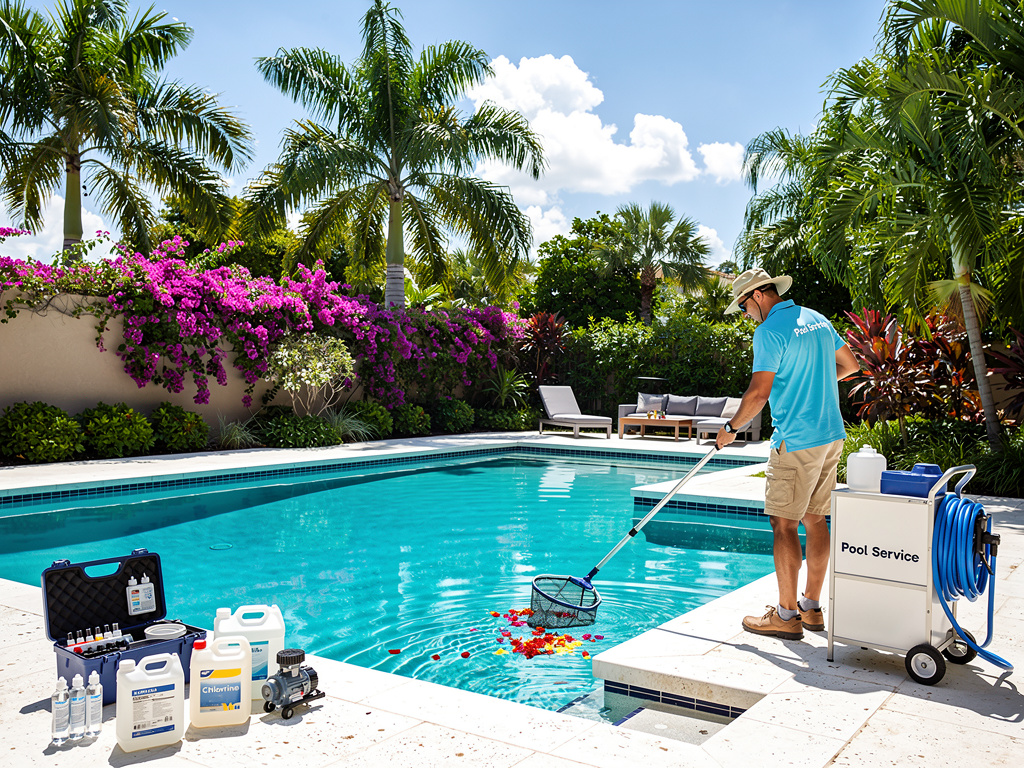
Miramar’s Tropical Aesthetic and the Pool Maintenance Trade-off
The newer residential developments of Miramar — Silver Lakes, Riviera Isles, Sunset Lakes, and the communities along Miramar Parkway — were landscaped with the lush tropical aesthetic that defines South Florida’s residential character. Mature palms, flowering bougainvillea climbing pool fences, ornamental heliconias, crotons, sea grapes, and the full range of South Florida ornamental plantings create the lush visual backdrop that makes these communities desirable. They also create a continuous and varied organic load for the pools they surround.
Not all organic debris is equal in its impact on pool chemistry and appearance. Understanding which plants in your Miramar yard create which specific pool management challenges allows you to address them efficiently rather than responding to problems reactively. In most Miramar yards, the relevant plants fall into a few categories: volume debris producers (palms, Washingtonian palms, traveler’s palms), color staining plants (bougainvillea, poinciana, jacaranda), and tannin producers (sea grape, live oak, certain ficus species).
Palm Trees: Volume Debris and Filter Loading
Palms are the signature plant of Florida’s residential landscaping and are nearly universal in Miramar’s newer developments. From a pool maintenance perspective, palms present a volume debris challenge rather than a chemistry challenge. Palm frond material is low in tannins and organic acids compared to broadleaf trees, so it doesn’t heavily affect water chemistry before it’s removed. The challenge is volume: a mature queen palm or Washingtonian palm sheds frond segments, flower stalks, and seed clusters continuously, and the sheer volume of material that lands in the pool requires daily skimming to prevent accumulation.
Palm fiber — the stringy, fibrous material that attaches fronds to the trunk — is particularly problematic for pool filters. Individual fibers are small enough to pass through the skimmer basket and enter the filter, where they accumulate between sand grains or in DE filter grids in ways that are harder to backwash out than typical debris. If your Miramar pool has palms immediately adjacent to the water, expect to inspect and service the filter more frequently than the monthly minimum — and budget for a manual filter cleaning (sand filter: hand-rake the top 3 inches of media; cartridge: full manual inspection and rinse) at least quarterly.
Bougainvillea: Beautiful Staining Risk
Bougainvillea is one of the most visually dramatic plants in Miramar’s landscape, and its spectacular color comes from papery bracts — modified leaves that surround the tiny white actual flowers — in shades of pink, magenta, orange, red, and purple. These bracts shed continuously during and after bloom cycles, and they fall in large quantities because the vines are prolific bloomers in Miramar’s climate. When bougainvillea bracts land in a pool and aren’t skimmed promptly, they can leach pink and orange pigment compounds onto white or light-colored plaster surfaces.
Bougainvillea staining appears as pink or rust-colored blotches at the waterline or on plaster sections that received heavy bract contact before the material was skimmed. Light staining can be addressed with a diluted acid spot treatment or with pumice stone rubbing on accessible surfaces. Heavy staining may require an acid wash during the next replastering cycle to fully remove. The prevention is simple: skim bougainvillea bracts daily when the vines are in active bloom. Don’t let them sit in the water for more than a few hours. A leaf skimmer net check at the beginning and end of each day near a bougainvillea-enclosed pool is the most effective prevention tool.
Tannin-Producing Plants and Brown Staining
Several trees and shrubs common in South Florida landscapes produce high-tannin leaf material that, when it decomposes in pool water, releases tannic acid — an organic acid that is slightly acidic (drops pH), consumes chlorine, and can stain light plaster surfaces brown or tan. The most common tannin-producing plants in Miramar’s residential landscape are sea grape (Coccoloba uvifera), live oak (Quercus virginiana), and certain ficus species.
Sea grape is particularly relevant because it’s commonly used as a privacy hedge in South Florida HOA landscapes — meaning it may be planted along the perimeter of the pool area in Silver Lakes or Riviera Isles properties as part of the community’s landscaping standard. Sea grape leaves are large, round, and waxy, and they shed in significant numbers during fall and winter. When they accumulate in a pool and begin to decompose, the tannin release can cause visible water tinting (slightly brownish or golden water color despite adequate chemistry) and contact staining where leaves rested on the plaster surface.
Managing tannin load requires prompt removal of fallen leaves before decomposition begins. For Miramar pool areas bordered by sea grape hedges or live oaks, daily skimming is essential from October through February when leaf shedding peaks. An ascorbic acid (vitamin C) treatment can address existing tannin staining on plaster — rubbing a vitamin C tablet on a tannin stain is a common pool professional field test that, if it lightens the stain, confirms tannic rather than metal staining and indicates that an ascorbic acid treatment will be effective.
Enzyme Treatments: The Consistent Solution
Across all categories of organic debris — palm fiber, bougainvillea pigment compounds, tannins, and general leaf decomposition — a monthly enzyme treatment is the most cost-effective proactive management tool for Miramar pools with heavy tropical landscaping. Enzyme products contain lipase, protease, and other biologically derived catalysts that break down complex organic molecules into simpler compounds that can be processed by the filter or oxidized by chlorine.
The distinction between what enzymes do versus what chlorine does is important: chlorine oxidizes and kills biological contaminants but converts many organic compounds into chloramines rather than eliminating them. Enzymes actually break down organic molecules, reducing the pool’s background organic load rather than just converting it to a different form. In a Miramar pool with heavy landscape inputs, the combination of weekly chlorine management and monthly enzyme treatment creates a system where the organic load is genuinely reduced rather than continuously managed at a high level.
Landscaping Choices That Reduce Pool Maintenance Load
For Miramar homeowners with HOA approval for landscaping modifications, some plant choices near the pool create significantly less maintenance than others. Low-debris options include: dwarf ornamental grasses (no significant shedding), succulents and bromeliads (minimal debris), birds of paradise (impressive appearance, minimal shedding), and large-leaf tropical plants like elephant ears that shed infrequently and don’t stain. High-debris plants to avoid positioning directly over or adjacent to the pool: any oak species, bougainvillea trained over pool fencing, sea grape as pool perimeter hedge, and shedding palms placed within their frond-dropping radius of the water.
Pool Service Fort Lauderdale provides weekly pool maintenance throughout Miramar FL’s landscaped developments. Call (954) 501-2754, visit our Miramar pool service page, or see our main website. 9900 W Sample Rd, Coral Springs, FL 33065.
{“@context”:”https://schema.org”,”@type”:”FAQPage”,”mainEntity”:[{“@type”:”Question”,”name”:”Can bougainvillea stain my pool plaster in Miramar FL?”,”acceptedAnswer”:{“@type”:”Answer”,”text”:”Yes. Bougainvillea bracts (the papery colored petals) leach pink and orange pigment compounds onto white or light-colored plaster when allowed to sit in water. Daily skimming during bloom cycles prevents staining. Light existing stains respond to diluted acid spot treatment; heavy staining may require an acid wash.”}},{“@type”:”Question”,”name”:”What causes brown staining in Miramar pools near sea grape or oak trees?”,”acceptedAnswer”:{“@type”:”Answer”,”text”:”Tannins from decomposing leaves of sea grape, live oak, and ficus species. Tannins leach into pool water from leaves that aren’t skimmed promptly, creating water tinting and contact stains on plaster. Ascorbic acid (vitamin C) treats tannin staining; daily leaf removal during heavy shedding seasons prevents it.”}},{“@type”:”Question”,”name”:”Do palms near a Miramar pool cause chemistry problems?”,”acceptedAnswer”:{“@type”:”Answer”,”text”:”Primarily volume problems rather than chemistry problems. Palm frond material is low in tannins and acids but generates significant debris volume and sheds fibrous material that loads pool filters faster than typical debris. Expect more frequent filter cleaning (quarterly manual service vs. biannual) if palms are adjacent to the pool.”}},{“@type”:”Question”,”name”:”How do enzyme treatments help Miramar pools with heavy landscaping?”,”acceptedAnswer”:{“@type”:”Answer”,”text”:”Enzymes break down oils, tannins, palm fibers, and other complex organic molecules into simpler compounds the filter can remove or chlorine can oxidize. Unlike chlorine, which converts organics to chloramines, enzymes actually reduce the organic load. Monthly enzyme treatment in heavily landscaped Miramar pools prevents the organic buildup that causes chronic chemistry management difficulty.”}},{“@type”:”Question”,”name”:”What plants should I avoid planting near my Miramar pool?”,”acceptedAnswer”:{“@type”:”Answer”,”text”:”High-debris or staining plants to avoid near pool water: bougainvillea trained over pool fencing (staining bracts), sea grape as pool perimeter hedge (tannin staining), any oak species (tannins, volume debris), and shedding palms within frond-drop radius. Lower-maintenance alternatives include dwarf grasses, bromeliads, birds of paradise, and succulents.”}]}}