Why Weston’s Location Creates a Distinct Weather Pattern
Weston FL sits at the western edge of Broward County’s developed area, with the Everglades Conservation Area directly to the west. This geography places Weston at the interface between South Florida’s urban heat island — which generates afternoon sea-breeze convective storms that move inland from the coast — and the Everglades’ distinctive atmospheric environment, where surface moisture from the vast shallow wetland interacts with the afternoon heating cycle to produce convective storms that are more intense and more reliably occurring than at any other location in Broward County at similar times of day.
South Florida’s summer afternoon thunderstorm pattern is broadly experienced across the region, but the intensity and rainfall totals at Weston’s western position are consistently higher than at coastal or mid-county locations during the same storm events. A storm that drops half an inch of rain at Fort Lauderdale Beach may drop a full inch at Weston. The tropical storm events and extended wet-season rainfall that produce flooding in any part of Broward County tend to produce more significant flooding events in Weston’s western areas than in more eastern parts of the county. Weston homeowners who have moved from eastern Broward or other parts of Florida often note the weather intensity difference within their first summer in the city.
Rainfall Chemistry Effects on Weston Pools
Rain is chemically clean water — essentially distilled water with no minerals, no chlorine, and a neutral-to-slightly-acid pH from dissolved atmospheric carbon dioxide. When large volumes of rain enter a pool rapidly, they dilute and alter the pool’s chemistry in ways that create temporary management challenges. The primary effects: pH depression (rain’s slightly acid chemistry pulls the pool pH lower, particularly in a pool that was at the lower end of the target range before the storm); total alkalinity dilution (the rain’s low-alkalinity water reduces the pool’s buffering capacity); and chlorine dilution (the rain volume reduces the concentration of free chlorine in the pool).
In Weston’s intense storm environment, a significant rain event — an inch or more in an afternoon — can depress a pool’s pH from 7.4 to below 7.2 and reduce alkalinity by 10–15 ppm in a single event. At pH below 7.2, water becomes aggressive — etching plaster and grout, irritating swimmers’ eyes and skin, and reducing chlorine’s effective sanitation capacity. For a pool with premium surface finishes in Weston’s estate communities, sustained operation below 7.2 — even for a day or two after a major storm — represents unnecessary chemistry stress on surfaces that represent significant investment.
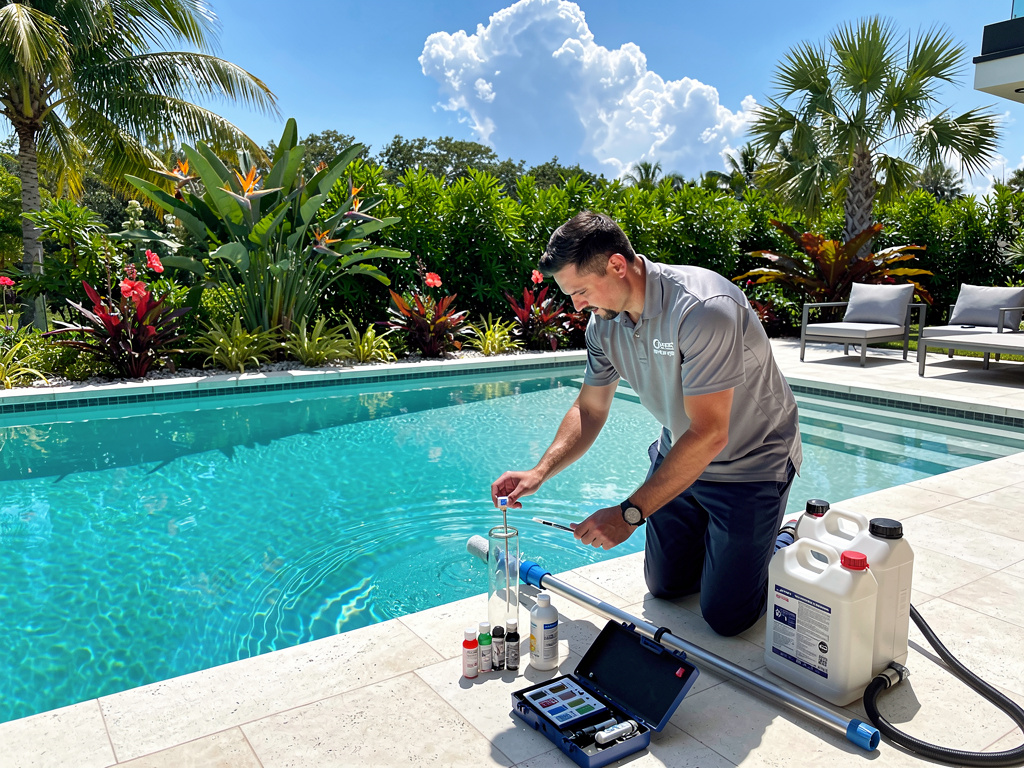
The appropriate response to any significant rain event in Weston: test pH and total alkalinity before the pool is used post-storm, and add sodium carbonate (soda ash) or sodium bicarbonate as needed to bring both parameters back to target range. A simple test kit on the pool deck for this specific post-storm test takes 5 minutes and prevents the aggressive-water window from persisting through the first weekend use after a midweek storm.
Everglades-Origin Organic Input
During the dry season (November through May), South Florida’s prevailing winds shift from summer’s afternoon sea-breeze pattern to a more variable pattern that includes eastward-moving air from the Everglades’ direction. During these periods, Weston pools receive organic input from the Everglades’ environment: airborne pollen from sawgrass and exotic invasives (melaleuca, Brazilian pepper) that carpet the Everglades’ edge communities; fine particulates of decomposing organic matter that the westerly winds lift from the Everglades’ surface; and in spring, the distinctive sawgrass pollen events that deposit visible quantities of yellow-green pollen on everything in Weston’s western areas — including pool surfaces and water.
Sawgrass pollen events in late March through April can be dramatic in Weston — visible pollen films on pool surfaces during peak events, elevated phosphate from pollen decomposition, and increased filter loads from the fine particulate. These events are short-duration (a week or two at peak) but intense while occurring. During pollen season, increasing filter run time, checking and clearing the skimmer basket more frequently, and adding an enzyme dose to help break down pollen organics prevents the pollen event from creating a lasting chemistry problem.
Flooding Risk and Pool Chemistry
Weston’s flat topography and western position means that significant rain events can produce surface flooding in low-lying areas before the drainage system manages the excess volume. While Weston’s master-planned infrastructure includes drainage systems specifically designed to handle South Florida’s rainfall patterns, unusual or extended rain events can produce temporary surface flooding that reaches pool decks and pool water. Flood water — which is surface runoff carrying soil, organic matter, fertilizers, and potentially contaminants from roads and developed surfaces — represents a meaningful chemistry input to any pool it contacts.
If surface flooding reaches a Weston pool, the post-flood chemistry assessment is more extensive than the post-rain test: pH, alkalinity, chlorine, turbidity, and phosphate should all be tested, and the pool should be shocked to restore chlorine to sanitation levels before use. Any visible turbidity (murky water from suspended flood sediment) should be cleared with clarifier and vacuum before the pool returns to use.
Pool Service Fort Lauderdale provides storm-response pool chemistry service throughout Weston FL. Call (954) 501-2754, visit our Weston pool service page, or see our full website. 9900 W Sample Rd, Coral Springs, FL 33065.
{“@context”:”https://schema.org”,”@type”:”FAQPage”,”mainEntity”:[{“@type”:”Question”,”name”:”Why does Weston FL get more intense afternoon storms than other Broward cities?”,”acceptedAnswer”:{“@type”:”Answer”,”text”:”Weston sits at the western edge of Broward County adjacent to the Everglades, where surface moisture from the vast shallow wetland interacts with afternoon heating to produce more intense convective storms than at eastern Broward locations. Storms that drop half an inch at the coast may drop a full inch at Weston. This intensity difference is consistently noted by residents who have moved from eastern Broward areas.”}},{“@type”:”Question”,”name”:”What should I test after a major rainstorm hits my Weston FL pool?”,”acceptedAnswer”:{“@type”:”Answer”,”text”:”pH and total alkalinity, before the pool is used post-storm. A 1-inch rain event can depress pH from 7.4 to below 7.2 and reduce alkalinity by 10–15 ppm. At pH below 7.2, water becomes aggressive — etching surfaces and irritating swimmers. Add sodium carbonate (soda ash) or sodium bicarbonate as needed to restore both parameters to target range before swimming.”}},{“@type”:”Question”,”name”:”How does Everglades proximity affect my Weston FL pool chemistry?”,”acceptedAnswer”:{“@type”:”Answer”,”text”:”During dry-season wind shifts, Weston pools receive airborne organic input from the Everglades: sawgrass pollen (April events can be dramatic), fine organic particulates, and exotic plant pollen from melaleuca and Brazilian pepper. Pollen events deposit visible yellow-green films on pools, elevate phosphate, and increase filter loads. Increase filter run time and add enzyme during peak pollen weeks (late March–April).”}},{“@type”:”Question”,”name”:”What should I do if floodwater reaches my Weston FL pool?”,”acceptedAnswer”:{“@type”:”Answer”,”text”:”Test pH, alkalinity, chlorine, turbidity, and phosphate — floodwater carries soil, organic matter, fertilizers, and surface contaminants that require more comprehensive assessment than a simple rain event. Shock to restore chlorine, treat with clarifier for any turbidity, vacuum settled sediment before use. Do not allow swimming until the post-flood chemistry assessment is complete and parameters are restored.”}},{“@type”:”Question”,”name”:”Does Weston FL’s location near the Everglades affect pool algae risk?”,”acceptedAnswer”:{“@type”:”Answer”,”text”:”Indirectly — through phosphate input from pollen and organic matter during Everglades-origin wind events. Sawgrass and exotic plant pollen that enters the pool decomposes and releases phosphate, which feeds algae growth. Monthly phosphate testing and preventive phosphate remover doses during dry-season pollen season (March–May) manage this input effectively.”}]}}