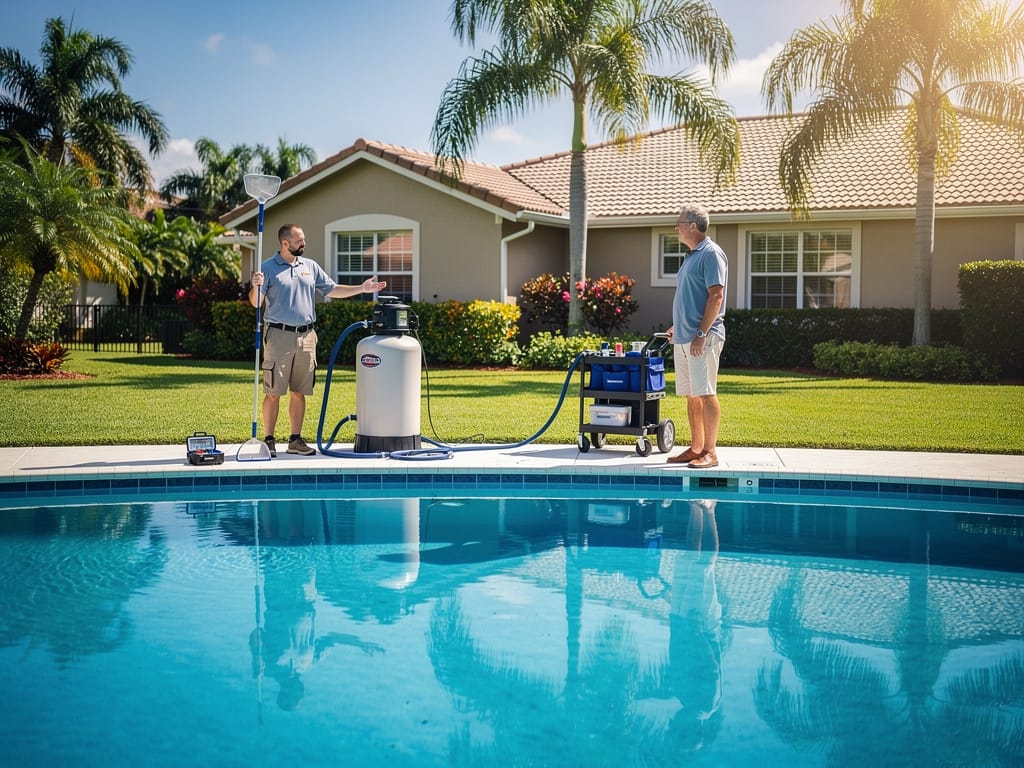
If you’ve never had a professional pool service before — or you’re switching providers and want to know what to expect — this guide explains exactly what a professional service visit in Coral Springs should include, what questions to ask, and what red flags signal that a company isn’t delivering what you’re paying for.
The Six Tasks Every Service Visit Should Cover
A complete pool service visit isn’t just someone dumping chemicals in your pool and leaving. Here’s what each component involves and why it matters:
1. Water chemistry testing: A technician should test your pool water using a proper test kit (not just a single test strip) for free chlorine, combined chlorine, pH, total alkalinity, stabilizer (CYA), and ideally calcium hardness and phosphates. This takes 3–5 minutes with a quality kit and gives the technician the data to know exactly what to add — not just what they think you need based on a visual check.
2. Chemical adjustment and addition: Based on test results, the technician adds whatever is needed to bring chemistry into balance. This might be chlorine, muriatic acid or sodium bicarbonate for pH/alkalinity, stabilizer, algaecide, phosphate remover, or shock. The amount added should correspond to what the test indicated — not a fixed quantity regardless of the current water state.
3. Vacuuming: Manual or automatic vacuuming removes settled debris from the pool floor and, in the case of manual vacuuming, allows the technician to direct suction where it’s needed — particularly in corners, behind steps, and in areas where your automatic cleaner may not reach well. Quality vacuuming is the most labor-intensive part of a service visit and the part most easily skipped by providers cutting corners.
4. Brushing: All pool surfaces — walls, floor, steps, corners — should be brushed with a pool brush to disrupt biofilm and early algae colonies before they become visible. Brushing also circulates water in dead spots and brings settled debris into suspension where the filter can capture it. Skipping brushing is common among rushed pool service routes and is a significant factor in recurring algae problems.
5. Skimmer and pump basket cleaning: Emptying skimmer baskets removes floating debris before it sinks and decomposes. Cleaning the pump strainer basket ensures unobstructed flow through the circulation system. Full baskets reduce pump efficiency and can cause the pump to run hot.
6. Equipment inspection: A quick visual and operational check of the pump, filter (noting pressure), heater, and any automation equipment. Most problems with pool equipment are detectable early — unusual motor noise, filter pressure that’s significantly above or below normal, visible leaks at unions or fittings. Catching these early prevents emergency failures.
What a Service Report Should Tell You
Every service visit should produce a written or digital service report that includes: the visit date and time, your water chemistry readings before and after treatment, what chemicals were added and in what quantities, any equipment observations, and any recommended follow-up actions.
In Coral Springs, many professional pool service companies now provide digital service reports via text or app notification immediately after the visit. You can see your water readings from your phone while the technician is still in your backyard — or review them later to track how your water chemistry trends over time.
If your current provider gives you nothing in writing after each visit, that’s a gap in professional standard. You have no way to verify the service was complete, no record if a dispute arises, and no baseline to diagnose chemistry problems over time.
How to Set Your Pool Up Between Service Visits
Between visits, there are a few things you can do to extend the quality of your service without needing to be a pool chemistry expert:
Empty skimmer baskets when they’re full: Baskets stuffed with leaves reduce skimmer efficiency. In tree-heavy Coral Springs yards, this may need to happen every few days.
Keep the pump running on schedule: Most Coral Springs pools should run 8–12 hours per day in summer. If your timer is misconfigured or a power outage reset it, stagnant water for even 24 hours in peak heat can cause chemistry drift.
Rinse off before swimming: Sunscreen, body oils, and cosmetics add significant organic load that consumes chlorine. A quick rinse before entering the pool extends the interval between chemical additions.
Note anything unusual and tell your technician: Water color changes, unusual odors, visible algae on walls, any noises from equipment — these are all valuable information for your service technician. A quick text to your provider between visits is better than letting a developing issue wait until the next scheduled visit.
Red Flags in Pool Service Quality
These are signs your current provider isn’t delivering full professional service:
- Visits consistently take under 15–20 minutes for a standard pool
- No written service report after any visit
- You’re asked for the same information about your pool each visit (provider isn’t keeping records)
- Water chemistry varies wildly between visits rather than staying in a consistent range
- Recurring algae despite regular service visits
- Provider doesn’t test before adding chemicals
- No response to equipment questions or observations
Pool service quality in Coral Springs varies significantly across providers. Price is not the only differentiator — some of the cheapest services are also the most complete, while some higher-priced providers run high-volume routes that sacrifice thoroughness for speed.
Starting Service With Pool Service Fort Lauderdale in Coral Springs
When you start service with us, the first visit includes a full pool assessment — current chemistry baseline, equipment condition, any deferred maintenance we observe, and confirmation of your regular schedule. From that first visit, you’ll receive a service report and have a direct contact for your assigned technician.
We serve residential and commercial pools throughout the Coral Springs area on weekly and bi-weekly routes. To schedule your first service or get a quote, call Pool Service Fort Lauderdale at (954) 501-2754.
Frequently Asked Questions
Should I be home during pool service visits?
You don’t need to be home for a standard service visit if your technician has access to the pool area. Gate codes or key access, if needed, are typically set up during your initial service arrangement. However, being home for the first visit or two allows you to meet your technician, see the service process, and ask questions about your specific pool’s needs.
How long should a typical pool service visit take?
For a standard 15,000–20,000 gallon residential pool in Coral Springs, a thorough service visit takes 30–50 minutes. Very small pools may be completed in 20–25 minutes; larger pools with extensive debris or water feature cleaning may take longer. Visits consistently under 20 minutes suggest tasks are being skipped.
What chemicals should I expect to be added at each visit?
Not every chemical is added every visit. Chlorine and pH adjustment are most frequent. Shock, algaecide, alkalinity adjustment, phosphate remover, and other chemicals are added as water testing indicates the need. A good service provider doesn’t add chemicals on a fixed schedule — they test first and add what’s actually needed.
Who is responsible if my pool equipment fails between service visits?
A service contract typically covers routine maintenance labor and sometimes chemicals, but not equipment repair or replacement. Equipment failures between visits should be reported to your service provider promptly — most professional companies can diagnose and either repair or arrange repair of equipment issues outside the standard visit if given prompt notice.
How do I switch pool service providers without disrupting my pool?
Request a service history and water chemistry records from your current provider if possible. When starting with a new provider, share what you know about your pool’s chemistry history, any recurring issues, and equipment age. Your new provider should perform a full assessment on the first visit regardless of what you share — a clean baseline evaluation is the right starting point.