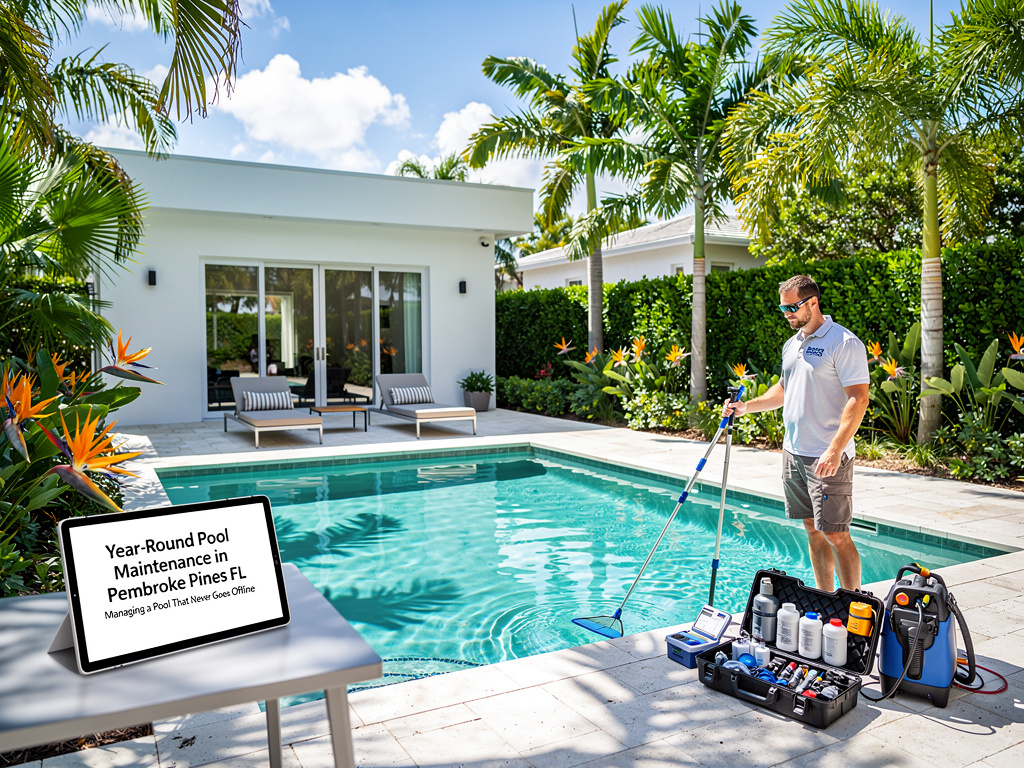
No Off-Season in Pembroke Pines
In pool service communities across northern states, there is a natural off-season structure: pools close in September or October, are professionally winterized, and reopen in May or June. During this 6–8 month dormancy, equipment rests, plumbing is protected from freeze damage, and chemical consumption stops entirely. The annual “spring opening” provides a natural reset point where chemistry baselines are reestablished, equipment is inspected after its rest period, and any off-season issues are identified before the pool is needed for summer use.
In Pembroke Pines, none of this exists. The pool operates continuously through December, January, and February — the months that would be the deep-winter dormancy period in a northern climate. Retirees in Chapel Trail use the pool for morning water aerobics during those cool winter months. Venezuelan and Colombian families use the pool for holiday gatherings in December and New Year celebrations in early January. And even when the household isn’t actively swimming, the pool’s filtration, chemical balance, and biological environment are all active and require maintenance. The practical consequence is that Pembroke Pines pools accumulate a full year of wear and chemical exposure without any natural break in the cycle.
Equipment Wear: Year-Round vs Seasonal Operation
A pool pump motor in a Pembroke Pines pool running 10 hours per day, 365 days per year, accumulates approximately 3,650 operating hours per year. The same pump in a northern pool running 10 hours per day for 150 seasonal days accumulates approximately 1,500 hours per year. After 10 years, the Pembroke Pines pump has 36,500 hours versus the northern pool’s 15,000 hours — more than twice the wear on the same mechanical components. A pump motor rated for 10–12 years of seasonal use may last 5–7 years in Pembroke Pines’ year-round service environment.
This wear acceleration applies to all mechanical and electrical pool equipment: pump seals and impellers, salt cell electrodes, heater heat exchangers, filter media, valve O-rings, and automation system components. The maintenance budget and replacement planning for a Pembroke Pines pool should reflect this accelerated cycle — essentially plan for 1.5× the replacement frequency compared to published seasonal-market service life estimates, because those estimates are calibrated for 5–6 month seasonal pools, not year-round Florida operations.
The practical implication for Pembroke Pines pool budgeting: a pool owner who has absorbed the “pool equipment lasts 10–15 years” advice from a northern source and applied it to their Pembroke Pines pool may find themselves with failed equipment at 7–9 years and no budget prepared for the replacement. Pembroke Pines-calibrated equipment life estimates — 6–10 years for pump motors, 4–6 years for salt cell electrodes, 8–12 years for heat pump compressors — and proactive budget allocation prevent the emergency replacement scenario that typically costs more than a planned replacement.
Chemistry Management Without a Natural Reset
In seasonal pools, the spring opening provides a natural chemistry reset: the pool is drained partially or fully, refilled, and chemistry is rebuilt from a fresh baseline. In Pembroke Pines’ year-round operation, accumulated chemistry changes — rising CYA from tablet programs, rising calcium hardness from evaporative concentration, rising TDS — build continuously without a natural correction event. Managing this continuous accumulation requires intentional intervention rather than relying on a seasonal reset that never comes.
The annual partial drain-and-refill is the Pembroke Pines equivalent of a seasonal opening reset. Replacing 20–30% of the pool volume in October or November — after the peak evaporation and heavy use of summer — dilutes accumulated CYA, calcium hardness, and TDS back toward manageable baseline levels. This intervention, combined with the normal weekly chemistry management, prevents the gradual chemistry drift that occurs in year-round pools that never receive a corrective partial drain.
Cyanuric acid management is particularly important for Pembroke Pines pools on tablet programs. Without a seasonal drain, CYA can climb past 100 ppm over 12–18 months on a tablet-only program, at which point chlorine effectiveness is meaningfully impaired. Tracking CYA quarterly and performing a partial drain when CYA exceeds 80 ppm (rather than waiting until a visible problem develops) is the proactive approach to managing this accumulation in Pembroke Pines’ year-round operation.
Scheduling Annual Maintenance in a Year-Round Operation
In a seasonal pool market, annual maintenance — filter deep cleaning, equipment O-ring inspection, heat exchanger service, salt cell inspection — is naturally timed to the spring opening or fall closing. In Pembroke Pines, there is no closing, so annual maintenance must be deliberately scheduled during a low-use period rather than occurring as part of a natural operational transition.
The best window for annual maintenance in a Pembroke Pines pool is typically January or February — the coolest weeks of the South Florida winter when pool use is at its annual low point and the pool can tolerate a day or two of reduced availability while maintenance is performed. Most Pembroke Pines pool households find this period acceptable for maintenance downtime: it’s cool enough that not swimming for a day is not a hardship, and the timing means the pool enters the spring and summer peak season with fresh maintenance behind it.
Annual maintenance items for a Pembroke Pines pool should include: filter deep cleaning (sand filter media replacement every 5–7 years, or DE filter grid inspection and cleaning; cartridge filter element inspection and replacement if degraded); equipment pad O-ring and gasket inspection; heat pump or gas heater heat exchanger cleaning (scale removal); salt cell inspection and cleaning; automation system calibration check; and plumbing union and valve inspection. A service company that provides an annual maintenance contract covering these items prevents the deferred-maintenance accumulation that leads to cascading failures in year-round operations.
Water Temperature Across Seasons
Pembroke Pines pools in year-round operation need heater management that matches seasonal water temperature patterns. In summer, water temperature in an unheated outdoor Pembroke Pines pool reaches 88–94°F — above the comfort range for vigorous swimming and above the temperature where chlorine stability is meaningfully reduced. In winter, the same unheated pool may drop to 68–72°F during cold fronts, which is below the comfort range for most recreational swimming and significantly below the therapeutic temperature range for water aerobics.
A heat pump heater with a temperature controller allows the pool to be actively cooled toward the setpoint in summer (by running at night to enable evaporative cooling via an aerator) and heated in winter to a consistent target. For a Pembroke Pines multigenerational household using the pool year-round, a consistent water temperature setpoint of 82–84°F serves both the summer swimmers (slightly cooler than the unheated summer peak) and the winter swimmers (above the uncomfortable cool range). Heat pump efficiency in Pembroke Pines’ mild winter climate is better than in colder markets — even in January, ambient air temperatures rarely drop below 55°F, which is within the operating range of most residential heat pump models.
Pool Service Fort Lauderdale provides year-round pool maintenance service throughout Pembroke Pines FL. Call (954) 501-2754, visit our Pembroke Pines pool service page, or see our full website. 9900 W Sample Rd, Coral Springs, FL 33065.
{“@context”:”https://schema.org”,”@type”:”FAQPage”,”mainEntity”:[{“@type”:”Question”,”name”:”How does year-round pool operation in Pembroke Pines affect equipment lifespan?”,”acceptedAnswer”:{“@type”:”Answer”,”text”:”Equipment accumulates 2–2.5× more operating hours per calendar year in Pembroke Pines than in a 5-6 month seasonal market. Pump motors rated for 10–12 seasonal years typically last 6–8 years in Pembroke Pines’ year-round service. Plan equipment replacement budgets using Pembroke Pines-calibrated estimates rather than seasonal-market figures.”}},{“@type”:”Question”,”name”:”When is the best time for annual pool maintenance in Pembroke Pines FL?”,”acceptedAnswer”:{“@type”:”Answer”,”text”:”January or February — the coolest and lowest-use weeks of the South Florida winter. This timing allows the pool to tolerate a brief service downtime without the hardship of summer, and the pool enters its spring and summer peak season with fresh maintenance behind it. Annual items include filter deep cleaning, O-ring inspection, heat exchanger service, and salt cell inspection.”}},{“@type”:”Question”,”name”:”How do I prevent CYA accumulation in a Pembroke Pines pool that never closes?”,”acceptedAnswer”:{“@type”:”Answer”,”text”:”Test CYA quarterly and perform a 20–30% partial drain-and-refill when CYA exceeds 80 ppm — rather than waiting for a visible problem. Without a seasonal shutdown that provides a natural drain/reset, CYA from tablet programs accumulates continuously and can exceed 100 ppm in 12–18 months, improperly reducing chlorine effectiveness.”}},{“@type”:”Question”,”name”:”What water temperature is best for a year-round Pembroke Pines pool used by both swimmers and retirees?”,”acceptedAnswer”:{“@type”:”Answer”,”text”:”82–84°F is a good year-round compromise for Pembroke Pines multigenerational households. This is slightly below the summer unheated peak (which can reach 92°F — too warm for vigorous swimming) and well above the cold-front winter lows (68–72°F — uncomfortable for most therapeutic use). A heat pump controller manages both heating in winter and assists with evaporative cooling targets in summer.”}},{“@type”:”Question”,”name”:”Does a Pembroke Pines pool need a partial drain if it never closes for winter?”,”acceptedAnswer”:{“@type”:”Answer”,”text”:”Yes — more so than seasonal pools that get a natural drain/reset at closure. Annual partial drain-and-refill (20–30% of volume in October–November) is the Pembroke Pines equivalent of a seasonal opening reset, diluting accumulated calcium hardness, CYA, and TDS back toward manageable baseline levels.”}]}}